
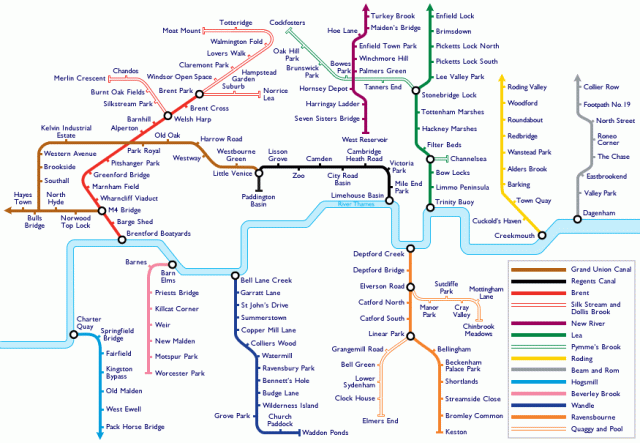
 London’s waterways mapped – the site also has sound clips of site recordings at each location. Thanks to several people who shared this on Facebook.
London’s waterways mapped – the site also has sound clips of site recordings at each location. Thanks to several people who shared this on Facebook.
More book-grumpiness from Schopenhauer…
Literary journals should be a dam against the unconscionable scribbling of the age, and the ever-increasing deluge of bad and useless books. Their judgments should be uncorrupted, just and rigorous; and every piece of bad work done by an incapable person; every device by which the empty head tries to come to the assistance of the empty purse, that is to say, about nine-tenths of all existing books, should be mercilessly scourged. Literary journals would then perform their duty, which is to keep down the craving for writing and put a check upon the deception of the public, instead of furthering these evils by a miserable toleration, which plays into the hands of author and publisher, and robs the reader of his time and his money.
If there were such a paper as I mean, every bad writer, every brainless compiler, every plagiarist from other’s books, every hollow and incapable…
View original post 327 more words
Review forum on Ben Woodward’s On an Ungrounded Earth at the Society and Space open site.
Update September 2025: the Berfrois site is now closed and the archive has been removed. My piece can now be found here.
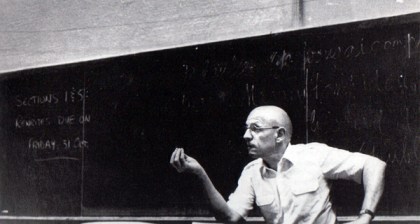
My review of Foucault’s La société punitive has now been published at Berfrois.
Interactive map of locations in the songs of Tom Waits.

Jussi Parikka with news of his forthcoming book. Lots of links to my own interest in the ‘Geo’ part of geopolitics, geometrics, geopower…
I am pleased to announce that I have signed a contract with University of Minnesota Press for a new book tentatively called A Geology of Media.
Planned for 2015, A Geology of Media forms the third, final part of the media ecology-trilogy. It started with Digital Contagions: A Media Archaeology of Computer Viruses (2007) and continued with Insect Media (2010). This book on the geophysics and the non-organic ground of media complements the earlier takes by offering a media materialism from the point of view of geological resources, electronic waste and media arts. Through engaging with several contemporary art and technology projects it provides a media theoretical argument: to think of materiality of media beyond the focus on machines and technologies by focusing on what they consist of: the chemistry and geological materials of media, from metals to dust.
In short, I am interested to see if what…
View original post 191 more words
In Le Monde, Peter Trawny discusses Heidegger’s ‘black notebooks’ – thanks to enowning for the link.
Two questions, and some interesting discussion in the comments, about Heidegger translations. I think Dasein should be kept, and all the nuances teased out in a translator note; and I dislike the capitalisation of nouns in English since it tends to reify or deify them. Nouns in German are capitalised anyway, so that’s a different convention. The biggest problem though, isn’t with the ones Adam Kotsko highlights, it’s Sein as ‘Being’… when it really should simply be ‘being’.
Stephen Graham’s “Foucault’s Boomerang” reposted.
Stephen Graham, Foucault’s Boomerang: the New Military Urbanism
OpenDemocracy, 14 February 2013.
According to Stephen Graham, a new set of ‘Foucauldian boomerang effects’ are shaping how states apply ‘tactics of control’ over everyday urban life. Today, he traces the emergence of what he calls a new military urbanism, which applies to cities both in the Global North and South.
On 4 February 1976, Michel Foucault, the eminent French social theorist, stepped gingerly down to the podium in a packed lecture at the Collège de France in the Latin Quarter on Paris’s South Bank. Delivering the fifth in a series of 11 lectures under the title ‘Il faut défendre la société’ (‘Society must be defended’), for once Foucault focused his attention on the relationships between western societies and those elsewhere in the world. Moving beyond his legendary re-theorisations of how knowledge, power, technology and geographical space were combined to underpin…
View original post 184 more words
Clive Barnett discusses Kevin Cox’s Making Human Geography – a book that is probably sitting waiting for me back in the UK. Looking forward to reading it – sounds intriguing.

I have just read Kevin Cox’s new book, Making Human Geography. It tells the story, as he sees it, of how over the last 50 years or so, human geography has become a field of sophisticated theoretical and methodological inquiry. He starts by admitting this is a ‘personal understanding’, and it has a strong ‘interpretative’ line that reflects is own convictions, not least about the continuing saliency not just of Marxism, but of geography’s Marxism, of ‘historical-geographical materialism’ as an explanatory framework. I guess this won’t be to everyone’s tastes (there is plenty to disagree with about Kevin’s account of all sorts of things). But one of the things that I liked about the book was its tone. He worries about the ‘eclecticism’ associated with contemporary human geography, especially in its self-consciously ‘critical’ varieties; but does not complain about fragmentation nor indulge in nostalgia for lost coherence. Above all…
View original post 690 more words


