
Dylan Maryk has made a Google Map of London Underground’s abandoned or relocated stations; usvsth3m has turned this into a map based on the standard Underground map.

Dylan Maryk has made a Google Map of London Underground’s abandoned or relocated stations; usvsth3m has turned this into a map based on the standard Underground map.
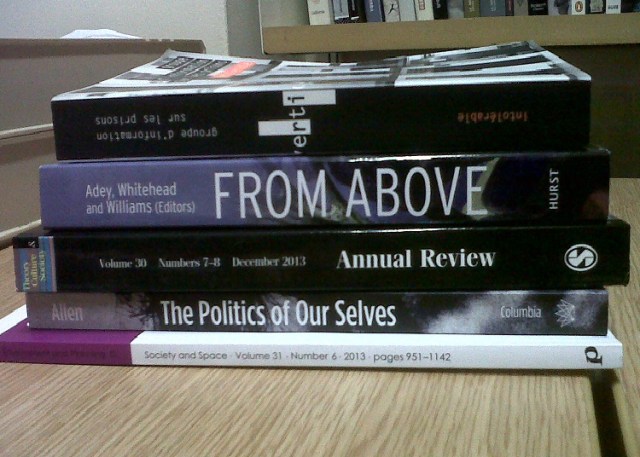 Philippe Artières (ed.), Intolérable: Groupe d’information sur les prisons; Peter Adey, Mark Whitehead and Alison Williams (eds.), From Above: War, Violence and Verticality; Amy Allen, The Politics of Ourselves; the Theory, Culture & Society annual review; and the latest Society and Space.
The Washington Post has a map of the United States with borders redrawn as if secessionist states had succeeded. Thanks to Michael Brown for the link.

A very interesting piece in the LRB on the housing crisis – stemming from the sale of council houses in the 1980s. Here’s one especially damning part:
Right to Buy thus created an astonishing leak of state money – taxpayers’ money, if you like to think of it that way – into the hands of a rentier class. First, the government sold people homes it owned at a huge discount. Then it allowed the original buyers to keep the profit when they sold those homes to a private landlord at market price. Then the government artificially raised market rents by choking off supply – by making it impossible for councils to replace the sold-off houses. Then it paid those artificially high rents to the same private landlords in the form of housing benefit – many times higher than the housing benefit it would have paid had the houses remained in council hands.
In other words, since Thatcher, the British government has done the exact opposite of what it has encouraged households to do: to buy their own homes, rather than renting. Thatcher and her successors have done all they can to sell off the nation’s bricks and mortar, only to be forced to rent it back, at inflated prices, from the people they sold it to. Before Right to Buy, the government spent a pound on building homes for every pound it spent on rent subsidies. Now, for every pound it spends on housing benefit, it puts five pence towards building.
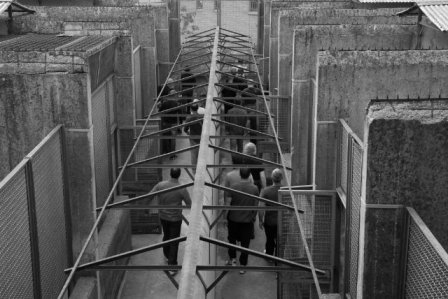 Caesar Must Die (Cesare deve morire) is a very powerful piece of cinema, now on dvd release, showing the rehearsals for a performance of Shakespeare’s Julius Caesar. The performers are all inmates of a high-security prison in Rome, and while they do show some clips of the stage production (in colour), most of the film is shot in the prison itself in black and white. The prison architecture makes for a very powerful backdrop, and some of the acting is excellent. An interesting juxtaposition of my two ongoing research concerns – Shakespeare and Foucault. I’m grateful to Luiza Bialasiewicz for recommending this.
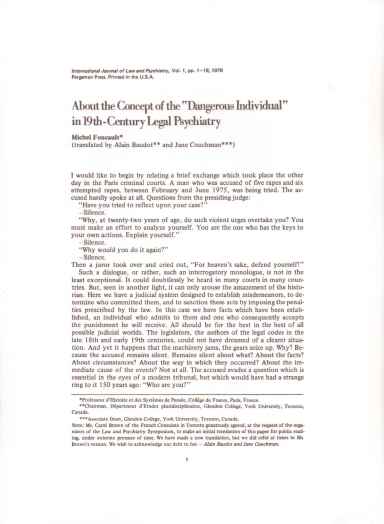 In 1977 Foucault gave a lecture in Toronto entitled ‘About the Concept of the ‘Dangerous Individual’ in 19th Century Legal Psychiatry’. It was published first in English in International Journal of Law and Psychiatry, Vol 1 No 1, pp, 1-18.
It was reprinted in Politics, Philosophy, Culture and again in Essential Works Vol III. The French version in Dits et écrits may be a translation or the original – it isn’t clear. Most texts in that book that originally appeared in languages other than French are re-translations, but no translator is listed for this one. The text in French can also be found here. We know there was an original text in French, not just because translators are credited for the English version, but because there is a note to say that it was previously translated for Foucault to use at the event. So, is the version in Dits et écrits the original French, or a re-translation with an uncredited translator?
The note in Politics, Philosophy, Culture says it was given to the “Law and Psychiatry Symposium at York University, Toronto”. The note in Dits et écrits says that it was a contribution to a Toronto symposium on ‘Law and Psychiatry’ at the Clarke Institute of Psychiatry, 24-26 October 1977. There is no note in Essential Works beyond the reference to the journal (with the name slightly incorrect).
The Clarke Institute of Psychiatry appears not to be linked to York University, but to the University of Toronto. There is a useful discussion of the Institute here. But the two translators of the English version, Alain Baudot and Jane Couchman, were both based at Glendon College, York University. So, was it at the Clark Institute or York University, or a joint event?
Daniel Defert’s “Chronology” says the same as the note in Dits et écrits, but adds that the lecture was a “summary of his 1976 seminar at the Collège de France” (p. 52/65). Foucault’s summaries of his Collège de France courses usually contain a brief note on the seminar that accompanied the lectures. But the one in «Il faut défendre la société»/‘Society Must Be Defended’ inexplicably doesn’t contain this, despite Foucault writing it for the Collège’s Annuaire. The relevant passage can be found in the compilation of the courses in Resumé des cours (p. 94); in Dits et écrits (Vol III, p. 130) and Essential Works (Vol I, p. 64). It reads:
This year’s seminar was devoted to the study of the category of the ‘dangerous individual’ in criminal psychiatry. The notions connected to the theme of ‘social defence’ were compared to notions connected to the new theories of civil responsibility, as they appeared at the end of the end of the nineteenth century.
Any ideas as to why the seminar paragraph was omitted from «Il faut défendre la société»? I can think of two reasons – either by mistake, or because the volume was the lecture course (and not seminar protocols). The subsequent lecture courses have not made that distinction however. (It would then follow that because ‘Society Must Be Defended’ was a translation of «Il faut défendre la société» it too didn’t include it.)
The text itself is interesting because, aside from the content itself, it is one of the insights we have of what went on in Foucault’s seminars. Other indications would include the I, Pierre Rivière collection; some of the other collaborative volumes such as Les machines à guérir; the posthumous collection The Foucault Effect; and Foucault’s use of cases discovered for the seminar by Jean-Pierre Peter in The Abnormals (which I discuss here).
Very good critique of TED talks from Benjamin Bratton (and reprinted in The Guardian):
In our culture, talking about the future is sometimes a polite way of saying things about the present that would otherwise be rude or risky.
But have you ever wondered why so little of the future promised in TED talks actually happens? So much potential and enthusiasm, and so little actual change. Are the ideas wrong? Or is the idea about what ideas can do all by themselves wrong?
I write about entanglements of technology and culture, how technologies enable the making of certain worlds, and at the same time how culture structures how those technologies will evolve, this way or that. It’s where philosophy and design intersect.
So the conceptualization of possibilities is something that I take very seriously. That’s why I, and many people, think it’s way past time to take a step back and ask some serious questions about the intellectual viability of things like TED.
So my TED talk is not about my work or my new book – the usual spiel – but about TED itself, what it is and why it doesn’t work. [continue reading here…]
 The new issue of Radical Philosophy is out – includes Derek Gregory on ‘Drone Geographies‘ and a critical review of Sloterdijk by Nina Power (both open access).
critical-theory.com’s 40 books that came out in 2013 has been updated to 50 books – including reader suggestions and December publications.

