Mark Blyth lecture on austerity – audio recording

Mark Blyth’s Copenhagen lecture on ‘Austerity: The History of a Dangerous Idea’, audio recording available here.

The current on-going global financial crisis invited a reading of its inception that was based upon ‘runaway government spending’ that had to be tempered with a firm diet of austerity. The problem was that ‘runaway government spending’ – at least in the form of government debt – was an effect rather than a cause of the crisis. The actual cause, both in the US and the EU, lay in banking systems that were ‘too big to fail’ and ‘too big to bail’ respectively. While the US was able to delever and recapitalize its banks, the EU has not been able to do so, which has resulted in a continent-wide game of ‘extend and pretend’ regarding the balance sheets of European banks paid for by slashing the public budgets of Southern European sovereigns. Meanwhile those states that have cut the most have in fact seen their debts increase the most. Why then is such a self-defeating policy still so eagerly pursued. The History of a Dangerous Idea offers us a clue.

Posted in Uncategorized | 1 Comment

As Above, So Below: A Colloquium on Drone Culture – call for papers

cropped-WEBBANNERAs Above, So Below: A Colloquium on Drone Culture, University of Lincoln, 24 May 2014 – keynotes from Derek Gregory and Benjamin Noys. Full details here.

Posted in Uncategorized | Leave a comment

A world map of submarine cables

3Interesting world map of submarine cables – can’t remember who alerted me to this, but thank you.

Posted in Uncategorized | 3 Comments

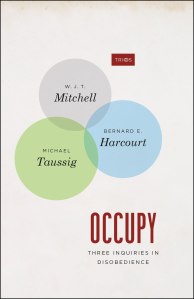
Mitchell, Harcourt and Taussig on Occupy

occupyI previously mentioned that W.J.T. Mitchell, Bernard Harcourt and Michael Taussig discussed Occupy in Critical Inquiry.

These essays have also been published in book form as Occupy: Three Essays in Disobedience.

Mic check! Mic check! Lacking amplification in Zuccotti Park, Occupy Wall Street protestors addressed one another by repeating and echoing speeches throughout the crowd. In Occupy, W. J. T. Mitchell, Bernard E. Harcourt, and Michael Taussig take the protestors’ lead and perform their own resonant call-and-response, playing off of each other in three essays that engage the extraordinary Occupy movement that has swept across the world, examining everything from self-immolations in the Middle East to the G8 crackdown in Chicago to the many protest signs still visible worldwide...
Occupy stands not as a primer on or an authoritative account of 2011’s revolutions, but as a snapshot, a second draft of history, beyond journalism and the polemics of the moment—an occupation itself.

Posted in Politics | 2 Comments

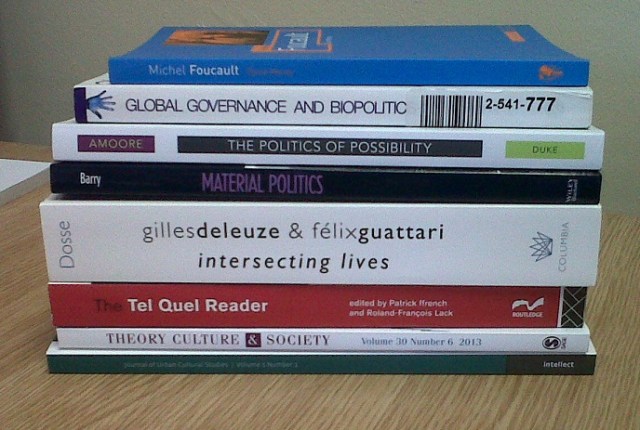
Books received – Macey, Roberts, Amoore, Barry, Dosse, Tel Quel Reader, TCS, JUCS

books received 26 Nov

Some older books ordered for the Foucault project – the Dosse has some important information on CERFI, there is a Foucault piece in The Tel Quel Reader; Andrew Barry’s Material Politics and Louise Amoore’s The Politics of Possibility sent by the authors; and two issues of journals where I’m on the board, including the inaugural issue of the Journal of Urban Cultural Studies.

Posted in Andrew Barry, Foucault's Last Decade, Journal of Urban Cultural Studies, Louise Amoore, Michel Foucault, Theory, Culture and Society | 1 Comment

Slavoj Žižek on Beethoven’s Ode to Joy and A Clockwork Orange and So On

A bit of the Pervert’s Guide to Ideology available on Youtube – the whole thing is interesting, but too long, somewhat repetitive and loses focus.

http://youtu.be/GCigxByRcNo 


Biblioklept's avatarBiblioklept

View original post

Posted in Uncategorized | Leave a comment

Everyday Utopias: Cooper reviews Gardiner

Davina Cooper reviews Michael E. Gardiner’s Weak Messianism: Essays in Everyday Utopianism.

Posted in Uncategorized | Leave a comment

Foucault’s Last Decade – fifth update

Foucault 24 Nov

Having put together rough drafts of chapters 1 and 2 (see previous update), I was now able to move to the real focus of the book. But there is no simple break, and even as I go onto these chapters there was some material from previous courses that was best discussed here. This was especially the case with the material on hysterics and children in Psychiatric Power. While the primary aim of the book is a chronological exposition, it’s not slavishly so.

The idea was that the next chapter (number 3 on the new plan), under the working title of ‘Pervert, Hysteric, Child’, incorporates material from Psychiatric Power and Abnormal into a coherent whole. The next step was, of course, the 1974-75 course Abnormal (incidentally I don’t know why it has this title instead of the more literal The Abnormals). Again, I wrote a piece on this when it first came out in French – a book review essay commissioned by Paul Bové that was in large part the beginning of this whole project. That piece appeared in boundary 2 in 2001 (open access here), and led to an invitation by Paul to speak at the University of Pittsburgh about the Society Must be Defended course, which also appeared in boundary 2 (open access here). But that course is for Chapter Four. So the key task was to go through Abnormal, to check to what I’ve already written on this, and rework this in relation to the sections left over from Psychiatric Power.

I spent quite a bit of time looking into Foucault’s source material for some of the cases he analyses, and this led me back to the collaborative work that led to the publication of the Pierre Rivière dossier. It’s now clear to me that much of the preparatory work for these two lecture courses was done in the seminars of previous years at the Collège. I wrote a short piece on the work Jean-Pierre Peter did, in part inspired by the seminars, and providing Foucault with details of some of the cases he would examine a few years later.

I then got a little side-tracked by going back into some of the pieces Foucault wrote in the 1960s that form a kind of bridge between his work on madness and medicine in books written at the beginning of that decade and his return to those topics in the 1970s. In particular, I became interested in two pieces – “Médecins, juges et sorciers au XVIIe siècle” and “Religious Deviations and Medical Knowledge” (I say more about these here and here). I wrote a bit about these in Chapter Two.

I found it really revealing to read The Abnormals immediately after reading Psychiatric Power – they were published in reverse order, and I initially read and worked on them as they came out. So it was very interesting to see the themes in Psychiatric Power get taken up again in the other course. I suspect that when La société punitive is finally published that too will be interesting in relation to subsequent courses as well, of course, in relation to Discipline and Punish.

I still have quite a bit of work to do on Chapter Three, but it is taking shape.

Posted in Foucault's Last Decade, Michel Foucault | 3 Comments

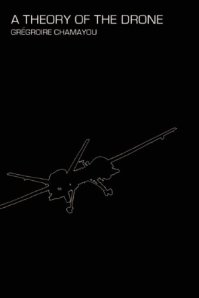
Grégoire Chamayou – A Theory of the Drone forthcoming in English

Chamayou

Grégoire Chamayou, A Theory of the Drone is forthcoming in English translation with New Press, publication date of August 2014. It doesn’t appear on the press’s site, but is listed on various online bookstores (i.e. here).

I’ve recently read the French version, and don’t have much to add to Derek Gregory’s excellent series of posts on the book. But I think I do have something to say about his earlier Manhunts, and hope to put that together as a short piece, likely for this site, soon.

Posted in Derek Gregory, Grégoire Chamayou | Leave a comment

‘Reflections on Jacoby and All That’: An Unpublished Essay by E. P. Thompson

History Workshop have made available a previously unpublished essay by E.P. Thompson here.

Posted in E. P. Thompson | Leave a comment