Neil Brenner (ed.) Implosions/Explosions – sample pages available

Sample pages for Neil Brenner’s collection, Implosions/Explosions: Towards a Study of Planetary Urbanization are now available on the publisher’s website.

BrennerIn 1970, Henri Lefebvre put forward the radical hypothesis of the complete urbanization of society, a circumstance that in his view required a radical shift from the analysis of urban form to the investigation of urbanization processes. Drawing together classic and contemporary texts on the “urbanization question”, this book explores various theoretical, epistemological, methodological and political implications of Lefebvre’s hypothesis. It assembles a series of analytical and cartographic interventions that supersede inherited spatial ontologies (urban/rural, town/country, city/non-city, society/nature) in order to investigate the uneven implosions and explosions of capitalist urbanization across places, regions, territories, continents and oceans up to the planetary scale.

The book has a scheduled publication date of December 2013.
Posted in Books, Henri Lefebvre, Neil Brenner, Territory, urban/urbanisation | Leave a comment

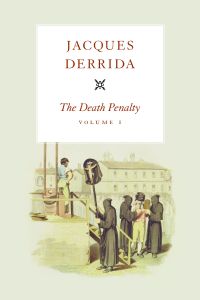
Derrida’s seminar on The Death Penalty – volume 1 published in English

9780226144320

Volume 1 of Derrida’s 1999-2000 seminar on The Death Penalty has been published in English.

In this newest installment in Chicago’s series of Jacques Derrida’s seminars, the renowned philosopher attempts one of his most ambitious goals: the first truly philosophical argument against the death penalty. While much has been written against the death penalty, Derrida contends that Western philosophy is massively, if not always overtly, complicit with a logic in which a sovereign state has the right to take a life. Haunted by this notion, he turns to the key places where such logic has been established—and to the place it has been most effectively challenged: literature.

With his signature genius and patient yet dazzling readings of an impressive breadth of texts, Derrida examines everything from the Bible to Plato to Camus to Jean Genet, with special attention to Kant and post–World War II juridical texts, to draw the landscape of death penalty discourses. Keeping clearly in view the death rows and execution chambers of the United States, he shows how arguments surrounding cruel and unusual punishment depend on what he calls an “anesthesial logic,” which has also driven the development of death penalty technology from the French guillotine to lethal injection. Confronting a demand for philosophical rigor, he pursues provocative analyses of the shortcomings of abolitionist discourse. Above all, he argues that the death penalty and its attendant technologies are products of a desire to put an end to one of the most fundamental qualities of our finite existence: the radical uncertainty of when we will die.

Arriving at a critical juncture in history—especially in the United States, one of the last Christian-inspired democracies to resist abolition—The Death Penalty is both a timely response to an important ethical debate and a timeless addition to Derrida’s esteemed body of work.
Posted in Jacques Derrida | Leave a comment

Antony and Cleopatra @theRSC

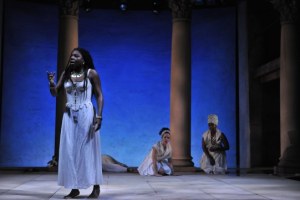
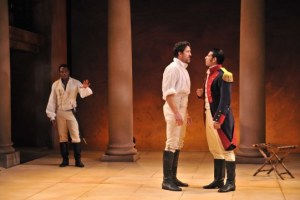
Antony-11-2013-541x361Last night I went to see Antony and Cleopatra at the Royal Shakespeare Company, in the smaller Swan Theatre. Despite a few fluffed lines from Jonathan Cake as Antony, it was a good production, effectively edited and reimagined in Haiti. The Romans were Napoleonic-era French, Cleopatra and her entourage Haitian, though the actors were not straight-forwardly racially divided, and there was a mix of Europeans, Americans and Africans in the cast. Antony-8-2013-541x361There were some interesting colonial and slave overtones, and some allusions to voodoo and the undead that I’m not sure worked so well. The use of water on stage was effective, and fitting for a play that is much about control of the sea as of land. The text was heavily edited by director Tarell Alvin McCraney, but it still ran for almost three hours – there were some effective uses of music and song, and some neatly choreographed movement. It is only on in the UK for a few more days, then transfers to the US in the new year.

Posted in William Shakespeare | Leave a comment

Campbell and Sitze, Biopolitics: A Reader – introduction available online

This looks a useful resource – Timothy Campbell and Adam Sitze, Biopolitics; A Reader. The introduction is available online here.

BiopoliticsThis anthology collects the texts that defined the concept of biopolitics, which has become so significant throughout the humanities and social sciences today. The far-reaching influence of the biopolitical—the relation of politics to life, or the state to the body—is not surprising given its centrality to matters such as healthcare, abortion, immigration, and the global distribution of essential medicines and medical technologies.

Michel Foucault gave new and unprecedented meaning to the term “biopolitics” in his 1976 essay “Right of Death and Power over Life.” In this anthology, that touchstone piece is followed by essays in which biopolitics is implicitly anticipated as a problem by Hannah Arendt and later altered, critiqued, deconstructed, and refined by major political and social theorists who explicitly engaged with Foucault’s ideas. By focusing on the concept of biopolitics, rather than applying it to specific events and phenomena, this Reader provides an enduring framework for assessing the central problematics of modern political thought.

Contributors. Giorgio Agamben, Hannah Arendt, Alain Badiou, Timothy Campbell, Gilles Deleuze, Roberto Esposito, Michel Foucault, Donna Haraway, Michael Hardt, Achille Mbembe, Warren Montag, Antonio Negri, Jacques Rancière, Adam Sitze, Peter Sloterdijk, Paolo Virno, Slavoj Žižek

Posted in Alain Badiou, Antonio Negri, Gilles Deleuze, Giorgio Agamben, Jacques Rancière, Michael Hardt, Michel Foucault, Paolo Virno, Peter Sloterdijk, Slavoj Zizek | Leave a comment

More-than-human intelligence: of dolphins, Indian law and the multispecies turn by Filippo Bertoni and Uli Beisel

A commentary on nonhuman sovereignty at the Society and Space open site.

Posted in Uncategorized | Leave a comment

Italo Calvino and Umberto Eco translator William Weaver has died

Crooked Timber has the news here, and links to an obituary in The Guardian.

Posted in Italo Calvino, Umberto Eco | Leave a comment

A short previously untranslated comment by Foucault on religion, witches and madness – and the need for a structuralist study

Update August 2026: Material from this post has been used in a longer discussion, The Experience of the Demonic and Its Waning: Foucault, Madness and Witchcraft.

In a post earlier this week I discussed a text of Foucault’s from 1969 on doctors, judges and witches in the 17th century. In that discussion I mentioned a related piece on “Religious Deviations and Medical Knowledge”, translated in the Religion and Culture book edited by Jeremy Carrette – delivered as a lecture in 1962 and published in 1968. I said then that the discussion following the lecture was not translated – an interesting discussion with a group of medievalists. Foucault only makes two interventions – a very brief remark and then a few sentences. I’ve made a translation of these, which are followed by a few notes.

But there is some relation between Cathars and magic…

We all agree on the progressive hereticisation [hérétisation] of witchcraft in the 16th and 17th centuries, or at least that the heretic and the witch are treated in the same way. And I would agree with Canon Delaruelle on the anticipation of certain natural concepts by theology before their use by medicine: at the end of the 17th century it is the Church itself which convenes doctors in relation to Jansenists and the Cévennes Protestants. Fléchier asks doctors to testify that this is merely pathological phenomena, visions, hallucinations: religious conscience was more ‘progressive’ than medical conscience in this series of events. I also agree with Professor Abel that that is an association [appartenance] of madness to a number of phenomena of religious irredentism and it would need a structural study of the whole, a synchronic study, as the system is clearly different in each epoch (Hérésies et sociétés, p. 29; Dits et écrits, Vol I, p. 635).

  • Hérétisation is, I think, as much of an ugly word in French as hereticisation is in English.
  • Esprit Fléchier, Bishop of Nîmes, was involved in the church’s treatment of Protestants following the repeal of the Edict of Nantes. He is often looked as a lenient and progressive figure in this regard.
  • ‘religious irrendentism’ is a striking phrase, not entirely clear. Irredentism is a political movement seeking to incorporate territories outside the existing boundaries of a state on the grounds of national or ethnic affinity. The term is most associated with Italian claims in the late 19th century. Does Foucault mean it to imply that the Catholic Church is trying to reincorporate breakaway elements? Carrette translates the phrase as ‘religious territoriality’ in a note following the translation of the lecture (Religion and Culture, p. 56).
  • Foucault’s agreement with Professor Abel is intriguing because Abel mentions the relation between heresy and the “sinner with terrible morals (sexual anomalies, communities of women, etc.)” (Hérésies et sociétés, p. 27; Dits et écrits, Vol I, p. 633). This is Armand Abel, a Belgian medieval Islamic scholar who gave a talk at the Colloquium on Muslim heresies.
  • The last sentence is interesting given the Structuralist language, which is close to the way Foucault originally wrote The Birth of the Clinic. Later editions removed this language, but the English translation is based on the first edition – James Bernauer has a good analysis of the differences in his Michel Foucault’s Force of Flight.
Posted in Michel Foucault | 3 Comments

CFP: Michel Foucault: Ethnography and Critique (2014)

Call for papers for a conference on Foucault, ethnology and critique

Clare O'Farrell's avatarFoucault News

Call for Papers

Michel Foucault: Ethnography and Critique
Convenors: Orazio Irrera & Martina Tazzioli

Bergamo, June 5-7, 2014
Deadline: February 17, 2014

Conference Website and contact details

[Editor: Link Updated 16 April 2026 to page archived on Wayback Machine]

Since the Sixties, Michel Foucault had described his work in ethnographic terms, stressing that for him it was a question of situating outside of the culture we belong to, in order to critically show the way in which this latter was built. Foucault’s perspective, far from representing only an historical analysis of the nexus between powers and knowledges, as a genealogy was firmly anchored to the analysis of the present; and it was also grounded on the ethical and political necessity to understand the present as the threshold that splits up what we have become from what we are no longer, in order to open some possibilities to think ourselves differently…

View original post 320 more words

Posted in Uncategorized | Leave a comment

The first issue of the Journal of Urban Cultural Studies [It’s Official]

Very pleased to see the first issue of this new journal published.

urbanculturalstudies's avatarurbanculturalstudies

Very happy to announce that…

the long awaited first issue of the Journal of Urban Cultural Studies is now posted on Intellect’s website! click here to see its contents, [and remember to have your library subscribe…] The contents of the first issue can be accessed free of charge here.

Thanks to all who have made this possible — and particularly to the crew at Intellect, the JUCS editorial board & numerous external peer reviewers, (it does take a village), but most of all thanks go to the authors whose interdisciplinary humanities-social science work has made this all so worthwhile.

Issue 1.2 will be on the way soon enough!

View original post

Posted in Uncategorized | Leave a comment

Noel Castree: Representing the Anthropocene

Noel Castree on the anthropocene.

http://youtu.be/3Ks3nGYTVlY

Jeremy Schmidt's avatarJeremy J Schmidt

Love the subtitle: Who will get to speak for everything and how?

View original post

Posted in Uncategorized | Leave a comment