The first issue of the Journal of Urban Cultural Studies [It’s Official]

Very pleased to see the first issue of this new journal published.

urbanculturalstudies's avatarurbanculturalstudies

Very happy to announce that…

the long awaited first issue of the Journal of Urban Cultural Studies is now posted on Intellect’s website! click here to see its contents, [and remember to have your library subscribe…] The contents of the first issue can be accessed free of charge here.

Thanks to all who have made this possible — and particularly to the crew at Intellect, the JUCS editorial board & numerous external peer reviewers, (it does take a village), but most of all thanks go to the authors whose interdisciplinary humanities-social science work has made this all so worthwhile.

Issue 1.2 will be on the way soon enough!

View original post

Posted in Uncategorized | Leave a comment

Noel Castree: Representing the Anthropocene

Noel Castree on the anthropocene.

http://youtu.be/3Ks3nGYTVlY

Jeremy Schmidt's avatarJeremy J Schmidt

Love the subtitle: Who will get to speak for everything and how?

View original post

Posted in Uncategorized | Leave a comment

Philippe Artières, Intolérable – Groupe d’information sur les prisons

ArtieresA collection of the writings of the Groupe d’information sur les prisons, edited by Philippe Artières, was published earlier this year by Gallimard – full details here. I’m not sure how this text relates to an earlier collection Artières was involved in, produced by IMEC – Le groupe d’information sur les prisons : Archives d’une lutte, 1970-1972. But this looks interesting and may have some new material. I think the earlier collection is out of print. I made a translation of the Groupe’s original manifesto here; and a translation of one of their reports is in Marcelo Hoffman’s new book Foucault and Power: The Influence of Political Engagement on Theories of Power.

Here’s the blurb on this new collection:

En février 1971, des intellectuels dont Michel Foucault, Daniel Defert, Jean-Marie Domenach, Pierre Vidal-Naquet et Gilles Deleuze fondent le Groupe d’Information sur les Prisons pour s’attaquer aux «barreaux du silence». Deux années durant, le GIP a su rassembler magistrats, journalistes, médecins, travailleurs sociaux, détenus, ex-détenus et leurs proches autour d’une volonté commune : «faire savoir la prison» et pratiquer à cette fin une intolérance active envers l’intolérable.
Cinq brochures ont paru, fruit d’enquêtes militantes, relayant la parole des détenus, sans filtre, dans sa brutalité et son intensité. S’y succèdent réponses à des questionnaires, correspondances, cahiers de revendications de mutins, entretiens avec un Black Panther incarcéré… Autant de documents qui permettent à ces invisibles de sortir de l’ombre, de s’inventer comme force politique.
Pour replacer cette expérience collective d’exception dans son contexte socio-politique, l’ouvrage comporte une chronologie détaillée des années GIP conçue par Philippe Artières.

Posted in Michel Foucault, Politics | Leave a comment

Michel Foucault, ‘Médecins, Juges et Sorciers au XVIIe Siècle’ – some thoughts on dating and content

Update August 2026: An updated and expanded version of this post is The Experience of the Demonic and Its Waning: Foucault, Madness and Witchcraft.

There is a curious text by Foucault, initially published as «Médecins, juges et sorciers au XVIIe siècle», Médecine de France, n°200, 1er trimestre 1969, pp.121-128; reprinted in Dits et écrits, text number 62 (Vol I, pp. 753-67 of the original edition); and available online here. As far as I am aware there is no published English translation – it’s not listed in Richard Lynch’s bibliography. Its title would be ‘Doctors, Judges and Witches in the 17th Century”. It doesn’t appear to be cited very often and I can’t remember any substantive discussions of it anywhere, but I’d be happy to be corrected.

The date is striking. It is closer to the work of the History of Madness and, in parts, to The Birth of the Clinic, than any other work of the 1960s, though it comes out several years later. It shares some interests with work of the early 1970s, particularly the likely content of Théories et institutions pénales and other lectures from that time (such as this one), but also as far forward as The Abnormals. It is of course conceivable that Foucault wrote it much earlier than its publication. There are no indications in Dits et écrits that it came from a lecture delivered somewhere – you could imagine Foucault being asked to speak about madness and medicine, rather than the topic of The Archaeology of Knowledge (which came out in March 1969), and finding this a new way to connect these questions. Or it may simply have been an occasional piece.

The material on possession is quite close to the discussion of this in The Abnormals, but – in one of the very few pieces I know which discusses this text – Colin Gordon suggests it might have been something more. It comes in his response to a number of pieces engaging with his article “Histoire de la folie: An Unknown Book by Michel Foucault“, published in 1990 in History of the Human Sciences (requires subscription).

On the question of the medical status accorded to religious possession, a topic whose neglect here Midelfort deplores, one should consult Foucault’s articles ‘Les deviations religieuses et le savoir medical” (Foucault 1968) and ‘Médecins, juges et sorciers en XVIIe siècles’ (Foucault, 1969). These pieces provide at least a fragment of the separate discussion of this issue which Foucault had promised in Histoire de la folie (1972: 39).

Colin Gordon, “History, madness and other errors: a response”, p. 389.

The first of these pieces appears as “Religious Deviations and Medical Knowledge” in the Religion and Culture collection edited by Jeremy Carrette, although the discussion that follows the lecture is not translated. The French original appeared in a book edited by Jacques le Goff, a medievalist and associate of the Annales school – Hérésies et sociétés dans l’Europe pré-industrielle, 11e-18e siècles (Mouton & Co, 1968). But, that book came from a Colloque de Royaumont of the Ecole pratique des hautes études, held between 27 and 30 May 1962 – a date which locates Foucault’s piece squarely between History of Madness and The Birth of the Clinic. In the ‘Note Liminaire’ Le Goff apologies for the delay in publication, and notes that some important scholarship has been produced in the interim, but thinks the analyses in the volume are still worthwhile. One of the reasons, he suggests, is that the texts are not independent of each other, but part of a communal reflection on the topic (p. 1). He notes that not everyone in the volume was present at Royaumont, but that some texts were read (p. 2). It appears Foucault was there because of the transcript of the discussion that followed his lecture, although he doesn’t seem to have contributed to discussion of other papers.

Foucault’s work of the mid-late 1960s is sometimes seen as comprising two main strands – the ‘archaeological’ work that led to The Order of Things and The Archaeology of Knowledge; and one that is somewhat neglected today, the literary work on the likes of Roussel, Flaubert, de Sade, Bataille, Klossowski, Breton, Robbe-Grillet, Verne, Blanchot etc – published in journals like Tel Quel and Critique. Some of that work blurs with what might be thought of as another element – the work on theorists like Deleuze (1970) and, partly with Deleuze, on Nietzsche (1967 and 1969-1971; see my note here). The book on Magritte and the abortive one on Manet come from this time period as well. But there is another strand of work, which is the continuation of work on questions of madness and medicine, and which partly anticipates later work on sexuality. The two works mentioned here appear to bookend that work – ‘Médecins, Juges Et Sorciers’ can then be seen as part of a sequence of papers that would include ‘L’eau et la folie’ (1963), ‘Madness, the Absence of Work’ (1964; and included as an appendix to the 1972 re-edition of Histoire de la folie, and so in History of Madness), and ‘Message ou bruit’ (1966). But even given that, its publication date seems late.

Here’s the text of the note Gordon cites promising a future work.

A later study will show how experience of the demonic and its waning between the sixteenth and eighteenth centuries should not be understood as a victory of humanitarian or medical theory over the old, wild [sauvage] universe of superstition, but as a taking up again [reprise], within a critical experience, of the forms that had previously borne the threat of a tear in the fabric of the world [du déchirement du monde]

Histoire de la folie p. 39 n. 1; History of Madness, p. 597 n. 83.

The closest we have to that, in materials currently available at least, is the discussion in The Abnormals, but it is anticipated in pieces including ‘Médecins, Juges Et Sorciers Au XVIIe Siècle’ in some important ways.

Posted in Michel Foucault | 8 Comments

Heidegger – Nature, History, State: 1933-1934

Some updated information on the publication of this politically-charged seminar of Heidegger’s – the hardback of this is now published; a paperback is due in 2015. The seminars were published in German in the Heidegger Jahrbuch vols 4 and 5.

stuartelden's avatarProgressive Geographies

[update: thanks to Harvey Shoolman for details – the hardback of this is now published; a paperback is due in 2015. The seminars were published in German in the Heidegger Jahrbuch vols 4 and 5].

Heidegger

Intriguing news of a new volume of Heidegger’s seminars – Nature, History, State: 1933-1934 (I’ve linked to the Google Books page, as the publisher one is missing.) Amazon have this listed for October 2013.

Nature, History, State: 1933-1934 presents the first complete English-language translation of Heidegger’s seminar ‘On the Essence and Concepts of Nature, History and State’, together with full introductory material and interpretive essays by five leading thinkers and scholars: Robert Bernasconi, Peter Eli Gordon, Marion Heinz, Theodore Kisiel and Slavoj Žižek. The seminar, which was held while Heidegger was serving as National Socialist rector of the University of Freiburg, represents important evidence of the development of Heidegger’s political thought. The text consists…

View original post 147 more words

Posted in Uncategorized | Leave a comment

Latour on War and Peace in an Age of Ecological Conflict

(via Anthem)

Posted in Bruno Latour | Leave a comment

Carolyn Pedwell on Affective Relations: The Transnational Politics of Empathy

Short video of Carolyn Pedwell talking about her forthcoming book Affective Relations: The Transnational Politics of Empathy (Palgrave 2014).

Posted in Politics | 2 Comments

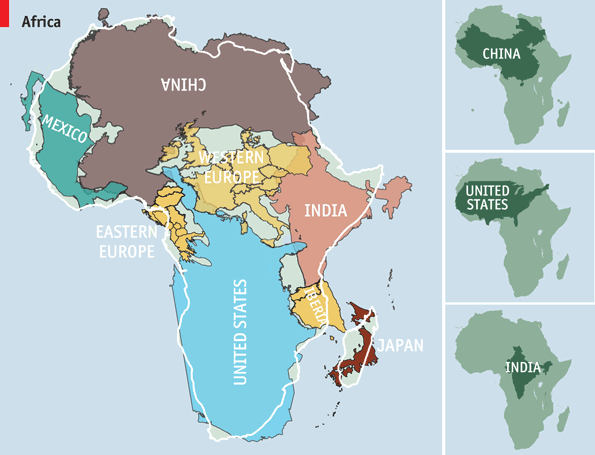
Constructing the world: the Mercator map vs the Peters projection

mapAn interesting map of the African continent, with the US, China, India etc. imposed on it to give a sense of its size.

Posted in Uncategorized | Leave a comment

Geo-political Economy – an open access virtual theme issue

A virtual theme issue on Geo-political Economy – put together by Deb Cowen and me. Papers open access for three months.

Posted in Uncategorized | Leave a comment

Michel Foucault and Jean-Pierre Peter – some thoughts on sources of ‘the abnormals’ and the case of Pierre Rivière

In The Abnormals lecture course, Foucault refers to a veritable rogues’ gallery of murderers, cannibals and perverts. The latter term, of course, is one that he examines in terms of its historical emergence – what counts as a deviation, an anomaly, abnormal behaviour? Foucault’s tactic, as with many other inquiries, is to provide the details of a case and then examine the legal, medical and psychiatric reports in the archives that shed light on how it was understood. The case of Pierre Rivière was conducted in a similar way, although in that instance they also had a remarkable first-person memoir and witness accounts. Foucault and his colleagues found this case in the Annales d’hygiène publique et de médecine légale.

For the cases in The Abnormals, it’s sometimes less clear on the sources. Part of this is due to the fact that the notes in the volume are the editors’, rather than Foucault’s. So, although they had access to the course notes, we are largely reliant on their editorial detective work.

Two very interesting texts are mentioned in the notes, after an indication by Foucault in the course that he was using the work of Jean-Pierre Peter (p. 94 French/p. 102 English). The texts referred to by the editors both appeared in the same journal:

Jean-Pierre PeterJean-Pierre Peter, “Le corps du délit”, Nouvelle revue de psychoanalyse, 3, 1971, pp. 71-108; and “Ogres d’archives”, Nouvelle revue de psychoanalyse, 6, 1972, pp. 249-67.

“Le corps du délit” appears in an issue on the theme of Lieux du corps, and begins with some remarks on Hamlet, goes on to discuss medicine in the 18th century, but is principally concerned with the body and ways of understanding it in medicine. “Le corps du délit” is the French equivalent of corpus deliciti, the evidence concerning the fact and circumstances of a crime, but also the object upon which the crime was committed (i.e. a dead body). Peter is interested in the corporeal nature of crimes, but the body of the criminal as much as the body of the victim.

There are some phrases that anticipate claims Foucault would make later in the 1970s, especially in the Rio lectures on medicine and The Abnormals, but there are also passages that are explicitly supported by reference to Foucault’s Birth of the Clinic, such as the discussion of medicine and space (p. 91).

In “Le corps du délit” Peter briefly mentions the anonymous woman of Sélestat who killed and ate her daughter at the time of a famine in Alsace in 1817 (pp. 103, 106, 107), the shepherd Léger who killed and ate a young girl (pp. 104, 105), and Henriette Cornier (p. 104). These are all cases Foucault discusses in The Abnormals. As Foucault describes it, Léger “killed a young girl, raped her, cut out her sexual organs and ate them, and tore out her heart and sucked it” (Les Anormaux, p. 94/102). Foucault describes the the Sélestat case as “the first recorded monster” (The Abnormals p. 94/102).

The second piece is not an essay by Peter, but two archival documents presented by him. “Ogres d’archives: Textes presents par Jean-Pierre Peter”. The issue is on the theme Destins du cannibalisme.

There is a brief note from Peter introducing the two texts (pp. 249-50) and then a reproduction of texts of ‘Affaire de Sélestat’ (pp. 251-58) and ‘Procès de Léger’ (pp. 259-67).

The first is a reproduction of a text from C.C.H. Marc, De la folie, Paris: J.-B. Bailliere, Two Volumes, 1840, Vol II, pp. 130-46; itself a reprint of “Examen médico-légal d’un cas extraordinaire d’infanticide”, Annales d’hygiène publique et de médecine légale, Vol 8 No 1, 1832, pp. 397-411.  That is a translation by Marc of a text that first appeared in Kopp, Annales de Médecine politique, Vol XI [I’ve been unable to trace a copy of this work].

The second comes from Étienne-Jean Georget, Examen médical des procès criminels des nommés Léger, Feldtmann, Lecouffe, Jean-Pierre et Papavoine… Paris: Migneret, 1825, pp. 2-16. For no reason I can see, Peter’s reproduction of the text breaks off two paragraphs before the end of Georget’s text. It provides the legal charge, some interview material and some discussion of the case.

A note in Peter’s “Le corps du délit” essay suggests the heritage of these cases from collaborative work done in “Foucault’s 1971 seminar on penality at the Collège de France”. The 1971 seminar is a reference to the 1970-71 seminar (beginning in December 1970 but continuing into 1971) which was on “psychiatric expertise in penal matters”. The next two years were on the Pierre Rivière case – initially research, and then preparing that case for publication. It’s clear from the publication of the “Le corps du délit” piece in 1971 that its origin was in Foucault’s first year at the Collège. It is easy to imagine Foucault and his seminar colleagues discovering a number of interesting cases – taking the Rivière case as the basis for the next two year’s work; and Peter publishing two other instances himself. Foucault then used those cases as illustrative examples in his lecture course a few years later. David Macey has the best account of this work that I’ve found.

The first year of Foucault’s seminar was devoted to the topic of penal psychiatry. The raw material for both that seminar and the lecture course of 1974-5 on ‘abnormality’ was culled mainly from the Gazette des tribunaux and the Annales d’hygiène publique et de médecine légale, which regularly published lurid accounts of murderers, hermaphrodites, degenerates and other social ‘monsters’. The tales of servant girls who suddenly and inexplicably murdered the children entrusted to their care were of interest because of the way they revealed the intersection between medical discourses about insanity and legal discourses about criminality (Michel Foucault, p. 106).

Peter was one of the collaborators on the Pierre Rivière project, and Foucault had got him to do much of the archival work including finding the original of Rivière’s memoir in archives in Caen which had somehow survived the Second World War bombardment (Macey, Michel Foucault, p. 107).

There is a longer version of this story in Macey’s The Lives of Michel Foucault, pp. 248-52, which additionally suggests that Peter thought he would have discovered the Rivière case on his own had he continued working on the area. Macey interviewed Peter for this book, and gives a bit more background on him and his earlier association with Braudel and Le Roy Ladurie.  With Braudel there was what Macey calls “a bitter quarrel that led to a rather blighted career” (p. 249). Le Roy Ladurie was critical of the book itself. Beyond this I can’t find much about Peter, who was based in the Centre de Recherches historiques, École pratique des Hautes Études.

There is a reflection by him on the Rivière project in Le Débat (“Entendre Pierre Rivière”, No 66, 1991, pp. 110-18) which is interesting for its account of the problems of Foucault’s seminar, and the open attendance policy the Collège enforced. Peter is scathing about many who attended, and suggests the publication was rushed to prevent an authorised publication based on recordings. I also found this video of him discussing the work with Gilles Lapouge.

His piece in the Rivière book is co-authored with Jeanne Favret, and suggests Rivière’s crime was a symptom of class revolt. The class politics come through in the first of the two pieces by Peter in the Nouvelle Revue. There is a lot of discussion of the impact of penal psychiatry on peasant populations. Jeanne Favret is better known as Jeanne Favret-Saada, a French ethologist, who worked on witchcraft and blasphemy, and whose major works are available in English translation.

In The Abnormals, Foucault discusses the three archival cases that Peter had discussed and, in two instances, presented. It’s always interesting to see how much Foucault built on the work of his contemporaries, and how his work at the Collège was so often collaborative – an aspect of Foucault’s work I’ve written about before, but which remains under-appreciated.

[Update: the only other place I know where Foucault mentions Peter is in “The Birth of Social Medicine” – the second of his 1974 lectures in Rio. Foucault mentions the work of Le Roy Ladurie and Jean Pierre-Peter on conscription statistics (DE III, 208; EW III, 135). The note – presumably added by the editors – references “Emmanuel Le Roy Ladurie, Jean-Pierre Peter, and Paul Dumont, Anthropologie du conscrit français, d’après les comptes numériques et sommaires du recrutement de l’armée (1819-1826), Paris: Mouton, ‘Civilisation and Societies’ 1972. However, references to this work elsewhere, such as the EHESS publisher page, say Jean-Paul Aron not Jean-Pierre Peter was the third editor. Update 2, 25 March 2014: Having now checked a copy of the book itself, I can confirm that Aron, and not Peter, was the third person involved. I say a bit about the book here.]

Posted in Foucault's Last Decade, Michel Foucault | 6 Comments