
Foucault, La société punitive – some more details

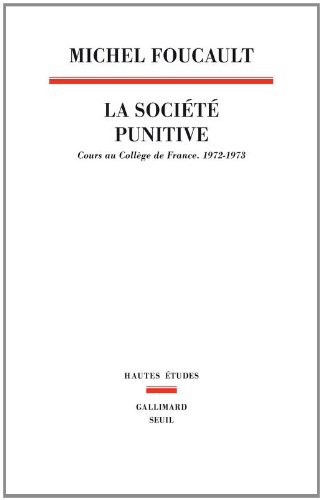
While the date of publication for Foucault’s La société punitive has slipped yet again to 5 December 2013, there are a few more details up on amazon.fr:

318prS0SjDLL’organisation d’une pénalité d’enfermement n’est pas simplement récente, elle est énigmatique. Qu’est-ce qui pénètre dans la prison ? En tout cas, pas la loi. Que fabrique-t-elle ? Une communauté d’ennemis intérieurs”. C’est en ces termes que Michel Foucault dénonce, dans ce cours prononcé en 1973, et que viendra compléter, en 1975, son ouvrage Surveiller et punir, le “cercle carcéral”. La Société punitive étudie ainsi comment les sociétés traitent les individus ou les groupes dont elles souhaitent se débarrasser, c’est-à-dire les tactiques punitives, mais aussi la prise de pouvoir sur le corps et sur le temps et l’instauration du couple pénalité-délinquance. Michel Foucault retrace l’histoire des “tactiques fines de la sanction” dont il distingue quatre modalités : exiler ; imposer un rachat ; marquer ; enfermer. C’est dans la seconde moitié du XVIIIe siècle que se développe une “science des prisons” à fonction corrective et que se construit un discours sur le criminel et son traitement possible, donnant naissance à un schéma de société qui vise à l’absolu du contrôle et de la surveillance. L’ajustement entre le système judiciaire et le mécanisme de surveillance (l’organisation d’une police), entre l’émergence de la richesse et la pratique des illégalismes, entre la force corporelle de l’ouvrier et l’appareil de production s’accomplit ensuite au tournant du XIXe siècle. Foucault démontre donc que ce sont les instances de contrôle para-pénal du XVIIe et du XVIIIe siècle qui ont abouti, in fine, au fonctionnement de la prison, visant à l’élimination du désordre, au contrôle de la distribution spatiale des individus, de leur emplacement par rapport à l’appareil productif. La Société punitive finit par poser la question, cruciale aux yeux du philosophe, de la validité intrinsèque de la loi pénale. A-t-elle vocation universelle ou se limite-t-elle à la douteuse applicabilité d’une somme de décrets ?

Posted in Michel Foucault | Leave a comment

Citizenship After Orientalism (Oecumene) project – Final Conference 6-7 March 2014

The final conference of Engin Isin’s Citizenship After Orientalism (Oecumene) project funded by the European Research Council (ERC) will be held in Milton Keynes on 6-7 March 2014. Draft programme available here, along with details of an international school for postgraduates as an opportunity to deepen their understanding of the findings of the project.

Posted in Conferences, Engin Isin | Leave a comment

Google Books Lawsuit Dismissed: “All Society Benefits,” Says Judge Chin

A good analysis of a major legal decision in publishing.

Posted in Uncategorized | Leave a comment

Nadezhda Tolokonnikova of Pussy Riot’s prison letters to Slavoj Žižek

Nadezhda Tolokonnikova of Pussy Riot writing to Slavoj ŽižekA remarkable exchange of letters between Nadezhda Tolokonnikova of Pussy Riot and Slavoj Žižek, published in The Guardian.

[Update – a little more here]

Posted in Politics, Slavoj Zizek | Leave a comment

Inventive Methods: Data, Calculation, and Bodies, Chris Salter & Celia Lury

Inventive Methods: Data, Calculation, and Bodies – a discussion between Chris Salter & Celia Lury.
Inventive Methods: Data, Calculation, and Bodies from The Center for the Humanities on Vimeo.

dmf's avatarANTHEM

http://vimeo.com/66161202

The digitization of daily life has led to an unprecedented surge of data, with vast implications for calculation, measurement, valuation, and analysis across social and cultural research. This conversation between renowned artist Chris Salter and social scientist Celia Lury will focus especially on the empiricism of sensation—how digital traces are meshed with the body—and addresses questions such as how aesthetics can be put to use across disciplines, from the social sciences to political branding to the arts.

View original post

Posted in Uncategorized | Leave a comment

Poverty and Dispossession: Land Grabs and the Right to Land and Resources

CUNY Graduate School debate on Poverty and Dispossession: Land Grabs and the Right to Land and Resources – discussion with David Harvey, Somnath Mukherjee, Smita Narula, Kathy LeMons Walker. More details on the background available here.
Poverty and Dispossession: Land Grabs and the Right to Land and Resources from The Center for the Humanities on Vimeo.

dmf's avatarsynthetic zerØ

View original post

Posted in Boundaries, Politics, Territory | Leave a comment

Atlas of migration in Europe launch event

atlas of migration cover finalLondon, December 2nd 2013, launch of the Atlas of migration in Europe: A critical geography of migration policies. More details here.

Thanks to Andrew Burridge for the link.

Posted in Books, Boundaries, Events, Politics | 1 Comment

Adam David Morton to give first Annual Warwick Lecture in IPE

Adam David Morton (University of Nottingham) will give the first Annual Warwick Lecture in IPE, on 29 November 2013 at 5pm. He has more details at his blog.

My presentation draws on my latest book Revolution and State in Modern Mexico, which is now out in an updated paperback edition, as a springboard to analysing a critical political economy of the production of space. In order to do so, my focus is on how space is produced and reconstructed in Mexico City through civic monuments, with specific attention cast towards the Monument to the Revolution, completed in 1938.

Posted in Conferences | Leave a comment

Empire, Biopower, Spectacle: Notes on Tiqqun

An interesting discussion of The Coming Insurrection, Hardt and Negri, Occupy, territory, etc.

edmundberger's avatarDeterritorial Investigations

04seoul-600

Today’s territory is the product of many centuries of police operations. People have been pushed out of their fields, then their streets, then their neighborhoods, and finally and from the hallways of their buildings, in the demented hope of containing all life between the four sweating walls of privacy. The territorial question isn’t the same for us as it is for the state. For us it’s not about possessing the territory. Rather, it’s a matter of increasing the density of communes, of circulation, and of solidarities that the territory becomes unreadable, opaque to all authority. We don’t want to occupy the territory, we want to be the territory.i

The quote above comes from the pamphlet The Coming Insurrection, put out in 2007 by the provocatively titled Invisible Committee. Its language anticipates American’s Occupy movements by years, and then surpasses them in the blink of sentence – “we want…

View original post 3,933 more words

Posted in Uncategorized | 1 Comment

James Scott reviews Jared Diamond’s The World Until Yesterday

A devastating review in the London Review of Books.

Posted in Uncategorized | Leave a comment