Karl Marx’s work habits

untitled2Writing advice from Karl Marx – from a piece of satire inspired by Sperber’s new biography.

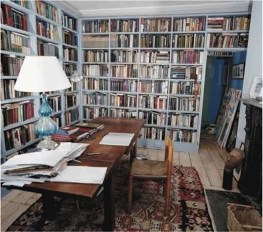
Whatever you make of his ideas, let alone their later proponents, it’s undeniable that Marx was astonishingly prolific: an unfinished project to publish his and Friedrich Engels’ complete works is reportedly expected to run to 120 volumes. Yet, Sperber shows, he worked in conditions of profound disorder. To chronic financial anxieties, exile and personal tragedies were added spectacularly stress-inducing work habits: long days and nights of frenzied reading and writing, followed by collapses into exhaustion; a total inability to meet deadlines, even when his family’s wellbeing depended on it; the “impenetrable chaos of books and papers… that was his study”; an obsession with completeness, combined with an inability to resist plunging off into new projects before finishing others; his neglect of personal hygiene. Sperber quotes another historian: untitled“As soon as he had written something down, it was Marx’s habit to stand up and walk around the table, faster and faster, until something occurred to him, and he then sat down again to write.” The more disciplined Engels berated his friend for being so easily distracted that he failed to fulfil his potential. A bit harsh, given that Marx’s work proved moderately influential, but his frustration is understandable.

Posted in Karl Marx, Writing | 1 Comment

Louise Amoore, The Politics of Possibility

My friend and Durham colleague Louise Amoore’s forthcoming book, The Politics of Possibility: Risk and Security Beyond Probability, now has a page up at Duke University Press site. It looks great:

Since September 11, 2001, the imagination of “low probability, high consequence” events has become a distinctive feature of contemporary politics. Uncertain futures—devastation by terrorist attack, cyber crime, floods, financial market collapse—must be discerned and responded to as possibilities, however probabilistically unlikely they may be. In The Politics of Possibility, Louise Amoore examines this development, tracing its genealogy through the diverse worlds of risk management consulting, computer science, commercial logistics, and data visualization. She focuses on the increasingly symbiotic relationship between commercial opportunities and state security threats, a relation that turns the trusted, iris-scanned traveler into “a person of national security interest,” and the designer of risk algorithms for casino and insurance fraud into a homeland security resource. Juxtaposing new readings of Agamben, Foucault, Derrida, Massumi, and Connolly with interpretations of post–9/11 novels and artworks, Amoore analyzes the “politics of possibility” and its far-reaching implications for society, associative life, and political accountability.

Posted in Books, Giorgio Agamben, Jacques Derrida, Louise Amoore, Michel Foucault, Politics, William E Connolly | 1 Comment

Workplaces of Writers and Artists

enhanced-buzz-11644-1366051662-0At Buzzfeed – the offices and studios of various writers and artists.enhanced-buzz-25353-1366045291-14

Posted in Writing | Leave a comment

Immanent Critique conference in Oregon, 19-20 April 2013

Immanent CritiqueJust been asked to post about this – begins tomorrow, and its location will make this relevant to just a few, but looks interesting and hopefully something will be done with the papers.

An international conference on the notions of critique and social justice in critical theory today will be hosted by the Department of Philosophy at the University of Oregon, 19-20 April 2013 in the Knight Library Browsing Room.

Organized by Assistant Professor Rocío Zambrana (University of Oregon), the conference will feature: Amy Allen (Dartmouth College), Cinzia Arruzza (New School for Social Research), Albena Azmanova (University of Kent), James Bohman (St. Louis University), Anita Chari (University of Oregon), Maeve Cooke (University College Dublin), Deborah Cook (University of Windsor), Andrew Feenberg (Simon Fraser University), Alessandro Ferrara (University of Rome “Tor Vergata”), Eduardo Mendieta (Stony Brook University), Kevin Olson (University of California, Irvine), Antonio Vasquez-Arroyo (University of Minnesota).

The conference is sponsored by the Department of Philosophy at the University of Oregon with support from the Oregon Humanities Center, the College of Arts and Sciences, the Center for the Study of Women in Society (CSWS), the Department of German and Scandinavian, the German Studies Committee, and the Department of Comparative Literature (COLT).

For more information, please contact Rocío Zambrana at zambrana@uoregon.edu.

Conference Poster

Conference Program

Posted in Conferences | 1 Comment

10th Annual Historical Materialism Conference CFP

HM 2013: Making the World Working Class

7-10 November

Central London

Organised in collaboration with the Isaac and Tamara Deutscher Memorial Committee and Socialist Register

‘Capital is not a thing, but a social relation between persons’ – and between classes. The complex task of analysing class structures and, at the same time, transforming and transcending them is at the core of Marx’s legacy. 2013 marks the 75th anniversary of CLR James’s “The Black Jacobins” and the 50th anniversary of EP Thompson’s “The Making of the English Working Class”. Wary of all reifications of class, Thompson showed how the working class was not only made by capital, but made itself in everyday struggles and political agitation. James affirmed the need to look at the international division of labour in the context of race and imperialism, and gave voice to the revolutionary agency of the ‘black Jacobins’ and other historically neglected enemies of capitalism and colonialism.

In the wake of the new conflicts thrown up by decolonisation and more recent processes of neoliberal ‘globalisation’, research in the field of labour and working class history has acquired an increasingly global dimension, and become more attentive to the critical role played by race and gender in the formations of working classes. Social struggles and resistance – from Latin America to Eastern Europe, from the Arab-Islamic world to East Asia – continue to show that working classes worldwide have not ceased remaking themselves, at the same time as they struggle against capitalist strategies to turn class composition into class decomposition, to unmake a world working class. Significantly, in order to understand this changing reality and the roots of the crisis of the neoliberal system, a growing body of scholarship questions the representation of labour as a passive factor in production, and investigates how workers’ struggles co-determine processes of capitalist development, as well as cultural mutations and political transformations.  

Despite rising levels of class struggle – from a growing working class movement in China to the Arab uprisings and mobilisation against austerity in Southern Europe – discourses of class remain largely marginal to political debate and action. Class struggle is often recognised, namely through the language of inequality, but is being increasingly filtered, also on the left, through notions of ‘the people’ or ‘the 99%’. The tenth annual Historical Materialism aims to provide a forum for debating  the descriptive and prescriptive roles that concepts of class and class struggle can have today. More generally, we seek contributions that account for how Marxist theory, historiography and empirical research can explain and intervene in the contemporary conjuncture. We will be hosting a stream on “Race and Capital” (for which a separate call for papers is forthcoming, along with a CFP building on last year’s “Marxism and Feminism” stream), and we especially welcome papers that address the following themes:

· class, imperialism and migration

· class and gender

· Marxism and feminism

· geographies and spaces of class

· class, capitalism and environment in the BRICS (Brazil, Russia, India, China and South Africa)

· changing geographies of accumulation and resistance

· working class movements today

· class strategies against the crisis and ‘austerity’

· revisiting Thompson’s The Making of the English Working Class

· revisiting the legacy of CLR James

· history of the international communist movement

· Marxism and theories of intersectionality

· class struggle and political organisation, party and class

· theories of class formation and class composition

· crisis, austerity, and proletarianisation

· class and the agrarian question

· class, literature and literary theory

· cultures of class

· ‘class struggle without classes’

· class, poverty, inequality

· representing class and capital in art and culture

· proletarianisation, pauperisation and precarity

We are, of course, open to proposals on other themes as well.

Abstracts (100-200 words) should be submitted at www.historicalmaterialism.org (shortly to go online). Panels can also be proposed but we reserve the right to disaggregate them and accept only some papers – they are not “package deals”. Deadline: 1 May 2013

Please note: the HM conference is not a conventional academic conference but rather a space for discussion, debate and the launching of collective projects. We therefore discourage “cameo appearances” and encourage speakers to participate in the whole of the conference. We also strongly urge all speakers to take out personal subscriptions to the journal.

For all queries: historicalmaterialism@soas.ac.uk

Posted in Conferences | 1 Comment

Modern European Philosophy and its Politics – CFP

Modern European Philosophy and its Politics

The Society for European Philosophy/Forum for European Philosophy Joint Annual Conference for 2013 will be hosted by the Centre for Research in Modern European Philosophy (CRMEP), Kingston University London

5–6 September 2013
Penrhyn Road Campus, Kingston upon Thames, KT1 2EE

Plenary speakers:
Professor Sara Ahmed, Goldsmiths/Cambridge University
“Queer Will”
Professor Robert Bernasconi, Penn Sate University
“Kant and the Hottentots”
Professor Tuija Pulkkinen, University of Helsinki
“Thinking Intervention”

The SEP/FEP conference is the largest annual event in Europe that aims to bring together researchers, teachers and others, from within different disciplines, interested in all areas of Modern European Philosophy. Submissions are therefore invited for individual papers and panel sessions in all areas of Modern European Philosophy. For 2013 submissions that address the conference’s plenary theme – Modern European Philosophy and its Politics – are particularly encouraged. This would include papers and panels that address philosophical issues in the history of Modern European Philosophy with regard to the cultural, social and political contexts of their elaboration; and those that address philosophical issues with regard to the social, cultural and political contexts of the present.

Abstracts of 500 words for individual paper submissions and proposals for panels should be sent to Stella Sandford (S.Sandford@Kingston.ac.uk) by 17 May 2013. Proposals for panels should include a 500-word abstract for each paper within the panel. Proposals from academics, graduate students and independent scholars are welcome.

Enquiries: S.Sandford@Kingston.ac.uk

Posted in Conferences | Leave a comment

Ian Hacking: ‘Making Up People’ Reconsidered (Public Lecture, Northumbria University, 15 May 2013)

For those in the northeast of England, a chance to hear Ian Hacking speak.

Centre for Medical Humanities's avatarCentre for Medical Humanities Blog

Professor Ian Hacking: ‘”Making Up People’ Reconsidered”
MEA House Auditorium, Northumbria University
15 May 2013, 10.30 am – 12 pm

HackingAs part of a series of workshops for the Leverhulme-funded project “Fashionable Diseases: Medicine, Literature and Culture”  at the Universities of Northumbria and Newcastle, the Northern Network for Medical Humanities are pleased to welcome Professor Ian Hacking (Philosophy, University of Toronto) on 15th May 2013, 10:30am at the MEA House Auditorium, Northumbria University.

Professor Hacking will give a lecture entitled “‘Making Up People’ Reconsidered” exploring the ways in which new scientific classifications of diseases such as multiple personality disorder and autism may affect experiences of them and thus give rise to a new type of person and way of being.    You may wish to read the following article in preparation for the event: Ian Hacking, “Kinds of People: Moving Targets.” Proceedings of the British Academy 151 (2007): 285-318.  A link to the…

View original post 12 more words

Posted in Uncategorized | Leave a comment

Jeremy Crampton on the geographies of Gunnar Olsson

Jeremy Crampton reviews GO: On the Geographies of Gunnar Olsson.

Posted in Uncategorized | Leave a comment

The Great University Gamble

This looks a depressing must-read – Andrew McGettigan, The Great University Gamble:9780745332932

In 2010 the UK government imposed huge cuts and market-driven reforms on higher education. Proposals to raise undergraduate tuition fees provoked the angriest protests for decades. This academic year has seen the first cohort of students begin study under the new arrangements. A proposed Higher Education Bill has been shelved, but changes are being cemented and extended through other means.

Displaying a stunning grasp of the financial and policy details, Andrew McGettigan surveys the emerging brave new world of higher education. He looks at the big questions: What will be the role of universities within society? How will they be funded? What kind of experiences will they offer students? Where does the public interest lie?

Written in a clear and accessible style, The Great University Gamble outlines the architecture of the new policy regime and tracks the developments on the ground. It is an urgent warning that our universities and colleges are now open to commercial pressures, which threaten to transform education from a public good into a private, individual financial investment.

Posted in Politics, Universities | Leave a comment

Boko Haram paper at the AAG

The audio recording of my AAG talk is available here.

The title was “Urban Territory: Violent Political Technologies in London and Kano”, but between writing the abstract and giving the talk events in Nigeria meant that my focus changed quite a lot. I debated changing the title and dropping the London part entirely, but decided to keep it very briefly at the beginning. Most of the paper was devoted to looking at the geopolitics of the Nigerian group Boko Haram, which I spoke about at more length at the L.S.E., in Aberystwyth and in Istanbul earlier this year. I hope to upload the Istanbul talk soon.

Posted in Conferences, Politics, Territory, urban/urbanisation | Leave a comment