Derek Gregory on an intriguing counterfactual historical novel.

Derek Gregory's avatargeographical imaginations

SANSOM Dominion

It’s been a long time since I read a novel with maps… and I don’t think I’ve ever read one that ends with an essay explaining its geopolitics.  I’ve just finished C.J. Sansom‘s Dominion (Pan/Macmillan, 2012), which is set in an alternative Britain in 1952.  The premiss is that Churchill never became Prime Minister in May 1940; instead, the British government under Lord Halifax sued for peace with Hitler.  In Sansom’s chillingly plausible vision, Britain became a German satellite state  but retained its nominal independence; it was not placed under military occupation but its government (and especially its police apparatus) became overwhelmingly fascist.  Germany was given carte blanche in Europe, and continued a relentless, remorseless but ultimately unwinnable war against what was left of the Soviet Union; Britain retained its Empire – which, apart from South Africa, became increasingly restive at the absolutist politics that festered at its heart…

View original post 377 more words

Posted in Uncategorized | Leave a comment

New Geographies 5 – The Mediterranean

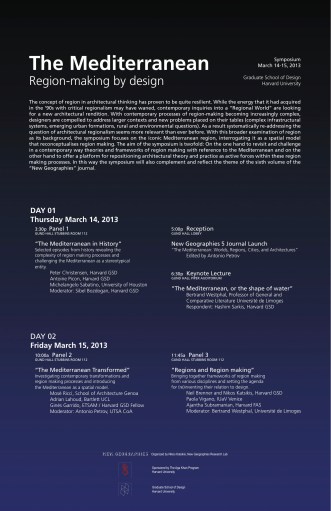
9781934510339New Geographies, Vol 5, is out shortly. There is a launch event at the Graduate School of Design later this month.

Most literature on the Mediterranean regarding architecture and urbanism has focused on the idea of the Mediterranean city and its history, but the spatial aspect also merits attention. This region, at the intersection of three continents, is one of the most important areas on earth—culturally, politically, and ecologically. New Geographies, 5 aims to recast “the Mediterranean” as a contemporary phenomenon and spatialize its formation as a larger geographic entity in the twenty-first century.

552847

Contributors from a variety of disciplines challenge conventional boundaries between cities and hinterlands and dismantle prevailing geographic, spatial, and cultural meanings.

New Geographies, 5 recovers the Mediterranean as a model for global interaction and critically examines how the migration of complex architectural and urban formations, micro-geographies, new infrastructures, and demographic flows revise geopolitical boundaries and actively reshape cities, regions, and hinterlands beyond recognized cultural and geopolitical contours. Moreover, the collected writings aspire to activate critical questions about the formation of regions and to address philosophical, cross-cultural, and interfaith relationships, preservation, cultural identity, trade, and geopolitics—all elements that influence the geographic.

Posted in Conferences, Neil Brenner, Publishing, Territory, urban/urbanisation | Tagged | 1 Comment

London Critical Theory Summer School with a stellar cast of academics.

Posted in Uncategorized | Leave a comment

Bruno Latour – fifth and sixth Gifford lectures

Links to the first four can be found here.

Posted in Bruno Latour | Leave a comment

Regimes of Calculation and Global Governance workshop

I’ve accepted an invitation to give the keynote address to a workshop on ‘Regimes of Calculation and Global Governance’, at the Balsillie School of International Affairs, Waterloo, Ontario, 19-20 September 2013.

Posted in Conferences, Politics | Leave a comment

Alexander von Humboldt lecture – The Emergence of Territory

An old lecture of mine, on the history of territory project, has been posted on YouTube. It’s one of the Alexander von Humboldt lectures at the University of Nijmegen, from September 2010. It’s introduced by Huib Ernste, and you can find my thoughts on how the lecture went here. The lecture was an updated version of one I gave in Erlangen earlier that year.

Posted in The Birth of Territory | Leave a comment

Books received

Books 4 March 2013

John Sallis, Logic of Imagination; the reissue of Michael Watts, Silent Violence; Paul Virilio’s The Great Accelerator, and Paidraig Carmody, The New Scramble for Africa.

Posted in Books, John Sallis, Michael Watts, Paul Virilio | Leave a comment

Andrew Barry, Material Politics

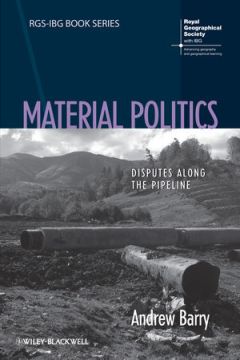
BarryAndrew Barry’s new book Material Politics: Disputes Along the Pipeline is forthcoming in September in the RGS-IBG book series.

In Material Politics, author Andrew Barry reveals that as we are beginning to attend to the importance of materials in political life, materials has become increasingly bound up with the production of information about their performance, origins, and impact.

    • Presents an original theoretical approach to political geography by revealing the paradoxical relationship between materials and politics

    • Explores how political disputes have come to revolve not around objects in isolation, but objects that are entangled in ever growing quantities of information about their performance, origins, and impact

    • Studies the example of the Baku-Tbilisi-Ceyhan oil pipeline – a fascinating experiment in transparency and corporate social responsibility – and its wide-spread negative political impact

    • Capitalizes on the growing interdisciplinary interest, especially within geography and social theory, about the critical role of material artifacts in political life

Posted in Andrew Barry, Books | 3 Comments

Clive Barnett on Iris Marion Young – one of his ‘favourite thinkers’ series. That series is an intriguing mix – David Byrne, JM Coetzee, Stanley Cavell et. al.

Admin's avatarPop Theory

Picture 092Noticing, rather belatedly I now realise, that the last book by Iris Marion Young had been published got me reflecting on the different encounters I have had with her work over the years, making me feel old, and slow, but also making me realise that sometimes thinkers act as helpful companions. I have always found, on reading Young, that she had got somewhere I wanted to be well before I arrived there, but I have also found this kind of affirming – she is one of the thinkers who always reassured me that I wasn’t completely on the wrong track. So I have been reconstructing ‘my life with Iris’, which does, oddly, include one occasion when I met her in person.

I think my first encounter was in late 1989 – I was in my first term as a graduate student, and this was the moment of postmodernism in geography: Ed Soja’s Postmodern…

View original post 1,448 more words

Posted in Uncategorized | Leave a comment

Léopold Lambert on his new book Weaponized Architecture.

Léopold Lambert's avatarThe Funambulist

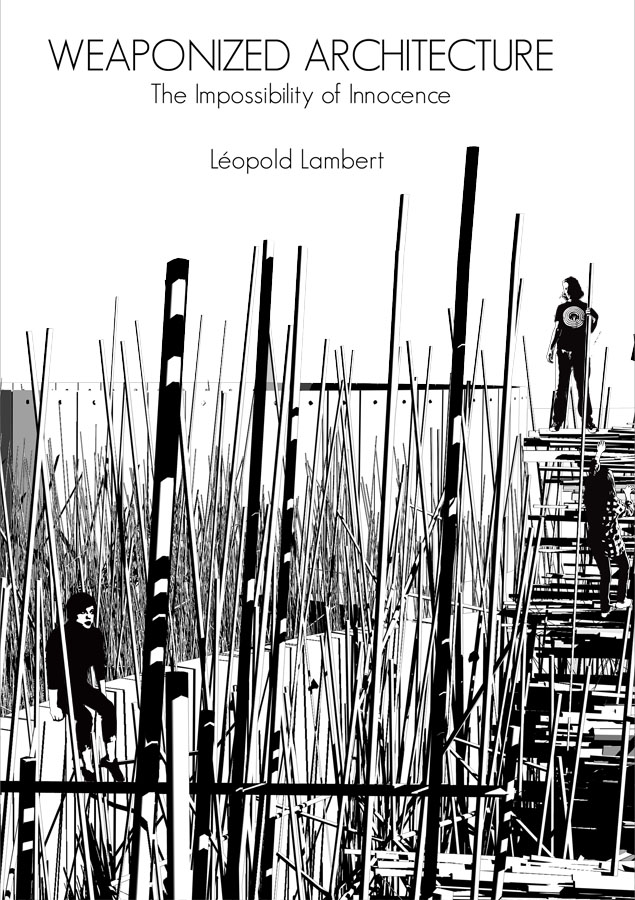
Weaponized Architecture 2011 Cover

I apologize to those of my readers who would reasonably see this article as a form of self-promotion, this will be the first and only post about this book. Following the research I undertook in 2010 and the architectural project that emerged from it in 2011, My good friends Ethel and Cesar from  DPR-Barcelona and I have worked together to come out with a book, Weaponized Architecture: The Impossibility of Innocence that would be available for all. This is now the case and you can find the book on any national franchise of amazon and (preferably!) in some bookstores in various countries. For a presentation of this work, you can see the small lecture I was lucky to be able to do at the school of architecture of Lund (Sweden) in September 2012. One particularity of the book that is also worth noting, was developed by dpr-barcelona is the introduction…

View original post 336 more words

Posted in Uncategorized | Leave a comment