Routledge Studies in Global and Transnational Politics Series

Call for proposals for a new book series – Routledge Studies in Global and Transnational Politics.

The core theme of the series is ‘global connectivities’ and the implications and outcomes of global and transnational processes in history and in the contemporary world. The series aims to promote greater theoretical innovation and inter-disciplinarity in the academic study of global transformations. The understanding of globalization that it employs accords centrality to forms and processes of political, social, cultural and economic connectivity (and disconnectivity) and relations between the global and the local. The series’ editors see the multi-disciplinary exploration of ‘global connectivities’ as contributing both to understanding the nature and direction of current global and transnational transformations, and to recasting the intellectual agenda of the social sciences.

The series aims to publish work that engages these aims and themes by leading and emerging scholars, and will comprise research monographs, edited collections and advanced textbooks for scholars, researchers, policy analysts, and students.

We invite proposals; and if you wish to discuss your ideas at any stage of the project, please contact one of the series editors, below:

Series editors:

Chris Rumford: Chris.Rumford@rhul.ac.uk

Sandra Halperin: Sandra.Halperin@rhul.ac.uk

Luis Lobo-Guerrero: Luis.Lobo-Guerrero@rhul.ac.uk

Download a flyer here.

Posted in Publishing | Leave a comment

Kaleidoscope – postgraduate Durham journal

Kaleidoscope Vol 5 No 1 is now available. This is a postgraduate journal at Durham University, edited by a small team of committed postgraduates linked to the Institute of Advanced Study.

Unusually, this is a special edition of proceedings from two conferences.

The first of these was the Fifth Annual Rhizomes conference held by The School of Languages and Comparative Cultural Studies in The University of Queensland, Australia in February 2010, entitled “Diaspora: Language and Place”. The annual Rhizomes Postgraduate Conference provides an opportunity for postgraduates and early career researchers to present research, exchange ideas, and build networks in a friendly and relaxed academic environment while engaging in interdisciplinary dialogue.

The second was the RGS-IBG Postgraduate Mid-term Conference, hosted by Durham University’s Geography Department in 2011. The RGS-IBG Postgraduate Forum Midterm Conferenceoffers a welcoming, supportive and affirmative environment for postgraduates to share emerging and ongoing geographical research.

This issue presents a highly diverse and engaging series of papers on topics ranging from British musical futurism, Indian urban imaginaries and Filipino diaspora studies to homosociality in Malory’s Lancelot, Chinese dialects and Dostoevsky’s post-Siberian works.

Issue 5.1 of Kaleidoscope is available to view at:-

http://www.dur.ac.uk/resources/ias/kaleidoscope/51Edition.pdf

The Call for Papers for the next edition will be in March, when we will be inviting submissions on the theme of ‘Time’, including full-length articles of 7,000 -10,000 words, as well as shorter articles, book reviews and interviews with academics or authors that are relevant to the theme.

Posted in Uncategorized | Leave a comment

Territory, Politics, Governance – new articles

My essay ‘How should we do the history of territory?‘, forthcoming in the first issue of the journal Territory, Politics, Governance has been downloaded 1,267 times. Being open access certainly helps. There are two more papers available at present, and the first issue should be out by the end of the month.

Posted in My Publications, Publishing, Territory | Leave a comment

Franco Moretti, Distant Reading and The Bourgeois

MorettiFranco Moretti’s book of essays, Distant Reading, is coming out in June. He also has a book entitled The Bourgeois: Between History and Literature coming out at the same time. The Verso blog has a post about his work here.

How does a literary historian end up thinking in terms of z-scores, principal component analysis, and clustering coefficients? The essays in Distant Reading led to a new and often contested paradigm of literary analysis. In presenting them here Franco Moretti reconstructs his intellectual trajectory, the theoretical influences over his work, and explores the polemics that have often developed around his positions.

Moretti2From the evolutionary model of “Modern European Literature,” through the geo-cultural insights of “Conjectures of World Literature” and “Planet Hollywood,” to the quantitative findings of “Style, inc.” and the abstract patterns of “Network Theory, Plot Analysis,” the book follows two decades of conceptual development, organizing them around the metaphor of “distant reading,” that has come to define—well beyond the wildest expectations of its author—a growing field of unorthodox literary studies.

Posted in Books, Franco Moretti | Leave a comment

Latour’s third and fourth Gifford lectures

Latour’s third lecture – The Puzzling Face of a Secular Gaia

and the fourth lecture – The Anthropocene and the Destruction of the Image of the Globe

The first and second are available here and here.

Posted in Bruno Latour | 2 Comments

Zizek recently gave a reply to his critics – the audio is available here.

dmf's avatarANTHEM

Slavoj Zizek – A reply to my critics

Although most of the critiques to which my work was exposed in the last years are “so-called” fast denunciations not worthy of a serious reply, some of them do at least raise pertinent questions : which, exactly, is the status of violence in social life, and how can one justify resort to it? Is in our societies a radical social change – not just a revolt but the imposition of a new order – objectively possible?   What is materialism today, beyond the usual versions of deconstructionist discursive materialism, Deleuzian “new materialism,” and scientific naturalism? And, last but not least, what immanent role do jokes play in theory?

View original post

Posted in Uncategorized | Leave a comment

Some interesting thoughts on the way Anglophone commentators work with Nietzsche’s notebooks – works unpublished in his lifetime. I suppose one reason why The Will to Power, for all its problems, is still used is that not everything in there is available in translation. Writings from the Late Notebooks, good though it is, is only a partial sample of the Nachlaß, and not the same sample as The Will to Power. Also, if you’re reading a book that uses The Will to Power as its source, such as Heidegger’s reading of Nietzsche, then you need The Will to Power to check what he is referring to. The editor of Heidegger’s Nietzsche, David Farrell Krell, talks of how hard it would have been for him to have changed or supplemented every reference to/with the Colli-Montinari edition of the Kritische Studienausgabe. There is a complete translation of the KSA coming out in English, with Stanford University Press, but it has been extremely slow in coming out. Only five volumes of a projected twenty (for reasons that escape me, they are not a direct one-to-one equivalent to the KSA) are out, two of which were in the past couple of years after a thirteen year gap. See here. I completely agree that The Will to Power is outdated, and really serious work should not be using it, but there are reasons why it is still a useful reference tool. Let’s hope that Stanford complete their translation project soon, so it can finally be put to rest.

Barry Stocker's avatarStockerblog

I’ve been busy (too much so for blogging, sadly) with work on a volume on Nietzsche and political thought, which I am co-editing. More details when the publication tome comes closer. One thing I’ve noticed is an extraordinary tendency to quote from The Will to Power, a book of Nietzsche’s notes. That is notes arranged as if constituting a draft for s book, The Will to Power, that Nietzsche was not able to write in a more final version before the collapse of 1889, followed by mental and physical paralysis until his death in 1900. However, though he considered writing a book with that title, it was not a constant project, and he never wrote any notes or drafts for it. After Nietzsche’s death, his friend Peter Gast and his sister Elisabeth Förster-Nietzsche collaborated on an edition of his notebooks with headings, section titles  and so on added…

View original post 649 more words

Posted in David Farrell Krell, Friedrich Nietzsche | 4 Comments

The complete Foucault-Chomsky debate on youtube – parts of this have been available for a while, but this is the full recording.

Clare O'Farrell's avatarFoucault News

Editor: Philippe Theophanidis on his blog Aphelislinks to a complete recording on YouTube of the Foucault-Chomsky debate and provides detailed background on the history of the recording and the various versions and publications of the transcript.

The Chomsky-Foucault Debate On Human Nature, New York: The New Press, 2006, pp. 57-58. Content of the transcript differs from the actual recording.

The video displayed […] is a complete 1 hour 11 minutes video recording of the original television program titled “Menselijke Natuur En Ideale Maatschappij” (“Human Nature and Ideal Society”). It took place in November 1971 at the Eindhoven University of Technology, in Nederland, as part of the “International Philosophers Project”. It was recorded and broadcast by the Dutch National Television. The video includes opening credits, an introduction by Prof. L. W. Nauta, the entrance of Noam Chomsky and Michel Foucault, the debate itself moderated by Dutch philosopher Fons Elders…

View original post 194 more words

Posted in Uncategorized | 1 Comment

How people die in Shakespeare’s tragedies

tragedies-2

via Biblioklept.

Posted in William Shakespeare | 7 Comments

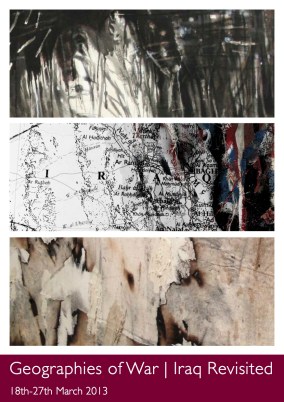
Geographies of War | Iraq Revisited

geographies-of-war-iraq-revisited-a5-flier1geographies-of-war-iraq-revisited-a5-flier21

Interesting looking exhibition and workshop, curated and organised by political geographer Alan Ingram.


Posted in Conferences, Events | 1 Comment