Boko Haram in World Policy Journal

Winter12_16-17_AnatomyWorld Policy Journal has a short and useful piece on Boko Haram by Carlo Davis, including this diagram of its political anatomy – clicking on the image will take you to their much larger version. The full piece is available open access.

As time allows I’ve been reading what I can on Boko Haram, towards my LSE and AAG papers. I am compiling a bibliography of references, and will post more about that soon.

Posted in Politics | Leave a comment

Greenwald and Cole on the Obama administration memo

The Obama adminstration memo on assassination, that I linked to this morning, is dissected by Glenn Greenwald and Juan Cole. Greenwald is especially good on the political and geographical elements; Cole on the legal/constitutional issues.

Posted in Politics | Leave a comment

Lefebvre, autogestion, Mexico and Turkey

autogestion-200x300Ertan Erol, one of Adam David Morton’s PhD students, discusses how Lefebvre’s notion of autogestion, especially in the State, Space, World collection is helpful in understanding spaces of difference and capitalist space in Mexico and Turkey at For the Desk Drawer.

Posted in Henri Lefebvre, Politics | Leave a comment

Peter Gratton links to an interesting historical document – the transcript of Sartre’s meeting with Andreas Baader of the Red Army Faction.

Peter Gratton's avatarPHILOSOPHY IN A TIME OF ERROR

New transcript released of his 1974 prison visit. This should be of interest to those working on the late Sartre and his thoughts on violence (though this article itself is almost so loaded it helps little).

View original post

Posted in Uncategorized | Leave a comment

Michael Dear on the US-Mexico border.

Posted in Uncategorized | Leave a comment

“there’s no geographic line” – Obama and assassination

The leaked US memo on drone strikes is available here. Craig Jones has a good analysis at War, Law & Space. Informed Comment points to this story

The Obama administration’s internal legal justification for assassinating U.S. citizens without charge has been revealed for the first time. In a secret Justice Department memo, the administration claims it has legal authority to assassinate U.S. citizens overseas even if there is no intelligence indicating they are engaged in an active plot to attack the United States. We’re joined by Jameel Jaffer, deputy legal director of the American Civil Liberties Union. “If you look at the memo … there’s no geographic line,” says Jaffer. “The Obama administration is making, in some ways, a greater claim of authority [than President Bush]. They’re arguing that the authority to kill American citizens has no geographic limit.” [includes rush transcript]

Posted in Boundaries, Politics, Territory | 3 Comments

Tom Engelhardt on the American Lockdown state

At TomDispatch, a piece on the security around the Obama inauguration. Here’s the beginning:

Consider Inauguration Day, more than two weeks gone and already part of our distant past.  In its wake, President Obama was hailed (or reviled) for his “liberal” second inaugural address.  On that day everything from his invocation of women’s rights (“Seneca Falls”), the civil rights movement (“Selma”), and the gay rights movement (“Stonewall”) to his wife’s new bangs and Beyoncé’s lip-syncing was fodder for the media extravaganza.  The president was even praised (or reviled) for what he took pains not to bring up: the budget deficit.  Was anything, in fact, not grist for the media mill, the hordes of talking heads, and the chattering classes?

One subject, at least, got remarkably little attention during the inaugural blitz and, when mentioned, certainly struck few as odd or worth dwelling on.  Yet nothing better caught our changing American world.  Washington, after all, was in a lockdown mode unmatched by any inauguration from another era — not even Lincoln’s second inaugural in the midst of the Civil War, or Franklin Roosevelt’s during World War II, or John F. Kennedy’s at the height of the Cold War.

Posted in Politics | Leave a comment

Angus Cameron discusses encountering Richard III, academic publicity and impact, along with the question of peer review – all in a single post.

Posted in Uncategorized | Leave a comment

Anti-Security – A Declaration

Finally got round to looking at a copy of Anti-Security, edited by Mark Neocleous and George S. Rigakos, which came out in 2011. After a brief introduction, there is a powerful ‘declaration’ which sets out the academic and political rationale for the project. I wanted to see if it was available online, and so came across the Anti-Security Studies site devoted to the project and linked work. The declaration is available here and the opening paragraph reads:
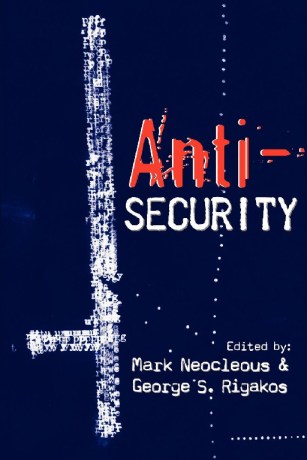
antisec_front_z5fhThe purpose of the project, put simply, is to show that security is an illusion that has forgotten it is an illusion. Less simply, that security is a dangerous illusion. Why ‘dangerous’? Because it has come to act as a blockage on politics: the more we succumb to the discourse of security, the less we can say about exploitation and alienation; the more we talk about security, the less we talk about the material foundations of emancipation; the more we come to share in the fetish of security, the more we become alienated from one another and the more we become complicit in the exercise of police powers. Fleshing out how we got here is the first challenge; showing how damaging this has been is an even greater challenge; doing these things in a way that contributes to a radical, critical and emancipatory politics even more so. But it is a challenge that must be made, and must be made collectively. As a start, we therefore offer the following declarations about an Anti-Security politics.

Posted in Mark Neocleous, Politics | 1 Comment

Two more links on Brooklyn College

Corey Robin writes at Crooked Timber, and the Verso blog has the story.

Posted in Politics, Universities | Leave a comment