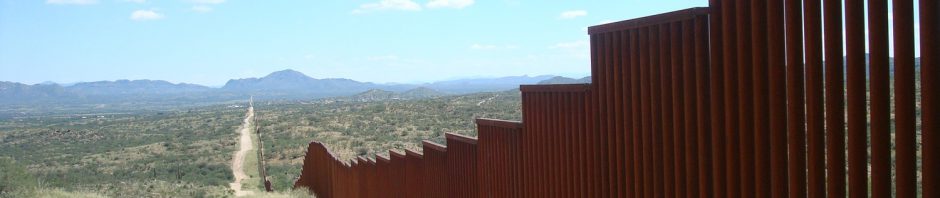
Short piece linking to recently published papers that look at the interrelation of climate change and vertical geopolitics.

mwfmahony's avatarGeography Directions

Martin Mahony

Global geopolitics have conventionally been conceived of in terms of the horizontal actions and interactions of territorially-bounded nation states. However, critical geographers have recently started giving consideration to ‘vertical geopolitics’, drawing greater attention to the spatial exercise of power in a dimension which cannot conventionally be discerned from a flat political map of the world.

Vertical geopolitics have figured prominently in the news recently, particularly as new technologies of surveillance and violence have challenged conventional orderings of vertical territory (such as the notion of sovereign ‘airspace’). In particular, the military use of drones – or unmanned aircraft – for the purposes of intelligence-gathering  and assassination has quite radically altered the political geographies of modern warfare. Meanwhile, the WWF’s recent announcement that drones will be used to help protect wildlife from poachers marks an interesting development in the sky-bound surveillance of the global environment.

Climate change offers an fascinating window through…

View original post 349 more words

Posted in Uncategorized | Leave a comment

Another interesting interview at Figure/Ground Communication.

Posted in Uncategorized | Leave a comment

Terricide – Lefebvre, Geopolitics and the Killing of the Earth

This is my abstract for the August 2013 Royal Geographical Society (with Institute of British Geographers) annual conference. It will be part of the sessions organised by Nigel Clark, Kathryn Yusoff and Arun Saldanha on ‘Geo-Social Formations: Capitalism and the Earth’.

Terricide – Lefebvre, Geopolitics and the Killing of the Earth

In a few places in his four volume study De l’État, Henri Lefebvre briefly discusses the idea of terricide—the killing, destruction or death of the earth. His sources are the poet Jean-Clarence Lambert and, less directly, the philosopher Kostas Axelos. Lefebvre locates the tensions in the international state system, and suggests that while reason of state might be attributed to each of the members, rationality does not characterise the system taken as a whole. His immediate context, writing in the mid 1970s, would seem to be the superpower conflict of the Cold War, but here and elsewhere there are hints that this might be linked to other issues—environmental degradation, modern technology, growth over development, the state mode of production and capitalism more generally.

How might Lefebvre’s spur to consider the potential destruction of the earth help us in rethinking geopolitics? Geopolitics is all-too-often seen as a synonym for global politics, international relations writ large, without much thought given to the globe, much less the world or the earth. But if geopolitics was to return to its etymological roots, as a politics of the earth, it might productively link with discussions of geopower and geophilosophy. This paper brings Lefebvre, Lambert and Axelos into those discussions.

Posted in Conferences, Henri Lefebvre, Kostas Axelos, Politics, Territory | 6 Comments

Judith Butler’s remarks at Brooklyn College

The Nation has published Judith Butler’s talk to the event at Brooklyn College on the Boycott, Divestment, Sanctions movement.

Posted in Judith Butler, Politics | Comments Off on Judith Butler’s remarks at Brooklyn College

Exhuming Mackinder

KaplanI’ve mentioned Robert Kaplan’s The Revenge of Geography before, along with some critical reviews, but I’ve now read the damn thing. One of the most peculiar elements is the attempt to exhume Mackinder, as if this is the cutting edge of what Geography is about. ParentiKaplan keeps claiming he is not a determinist, but it’s a particularly clunky version of what Geography is, and how it effects human actions, collective and social. Alongside it I read Christian Parenti’s Tropic of Chaos, which looks at the interrelation of geography and violence in a much more thoughtful, nuanced and critical way.

Posted in Christian Parenti, Uncategorized | Leave a comment

Dominique Moran Reviews Beyond Walls and Cages.

Posted in Uncategorized | Leave a comment

Jo van Every on book proposals

Some good advice on book proposals from Jo van Every.

Posted in Publishing, Writing | Leave a comment

Secure the Volume – Political Geography paper available

My paper “Secure the Volume: Vertical Geopolitics and the Depth of Power” has now been published by Political Geography in their ‘articles in press’ section [open access here]. They’ve not yet posted the responses by Peter Adey and Gavin Bridge but my reply “Bodies, Books, Beneath” is also available. The journal requires a subscription, but if you are having difficulties, please contact me.

Abstract

We all-too-often think of the spaces of geography as areas, not volumes. Territories are bordered, divided and demarcated, but not understood in terms of height and depth. ‘Secure the area’ is a common expression for the military and police, but what happens if another dimension is taken into account and we think what it means to ‘secure the volume’? This article draws on the emergent literature on vertical geopolitics and Peter Sloterdijk’s work on spheres, but also looks at what happens below the surface, with a particular focus on tunnels. Using Paul Virilio’s work, and some examples from the West Bank and Israel’s border with Lebanon, it demonstrates how we need to think volume—think about volume, through volume, with volume—rather than simply the vertical to make sense of the complexities of territory today.

Highlights

► Argues that we need to think of territories as volumes rather than areas; three not two dimensions. ► Links work on vertical geopolitics to literature on urban exploration. ► Broadens the sense of geopolitics to think about land and earth. ► Theorises the notion of the volumetric as combining volume and metrics. ► Provides a discussion of sites in Israel/Palestine, and Paul Virilio’s early work on architecture.

Keywords
  • Volume;
  • Security;
  • Verticality;
  • Volumetric;
  • Power;
  • Geopolitics
Posted in My Publications, Paul Virilio, Peter Sloterdijk, Politics, Territory | 8 Comments

Derek Gregory notes a call for proposals for the UBC Peter Wall Institute of Advanced Studies roundtables, along with the relocation of the TED talks to Vancouver.

Derek Gregory's avatargeographical imaginations

This week it was announced that the TED talks will be moving from California to Vancouver in March 2014 – Mayor Gregor Robertson supposedly saw this as a sign that ‘we’re breaking through in thought leadership’ (sic) – so this may be a good time to announce something different (particularly for those, like Nathan Jurgenson, who are leery of the TED bandwagon).

PWIAS

The Peter Wall Institute for Advanced Studies at UBC plans to host six International Roundtable Discussions next year in Vancouver; the outline call is below, and you can find more details here, and details of our other international programs here.

Big Ideas. Time and space to explore them. The Peter Wall Institute for Advanced Studies at the University of British Columbia will host six International Roundtable Discussions each year for scholars from the international community and Canada to come together in the pursuit of knowledge…

View original post 168 more words

Posted in Uncategorized | Leave a comment

Clare O’Farrell links to an important forthcoming book on Foucault and genealogy by Colin Koopman.

Clare O'Farrell's avatarFoucault News

Colin Koopman, Genealogy as Critique:Foucault and the Problems of Modernity, Indiana University Press, Series: American Philosophy

Publication date: 2/25/2013
Format: paper 362 pages
ISBN: 978-0-253-00621-9

Author’s blog

Description
Viewing Foucault in the light of work by Continental and American philosophers, most notably Nietzsche, Habermas, Deleuze, Richard Rorty, Bernard Williams, and Ian Hacking, Genealogy as Critique shows that philosophical genealogy involves not only the critique of modernity but also its transformation. Colin Koopman engages genealogy as a philosophical tradition and a method for understanding the complex histories of our present social and cultural conditions. He explains how our understanding of Foucault can benefit from productive dialogue with philosophical allies to push Foucaultian genealogy a step further and elaborate a means of addressing our most intractable contemporary problems.

Table of contents
Acknowledgments
Introduction: What Genealogy Does
1. Critical Historiography: Politics, Philosophy & Problematization
2. Three Uses of Genealogy: Subversion, Vindication & Problematization

View original post 73 more words

Posted in Uncategorized | Leave a comment