Planned Cities seen from space

canberra_full1000

Wired has some striking images (via Antoine Bousquet). The one I’ve included above is Canberra, and you can get a sense of this view when flying in – it’s a small enough city that you can see a lot in a single view; and you can also see the logic behind its design from the top of Mount Ainslie (top right in the photo). The circuit round the artificial lake was 17 1/2 miles, and was one of my regular bike rides in the evening when I was there for three months in 2011. Mount Ainslie, the Black Mountain (top left) and Red Hill (bottom) were rather more challenging.

Posted in Cycling | Leave a comment

Greenblatt, The Swerve – prizes and criticisms

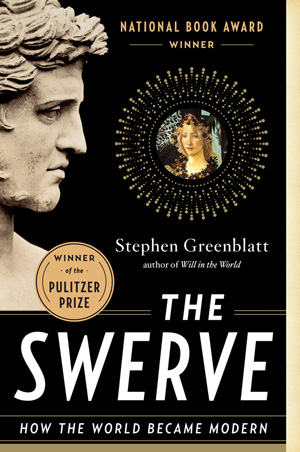
Swerve_TipIn_FINAL.inddJeffrey Cohen has an interesting post on Stephen Greenblatt’s The Swerve: How the World Became Modern which has been gathering prizes, including the Pulitzer and the National Book Award, and severe criticism at the same time.

I have the book, but it’s been sitting unread on a shelf for a while now. I’ll read it with open eyes now.

Posted in Jeffrey Jerome Cohen, Stephen Greenblatt | Leave a comment

Nigel Thrift on the future of Big Ed(ucation)

In the Chronicle of Higher Education. Here’s a couple of key paragraphs:

It is possible to see a new political economy of higher education coming into existence born out of the huge increase in students around the world, as well as boosts to university research funds and the prevalence of information technology that allows lower transaction costs and more syndication. Whether we like it or not, higher education will almost certainly follow something much closer to a mass-production model as it scales up even further. The only question to be answered is, what kind of industrial model? […]

Like many, I don’t find this vision of the future to be a particularly inviting or attractive one—to put it but mildly. But for those who live outside the laagers and compounds of the few elite universities, it may well be their lot in years to come. If we don’t like it, then we need to propose real alternatives, not just protect what to many from outside higher education looks like a status quo that is already frayed around the edges. See, for example, the case of the setting up of the new Council for the Defence of British Universities and this vitriolic response. The challenge is not to just complain but to propose something better. That challenge is urgent.

Posted in Nigel Thrift, Politics, Universities | Leave a comment

Urban/Territory/World

The ‘Thinking Urban Worlds’ workshop at Durham was held on Wednesday. A very interesting afternoon of discussion organised by Colin McFarlane with presentations by Andy Merrifield and Simon Marvin, and discussant comments from Gordon MacLeod along with my own paper. The event was recorded, so hopefully that will be available soon.

[Update – recordings and reflections available here]

In my paper ‘Urban/Territory/World’ I tried to think about the relation between these three terms. I decided to write something new, rather than just talk about previous work. I ended up with something that was too long, so decided to cut all the stuff I was comfortable with – the historical discussion of the urban/territory relation, and theorisations of the world in Lefebvre, Axelos and Fink – and just try out the newer ideas that I was thinking through. So it was a deliberately tentative paper, with indications and suggestions rather than firm propositions.

I began with the suggestion that urban, world and territory should all be thought as processes rather than objects or outcomes. There are existing bodies of literature that make such claims. But how do we think about the relation between them if they operate in that way, and especially if territory is not a container within which things happen? I wanted to get away from the idea that there were either territories within the urban, or that some parts of territory were urban and others not, and equally to resist the idea that the world was made up of territories in any simple way. The paper was in part an engagement with an unpublished paper by Neil Brenner and Christian Schmid which takes issue with the idea of an ‘urban age’ – the well-known claim that we now live in a world where more than half the population live in cities. What Brenner and Schmid do, having taken apart the basis for such arguments, is propose a different way of thinking about the urban. They suggest we should think about concentrated and extended urbanization. The first is the idea that urban studies has long focused on – agglomerations. The second is by far the more interesting – looking at the way that processes of urbanization extend beyond the agglomeration in a variety of economic, social, cultural, resource-use and ecological ways. They make a number of suggestions about the way we should think the urban and urbanization.

The suggestions they make are close to the ways I’ve tried to think about territory, and I think their theses would work well if ‘urban’ was replaced by ‘territory’, and ‘urbanisation’ by ‘territorialisation’ – understood not as territoriality, but as state-territorial strategies. Neil and I have worked on that later idea through an engagement with Lefebvre – especially in the paper “Henri Lefebvre on State, Space, Territory” (download it here). So I spent the rest of the talk trying to work through whether these ways of thinking about the urban were useful in terms of thinking about territory, and equally if my way of thinking about territory could be useful in terms of thinking about the urban – not in terms of the urban as territory, but the processes that create and transform territory being used to create and transform the urban, such as state-spatial strategies, military techniques, resistances, cartography, surveying, economic processes, strategic struggles and so on.
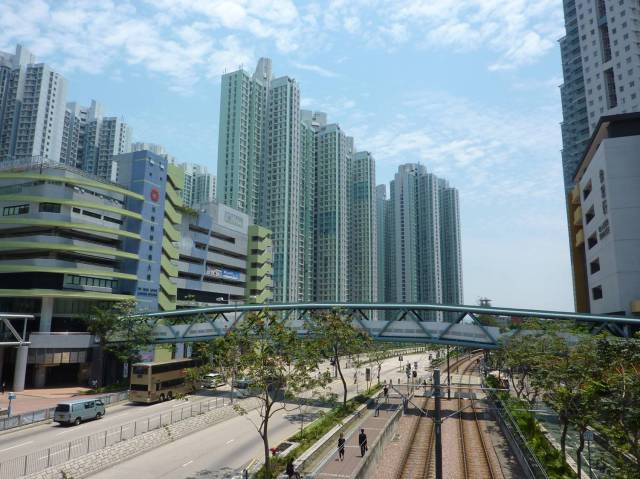
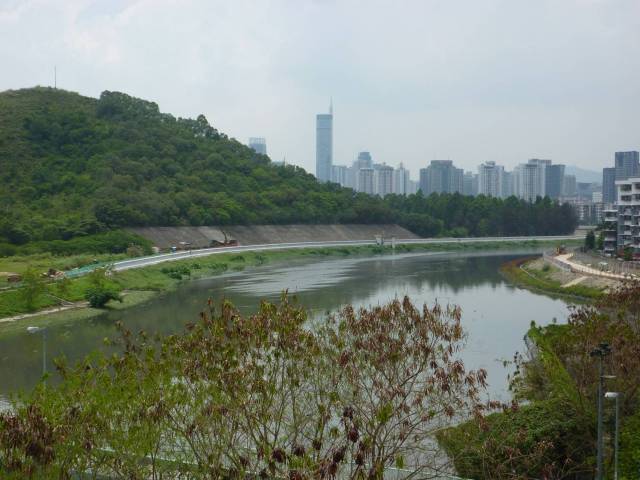
UTW1I used various examples from recent reading and thinking – Gastón Gordillo’s Landscapes of Devils: Tensions of Place and Memory in the Argentinean Chaco; Phil Steinberg and Rob Shields’s edited collection What is a City? Rethinking the Urban after Hurricane Katrina; the British Metropolitan police’s Territorial Support Group; and the Boko Haram attacks in Kano in January 2012 and the state response. All of these were indicative and not detailed, but as possible examples to develop in a fuller analysis. I also used a number of images from Hong Kong – the city of Tin Shui Wai in the New Territories (one example above), and the border between Hong Kong and Shenzhen (below).
UTWI’ll be talking more about all this at the AAG in Los Angeles in April 2013 – abstract here. There is also some relation to the ‘Secure the Volume’ paper I gave in Kentucky (video here) and Edinburgh earlier this year which is coming out in Political Geography next year.

Posted in Conferences, Gaston Gordillo, Henri Lefebvre, My Publications, Neil Brenner, Territory, urban/urbanisation | 8 Comments

Richard Sennett public lecture in Newcastle

banner_about

Richard Sennett – The Architecture of Cooperation, Thursday 13 December 2012, Architecture, Planning and Landscape Annual Lecture 2012, Newcastle University.

More details here. Details on the series as a whole here.

Posted in Conferences | Leave a comment

Collapse I-IV reprinting

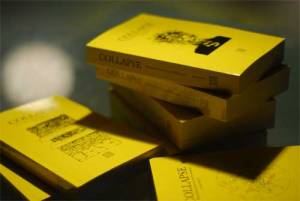
Untitled-1Collapse volumes I-IV are being reprinted. Details here.

Posted in Publishing | Leave a comment

Gregynog Ideas Lab II

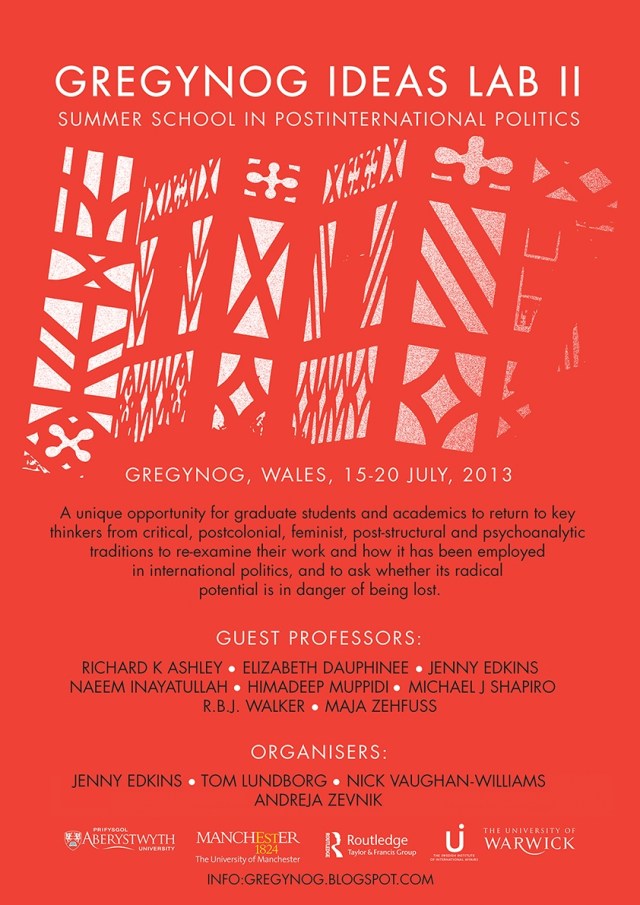
Details now available of the second Postinternational Politics summer school in Gregynog, Wales.

Gregynog

Posted in Conferences, Jenny Edkins | Leave a comment

Global Studies Association – call for papers

Please contact conference organizer Darren O’Byrne at D.OByrne@roehampton.ac.uk with any queries.

Global Studies Association

Annual Conference 2013

The Cosmopolitan Ideal: Challenges and Opportunities

Roehampton University, Wed 10th – Fri 12th July 2013

Keynote speakers (confirmed): Gerard Delanty (University of Sussex), Kate Nash (Goldsmith’s College, University of London)

Call for papers:

The conference aims to critically interrogate the idea of cosmopolitanism. Whereas previously cosmopolitanism was associated with (abstract) ideas of world citizenship and universal brotherhood, more recent constructions emphasize the multiplicity of identities, belongings, and memberships that are possible across a plurality of communities. In addition to a rejection of a narrow nationalistic outlook cosmopolitanism can claim a new political content: the idea of world citizenship has been given substance through notions of environmental responsibility, the universality of human and personhood rights, and the drive for worldwide human development. For these and many other reasons cosmopolitanism provides an important perspective on processes of globalization and the interconnectedness of the world.

The conference organizers invite proposals for papers which address themes of relevance to the conference, including:

·         The politics of cosmopolitanism

·         Cosmopolitanism, global civil society and human rights

·         Cosmopolitanism and identity

·         The cosmopolitan city

·         Cosmopolitan business practices and cross-cultural management

·         Critical cosmopolitanism

·         Cosmopolitan theory in global studies 

·         Cosmopolitanism and the media

Proposals for papers should take the form of a 300 word abstract and may be submitted on any aspect of the conference theme. The organisers will allocate papers to an appropriate panel. The deadline for submission of abstracts is April 30 2013. Please send to conference organizer Darren O’Byrne at D.OByrne@roehampton.ac.uk 

Conference registration:

Costs: Full registration £175 (includes accommodation, lunch and other refreshments, and conference fee).  Discounted student registration £150. Conference dinner £40 extra for all delegates. Registration includes automatic GSA membership.  A conference webpage will go live shortly giving details of how to register. For updates and news visit the GSA webpage http://globalstudiesassoc.wordpress.com/

Posted in Conferences | Leave a comment

Film inspired by Paul Virilio’s Bunker Archaeology

Short film inspired by Paul Virilio’s Bunker Archaeology. I discuss this in the ‘Secure the Volume’ paper forthcoming in Political Geography. Thanks to Bradley Garrett for the link.

RUIN VALUE from robindegoede on Vimeo.

Posted in Paul Virilio | 2 Comments

Routledge books received

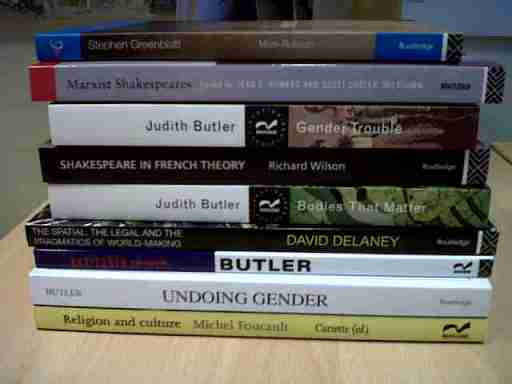
Routledge booksI did some review work for Routledge a while back. These are the books I received in recompense – mainly some Judith Butler books I’d read but didn’t own; some for the Shakespeare project; and David Delaney’s The Spatial, the Legal and the Pragmatics of World-Making.

Posted in Judith Butler, Michel Foucault, Stephen Greenblatt, William Shakespeare | Leave a comment