The New Ruralism…

urbanculturalstudies's avatarurbanculturalstudies

Henri Lefebvre did work in rural sociology before turning fully to urban matters (does the urban even exist ‘outside of’ the rural?)…

This new edited volume by Joan Ramon Resina and William R. Viestenz “The New Ruralism: An Epistemology of Transformed Space” seems to look at new stages in the dialectical relationship between the city and the country (mentioning Raymond Williams’ book by that title in its introduction) You can download the pdf of the introduction to The New Ruralism for free from the publisher’s site here.

Resina, Joan Ramon; Viestenz, William (eds.)
The New Ruralism: An Epistemology of Transformed Space.
Madrid / Frankfurt, 2012, Iberoamericana / Vervuert, 220 p., € 22.00
ISBN: 9788484896562
Presents new ways of understanding the old dichotomy city vs country in an effort to think through the epistemological and artistic implications of the modern antinomy’s demise, whereby the non-city ceases to be the city’s…

View original post 2 more words

Posted in Uncategorized | Leave a comment

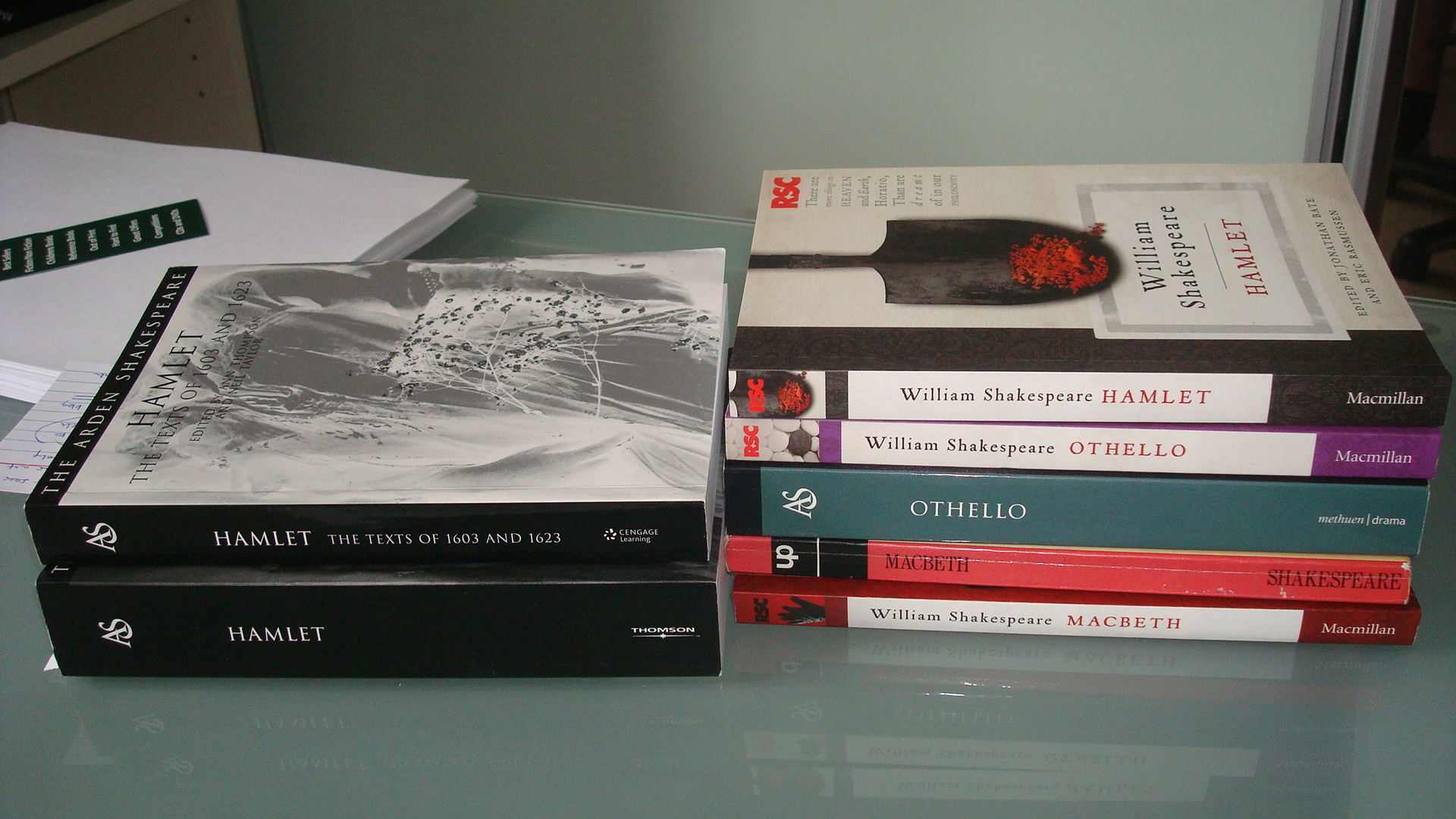
Recent Shakespeare reading

Working on my paper for Warwick in October. Hamlet, Macbeth and possibly something on Othello.

Posted in Shakespearean Territories, William Shakespeare | Tagged , , | Leave a comment

Open Access papers from Society and Space – Serres; Harman; Paglen; November, Camacho-Hübner & Latour; Doty, Adey & Bissell, Klauser, Blum & Secor, Woon, Brown & Rasmussen, Lisle…

Posted in Uncategorized | Leave a comment

European Integration and the Global Political Economy/Comparative European Politics prize

Prize for PhD students on European Integration and the Global Political Economy, with the journal Comparative European Politics – full details here.

Posted in Uncategorized | Leave a comment

‘How to Read Žižek’ by Adam Kotsko

In the Los Angeles Review of Books.

Posted in Slavoj Zizek | Leave a comment

London Group of Historical Geographers Seminar Series: Autumn 2012

Institute of Historical Research, University of London

Autumn 2012

 
TIME, MODERNITY & THE CITY

Guest Convenor: Mustafa Dikec

2 October 2012   James Nye (King¹s College, London)
 
The Tricky Business of Selling Time
 
16 October 2012           Peter Soppelsa (University of Oklahoma)
 
Stopping Time in Paris, 1830­1910
 
30 October 2012           Carlos Galvis (Royal Holloway, London)
 
Circles of Discontinuity: the Time of Railways and the Time of Cities, London & Paris 1860-1900
 
 13 November 2012        Charles Withers (University of Edinburgh)
 
The Prime Meridian, Metrology and the Internationalisation of Science, Space and Time

27 November 2012        Mustafa Dikeç (Royal Holloway, London)
 
Pumping Time: Temporal Infrastructures in Fin-de-siècle Paris
 
These seminars are held on Tuesdays at 5.15pm in the Torrington Room 104, South Block, Senate House, University of London (apart from 13 November when the venue is
Stewart House, STB8). For further details, or to have your name added to our e-mail list, please contact Felix Driver, Royal Holloway (f.driver@rhul.ac.uk) or Miles Ogborn, Queen Mary (m.j.ogborn@qmul.ac.uk). We are grateful to AHRC, Queen Mary, Royal Holloway, Kings, Birkbeck, UCL, LSE, University of Sussex, Open University and the IHR for supporting this seminar series.

Posted in Conferences | 2 Comments

IJURR review essay on Foucault and Geography

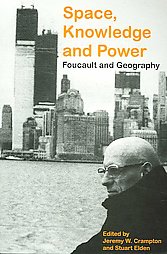
The latest issue of IJURR has a review essay on cities by Martina Löw that takes the Space, Knowledge and Power: Foucault and Geography collection that Jeremy Crampton and I edited as one of the three books under review.

The review is broadly appreciative though does make a small error. It suggests that

In 1976 Foucault addressed questions to the geographers of the French journal Hérodote, and they responded in an issue of the journal. However, the exchange did not appear in English until a translation was published in 1980. Members of the English-speaking community therefore read the interview only after having read Foucault’s works such as Discipline and Punish (1977) and The History of Sexuality (1978).

What actually happened was that Foucault was interviewed by the journal, for a piece that was indeed translated in 1980 for Colin Gordon’s Power/Knowledge collection – ‘Questions on Geography’. Foucault’s questions to the geographers (and some of the responses from Francophone geographers) were not translated until the collection under review. So while English-language readers had access to Foucault’s thoughts in 1980, they didn’t have access to his questions until 2007. It was making those questions, a selection of responses, and some new responses from English-language authors available that was the initial impetus behind this collection.

Posted in Jeremy Crampton, Michel Foucault, My Publications | Leave a comment

Interview with Alberto Toscano

Interesting interview with Alberto Toscano, which discusses his forthcoming co-authored book Cartographies of the Absolute, his previous work, and the state of universities today.

Posted in Alberto Toscano, Politics, Universities | Leave a comment

The State of the Field of Geography

Panel discussion on ‘The State of the Field of Geography’ at the Weatherhead Center for International Affairs, including Hashim Sarkis and Neil Brenner.

Posted in Conferences, Neil Brenner, Universities | Leave a comment

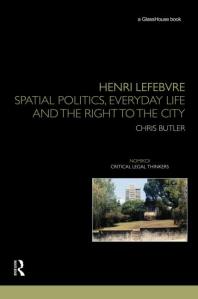
Chris Butler – Henri Lefebvre: Spatial Politics, Everyday Life and the Right to the City

Recently out with Routledge. Looks good, though shame about the price.

While certain aspects of Henri Lefebvre’s writings have been examined extensively within the disciplines of geography, social theory, urban planning and cultural studies, there has been no comprehensive consideration of his work within legal studies. Henri Lefebvre: Spatial Politics, Everyday Life and the Right to the City provides the first serious analysis of the relevance and importance of this significant thinker for the study of law and state power. Introducing Lefebvre to a legal audience, this book identifies the central themes that run through his work, including his unorthodox, humanist approach to Marxist theory, his sociological and methodological contributions to the study of everyday life and his theory of the production of space. These elements of Lefebvre’s thought are explored through detailed investigations of the relationships between law, legal form and processes of abstraction; the spatial dimensions of neoliberal configurations of state power; the political and aesthetic aspects of the administrative ordering of everyday life; and the ‘right to the city’ as the basis for asserting new forms of spatial citizenship. Chris Butler argues that Lefebvre’s theoretical categories suggest a way for critical legal scholars to conceptualise law and state power as continually shaped by political struggles over the inhabitance of space. This book is a vital resource for students and researchers in law, sociology, geography and politics, and all readers interested in the application of Lefebvre’s social theory to specific legal and political contexts.

Thanks to Nick Blomley for alerting me that this was now out.

Posted in Henri Lefebvre | 6 Comments