

The Pluto ones are for review work, and a couple of others are review copies. More interesting reading here.
The Pluto ones are for review work, and a couple of others are review copies. More interesting reading here.
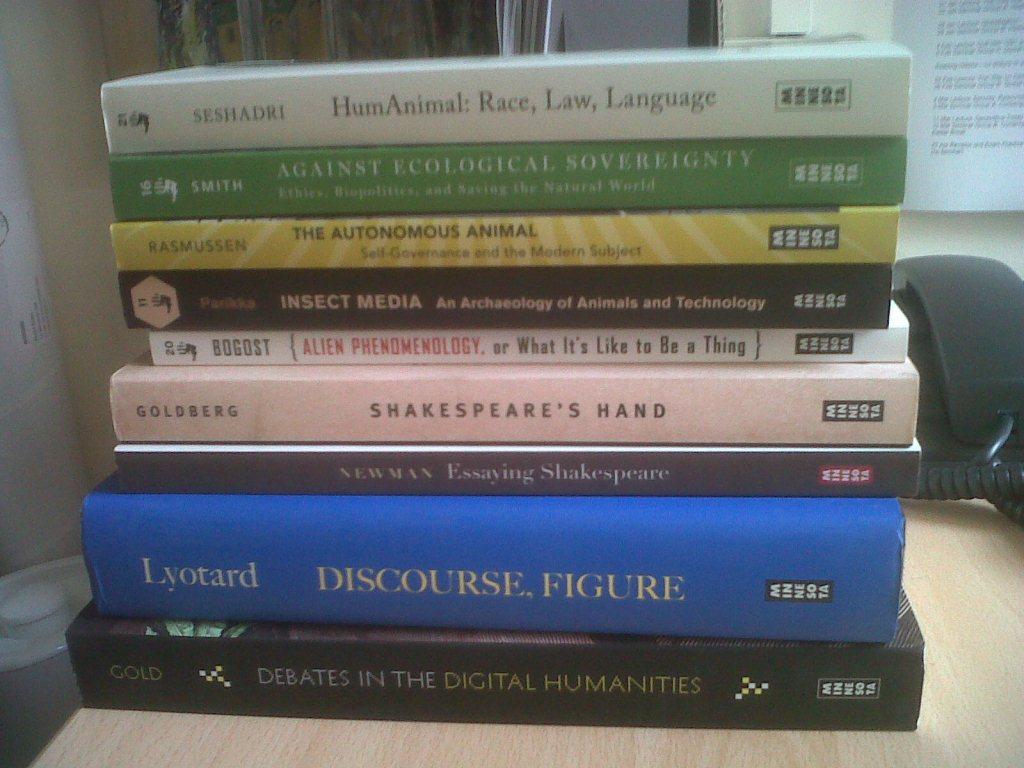
I did some review work for University of Minnesota Press – lots of nice new books received in recompense (plus two on order).
The Department of Geography is seeking to appoint a full-time Lecturer in Urban/Political Geography for a fixed-term of 3 years from 1 October 2012. The person appointed will undertake high quality research, provide excellent teaching across a range of modules and contribute to the administration of the Department.
Further details here. Please contact my colleague Ben Anderson if you have any questions.
Also in the Annals of the AAG (requires subscription) Alec Murphy has an interesting piece about questions of territory today.
The role of the territorial state has changed in recent decades in the wake of the communications revolution; the explosion of transnational social, political, and economic formations; accelerated mobility across international boundaries; and the inability of states to address pressing socioeconomic and environmental issues. Yet in the rush to document and assess the networks, flows, and relational spaces that are part of this shift, it is important not to overlook the continuing hold of modernist territorial ideas on the geographical imagination. Geographical writings on territoriality, spatial socialization, state-driven knowledge production, and regimes of territorial legitimation provide tools for understanding the power and inertia of modernist territorial ideas, which continue to influence patterns of identity and state practice in wide-ranging and significant ways. Contemporary interpretations of the doctrine of self-determination and its application in the Western Sahara case demonstrate that modernist ideas about territory continue to have far-reaching political and social consequences. It follows that any balanced assessment of the contemporary political–geographic order should not ignore the ways in which the continuing allure of territory articulates with the material and functional shifts that are challenging traditional political–territorial arrangements.
Jeremy Crampton has an interesting post at Open Geography about the links between Walter Christaller and Nazism. It begins with a link to an important paper by Trevor Barnes and Claudio Minca on Christaller and Carl Schmitt forthcoming in the Annals of the AAG (available online, but requires subscription) and then provides some discussion and links to a range of other geographers including William Bunge, Fred Schaefer and Richard Hartshorne. Jeremy has some interesting documentary material to add to the story.
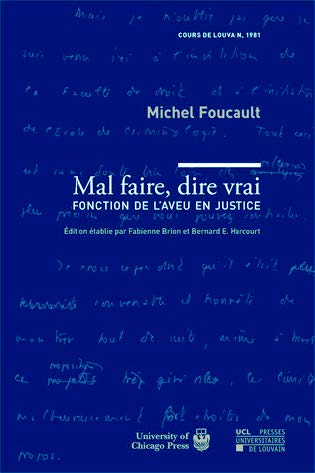 Clare O’Farrell has posted news of the publication of Foucault’s 1981 Louvain lectures – an English translation is forthcoming (details here).
I won’t repost all the information you can find on the Foucault News blog (or here), which includes the table of contents, with detail of each lecture, and reveals a couple of interviews have been added. Looks very exciting. You can order the book here.
Posts on writing seem to get quite a bit of interest here, so I’ll use classicist Mary Beard’s question to say a little more about this again.
In her TLS column, Beard asks ‘How many words can you write in a day?’ She quotes a friend who claims 500 words is as good as you can get – 500 words of “proper original academic writing” that is. Beard is trying for 1,000, which is partly a result of a deadline for the next project. I’ve discussed this question before (then in relation to Foucault), and also picked the 500 words as a notional figure. Part of the reason for that was that with a relatively small number of writing days a week it quickly added up to a substantial amount.
As I tried to clarify in a comment to that earlier post, the 500 words target is good, finished, polished, and properly footnoted text. I write, edit, rewrite, etc. multiple times. I’ve recently been working on my ‘Secure the Volume’ text – the lecture given in Kentucky and at the RGS, and destined for Political Geography. In over-writing the text I had for the two lectures I’ve filled in some of the things I said as I delivered it, added some comments and more extensive references, clarified a few things, elaborated a bit, changed the order of some of the sections, improved links, etc. I’ve been editing it for the past six days, and it’s increased in length from just over 8,000 words (the draft I circulated before the RGS for my discussants to read) to just over 11,000 words. That’s coincidently an increase of 500 words a day. But the 11,000 words are pretty polished, whereas what was circulated wasn’t, so much of the writing work isn’t visible in the crude numbers.
One other thought – I don’t get why people don’t count footnotes as they go. Journal articles, books, etc. are all inclusive words, because words mean pages, which is what journal editors need to plan for, and what book publishers use to calculate costs. So count the footnotes/references in the total – it all adds up.
For other inspiration, check out this site which collects the daily routines of famous writers – mentioned in the comments thread following Beard’s article. Some good stuff there. I don’t suggest you follow W.H. Auden!
Some of my other posts on writing include here (on mechanics), here (the Foucault related piece mentioned above) and here (some comments following that).
Also from Derek Gregory – some discussion of the arms trade, and lots of links, following from this powerful film clip.
Some discussion and lots of useful links here.
 At Boitempo (warning – contains spoilers). Thanks to David McInerney for the link.

