

Blog Stats
- 3,775,588 hits
-
Join 12.1K other subscribers
-
Recent Posts
- Mélanie Lamotte, By Flesh and Toil: How Sex, Race and Labor Shaped the Early French Empire – Harvard University Press, January 2026 and New Books discussion
- Stuart Hall Digital: Mediations of the Stuart Hall Archive
- Leonhard Emmerling, The Idiots: The History of the Homo Nullius – trans. Parnal Chirmuley, Seagull, 2026 and New Books discussion
- Michel Foucault, La Place de l’homme dans la pensée occidentale moderne: Cours de Tunis (1966-1967) – Seuil/Gallimard/EHESS, November 2026
- Mark Carrigan, The AI Crisis in Higher Education: A Strategic Proposal – University of Manchester, September 2026 (open access)
Archives
- October 2026
- September 2026
- August 2026
- July 2026
- June 2026
- May 2026
- April 2026
- March 2026
- February 2026
- January 2026
- December 2025
- November 2025
- October 2025
- September 2025
- August 2025
- July 2025
- June 2025
- May 2025
- April 2025
- March 2025
- February 2025
- January 2025
- December 2024
- November 2024
- October 2024
- September 2024
- August 2024
- July 2024
- June 2024
- May 2024
- April 2024
- March 2024
- February 2024
- January 2024
- December 2023
- November 2023
- October 2023
- September 2023
- August 2023
- July 2023
- June 2023
- May 2023
- April 2023
- March 2023
- February 2023
- January 2023
- December 2022
- November 2022
- October 2022
- September 2022
- August 2022
- July 2022
- June 2022
- May 2022
- April 2022
- March 2022
- February 2022
- January 2022
- December 2021
- November 2021
- October 2021
- September 2021
- August 2021
- July 2021
- June 2021
- May 2021
- April 2021
- March 2021
- February 2021
- January 2021
- December 2020
- November 2020
- October 2020
- September 2020
- August 2020
- July 2020
- June 2020
- May 2020
- April 2020
- March 2020
- February 2020
- January 2020
- December 2019
- November 2019
- October 2019
- September 2019
- August 2019
- July 2019
- June 2019
- May 2019
- April 2019
- March 2019
- February 2019
- January 2019
- December 2018
- November 2018
- October 2018
- September 2018
- August 2018
- July 2018
- June 2018
- May 2018
- April 2018
- March 2018
- February 2018
- January 2018
- December 2017
- November 2017
- October 2017
- September 2017
- August 2017
- July 2017
- June 2017
- May 2017
- April 2017
- March 2017
- February 2017
- January 2017
- December 2016
- November 2016
- October 2016
- September 2016
- August 2016
- July 2016
- June 2016
- May 2016
- April 2016
- March 2016
- February 2016
- January 2016
- December 2015
- November 2015
- October 2015
- September 2015
- August 2015
- July 2015
- June 2015
- May 2015
- April 2015
- March 2015
- February 2015
- January 2015
- December 2014
- November 2014
- October 2014
- September 2014
- August 2014
- July 2014
- June 2014
- May 2014
- April 2014
- March 2014
- February 2014
- January 2014
- December 2013
- November 2013
- October 2013
- September 2013
- August 2013
- July 2013
- June 2013
- May 2013
- April 2013
- March 2013
- February 2013
- January 2013
- December 2012
- November 2012
- October 2012
- September 2012
- August 2012
- July 2012
- June 2012
- May 2012
- April 2012
- March 2012
- February 2012
- January 2012
- December 2011
- November 2011
- October 2011
- September 2011
- August 2011
- July 2011
- June 2011
- May 2011
- April 2011
- March 2011
- February 2011
- January 2011
- December 2010
- November 2010
- October 2010
- September 2010
- August 2010
- July 2010
- June 2010
- May 2010
- April 2010
Categories
- Achille Mbembe
- Adam David Morton
- Adam Tooze
- Adrian Johnston
- Adriana Cavarero
- Adriano Prosperi
- Alain Badiou
- Albert Camus
- Alberto Toscano
- Alexander B. Murphy
- Alexandre Kojève
- Alexandre Koyré
- Allen Scott
- Alphonso Lingis
- André Leroi-Gourhan
- Andreas Knichen
- Andrew Barry
- Andy Merrifield
- Ann Laura Stoler
- Anthony Giddens
- Antoine Meillet
- Antonio Gramsci
- Antonio Negri
- Arlette Farge
- arundhati roy
- Ash Amin
- Aurel Stein
- Axel Honneth
- Étienne Wolff
- Babette Babich
- Baldus de Ubaldis
- Bartolus of Sassoferrato
- Baruch Spinoza
- Bernard E. Harcourt
- Bernard Stiegler
- Bill Martin
- Bob Jessop
- Bogislaw Philipp von Chemnitz
- Books
- Boris Porshnev
- Boundaries
- Bradley Garrett
- Bruno Latour
- C.L.R. James
- Canguilhem (book)
- Caren Kaplan
- Carl Schmitt
- Carlo Ginzburg
- Catherine Malabou
- China Mieville
- Chris Philo
- Christian Parenti
- Clarence J. Glacken
- Claude Lévi-Strauss
- Claude Lefort
- Claude Raffestin
- Clémence Ramnoux
- Colin Gordon
- Conferences
- Cornel West
- Couze Venn
- Cricket
- Cycling
- Daniel Defert
- Daniel Heller-Roazen
- David Byrne
- David Campbell
- David Farrell Krell
- David Harvey
- David Lachterman
- David N. Livingstone
- Deborah Cowen
- Derek Gregory
- Derek Parfit
- Didier Eribon
- Don Mitchell
- Doreen Massey
- E. P. Thompson
- Ebola
- Edgar Allan Poe
- Edmund Husserl
- Eduardo Mendieta
- Edward Casey
- Edward Gibbon
- Edward Said
- Edward Soja
- Elizabeth Grosz
- Ellen Meiksins Wood
- Emile Benveniste
- Emmanuel Levinas
- Engin Isin
- Enrique Dussel
- Eric Hobsbawm
- Ernesto Laclau
- Ernst Cassirer
- Ernst Kantorowicz
- Erwin Panofsky
- Etienne Balibar
- Eugen Fink
- Events
- Eyal Weizman
- Felix Guattari
- Ferdinand de Saussure
- Fernand Braudel
- Football
- Fossils
- Foucault's Last Decade
- Foucault: The Birth of Power
- François Delaporte
- François Ellenberger
- Francisco de Vitoria
- Franco Moretti
- Frantz Fanon
- Franz Kafka
- Fredric Jameson
- Friedrich Engels
- Friedrich Nietzsche
- Friedrich Wilhelm Joseph Schelling
- Gaston Bachelard
- Gaston Gordillo
- Geographica Helvetica
- Georg Lukács
- Georg Wilhelm Friedrich Hegel
- George Lawson
- Georges Bataille
- Georges Canguilhem
- Georges Dumézil
- Giacomo Marramao
- Gilles Deleuze
- Gillian Rose
- Giorgio Agamben
- Giovanni Botero
- Gottfried Leibniz
- Graham Harman
- Grégoire Chamayou
- Gunnar Olsson
- Guy Debord
- H.P. Lovecraft
- Haim Yacobi
- Hannah Arendt
- Hélène Legotien
- Henri de Boulainviller
- Henri Lefebvre
- Herbert Marcuse
- Horace Kallen
- Hugo Grotius
- Ian Bogost
- Ian Hacking
- Immanuel Kant
- Institute of Advanced Study
- Irnerius
- Isaac Newton
- Isabelle Stengers
- Italo Calvino
- J.G.A. Pocock
- Jacob Klein
- Jacob Taubes
- Jacques Derrida
- Jacques Lacan
- Jacques Rancière
- Jakob von Uexküll
- James Harrington
- Jane Bennett
- Jürgen Habermas
- jean baudrillard
- Jean Bodin
- Jean Cavaillès
- Jean de Menasce
- Jean Gottmann
- Jean Hyppolite
- Jean Jacques Rousseau
- Jean Wahl
- Jean-Luc Nancy
- Jean-Paul Sartre
- Jeff Malpas
- Jeffrey Jerome Cohen
- Jenny Edkins
- Jeremy Bamber
- Jeremy Bentham
- Jeremy Crampton
- Jodi Dean
- Johannes Althusius
- Johannes Hertius
- John Agnew
- John Locke
- John Protevi
- John Rawls
- John Sallis
- John Urry
- Jonathan Simon
- Journal of Urban Cultural Studies
- Judith Butler
- Julia Kristeva
- Juliet Fall
- Karl Jaspers
- Karl Marx
- Klaus Theweleit
- Kostas Axelos
- Lauren Berlant
- Léopold Lambert
- Lee Braver
- Levi Bryant
- Louis Althusser
- Louise Amoore
- Luce Irigaray
- Lucien Febvre
- Lucien Gerschel
- Ludwig Binswanger
- Luiza Bialasiewicz
- Maja Zehfuss
- Manuel deLanda
- Mapping Indo-European Thought in Twentieth Century France
- Mapping the Present
- Marc Bloch
- Marc Crépon
- Marcel Detienne
- Marcel Mauss
- Marie-Eve Morin
- Marie-Madeleine Davy
- Mark Neocleous
- Martin Heidegger
- Martin Luther
- Mary Beard
- Massimo Cacciari
- Matthew Hannah
- Matthias Stephani
- Maurice Blanchot
- Maurice Merleau-Ponty
- Maximilien Robespierre
- Medieval Studies
- Mehdi Belhaj Kacem
- Michael Dillon
- Michael Hardt
- Michael Mann
- Michael Watts
- Michel Foucault
- Michel Serres
- Mircea Eliade
- Music
- My Publications
- Naomi Klein
- Nathan Widder
- Neil Brenner
- Neil Smith
- Niccolò Machiavelli
- Nicholas Blomley
- Nicholas of Cusa
- Nicos Poulantzas
- Nigel Thrift
- Nina Power
- Noam Chomsky
- Novels read
- Paolo Virno
- Paul Veyne
- Paul Virilio
- People
- Peter Brown
- Peter Gratton
- Peter Hallward
- Peter Sloterdijk
- Philip Steinberg
- Philipp Melanchthon
- Pierre Bourdieu
- Pierre Hadot
- Pierre Klossowski
- Pierre Macherey
- Politics
- Publishing
- Quentin Meillassoux
- Quentin Skinnner
- Ralph Miliband
- Ray Brassier
- Raymond Ruyer
- Raymond Williams
- Reinhart Koselleck
- Remarkable Research
- René Descartes
- René Girard
- Revista Urban
- Robert Filmer
- Roberto Esposito
- Roger Caillois
- Roland Barthes
- Roman Jakobson
- Samuel Pufendorf
- Sara Ahmed
- Saskia Sassen
- Setha Low
- Shakespearean Territories
- Sigmund Freud
- Simon Critchley
- Simon Schama
- Simone de Beauvoir
- Simone Weil
- Slavoj Zizek
- Society and Space
- Speaking Against Number
- Stanley Cavell
- Stefanos Geroulanos
- Stephen Graham
- Stephen Greenblatt
- Stuart Hall
- Sunday Histories
- Suzanne Bachelard
- T.S. Eliot
- Tariq Ali
- teaching
- terrain
- Territory
- Terror and Territory
- Terry Eagleton
- The Archaeology of Foucault
- The Birth of Territory
- The Early Foucault
- The Space of the World
- Theodor Reinking
- Theory
- Theory, Culture and Society
- Thomas Hobbes
- Thomas Pynchon
- Timothy Morton
- Travel
- Trevor Paglen
- Tristan Garcia
- Troy Davis
- Udalricus Zasius
- Umberto Eco
- Uncategorized
- Understanding Henri Lefebvre
- Universities
- urban/urbanisation
- Vladimir Nabokov
- Walter Benjamin
- Walter Ralegh
- Wendy Brown
- William E Connolly
- William Shakespeare
- Writing
- Wu Ming
Meta
-
Douglas Kellner interview at Figure/Ground
Interesting and wide-ranging interview here
Posted in Uncategorized
Leave a comment
Mark Purcell on writing – I do the “re-read yesterday’s writing” thing first off, but sometimes end up spending most of the time adding, editing, cutting that, rather than forging ahead. But I do think it’s invaluable as means of picking up the threads from what came before. That said, I rarely write in a simple linear fashion.

I just ran across this post on writing, via Progressive Geographies. One of the things I found worth noting was Simone de Beauvoir‘s comment that before she began writing she spent a half hour reading over what she wrote the day before. I guess this is just common sense, and maybe everyone who writes seriously does this out of habit, but since I tend to be impatient, over-eager to start producing when I sit down, I fail to practice this good habit more often than not. I am going to try to do better.
A more theoretical point comes from the discussion between Jonathan Lethem and Paul Auster:
JL: For me, five or six hours of writing is plenty. That’s a lot. So, if I get that many hours the other stuff feels satisfying. The other stuff feels like a kind of grace. But if I…
View original post 243 more words
Posted in Uncategorized
Leave a comment
Object-Orientated Literary Criticism
In the latest issue of New Literary History, Graham Harman, Timothy Morton and Jane Bennett discuss object-orientated literary criticism.
Harman’s piece begins with an overview of his approach, which is a useful starter for those unfamiliar, but moves into criticism of other literary approaches including New Historicism and Deconstruction. One short passage:
The call for “the death of the author” needs to be complemented by a new call for “the death of the culture.” Rather than emphasize the social conditions that gave rise to any given work, we ought to do the contrary, and look at how works reverse or shape what might have been expected in their time and place, or at how some withstand the earthquakes of the centuries much better than others. To call someone “a product of their time and place” is never a compliment; neither should it be a compliment when aimed at a literary work.
[Update: While the pieces are subscription only, they have been uploaded here.]
Łukasz Stanek – Henri Lefebvre on Space
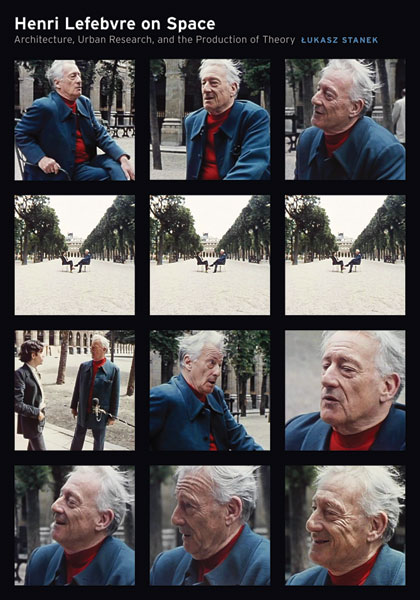 I finally got round to reading Łukasz Stanek, Henri Lefebvre on Space: Architecture, Urban Research, and the Production of Theory, which has been out for a little while. The book is extremely well researched, and filled with interesting discoveries from archives and through interviews. The key addition the book provides is to ground Lefebvre’s work on space and the urban in the empirical work he was involved with in architecture and urban planning. This adds a valuable counterbalance to work that seeks to understand Lefebvre’s theories on space in their conceptual and historical context. I don’t agree with the claim on the backcover of the book that the “prevailing view… reduces Lefebvre’s theory of space to a projection of his philosophical position”. My sense is that the attempt to see his theory of space as philosophically grounded – something I attempted in my Understanding Henri Lefebvre – is far from dominant and not discussed nearly as much as it should. I think much work on Lefebvre sees his claims as operating without any context – historical, political, empirical or conceptual. In my book I tried to show how the work on space developed out of two key strands – his work on the urban and the rural (the latter largely neglected in anglophone debates, though Nick Entrikin has done some interesting work on this); and his philosophical work. Stanek provides a major contribution to the understanding of the first of these, but I see them as complementary, rather than opposed, contextualisations.
One of the most interesting bits of the book is in the closing few pages, when Stanek discusses a manuscript Lefebvre wrote entitled Vers une architecture de la jouissance in 1973 – immediately before The Production of Space. Stanek is editing this manuscript for publication, and it is likely to be a really important addition to what we know of Lefebvre’s work in this field.
Posted in Henri Lefebvre
3 Comments
Heidegger and Schmitt correspondence (again)
Twenty-five years after they first published it, Telos are again highlighting the letter Martin Heidegger sent to Carl Schmitt in August 1933. The point of the letter was to thank Schmitt for sending a copy of The Concept of the Political. After praising the reading of Heraclitus, Heidegger signifies he doesn’t have time to further comment on the text, making the quip that “But now I myself am in the middle of polémios [war] and all literary projects must take second place”.
In the 25th anniversary commentary on this piece, Juan Carlos Donado discusses the piece, and makes something of the notion of ‘war’. Given the year, that Heidegger was then Chancellor of Freiburg, a political post, and had recently joined the Nazi party, this is significant – he is describing his political actions as ‘war’. Or so we would be led to believe.
Except Heidegger doesn’t say ‘war’ – that’s the translator’s additional gloss. And he actually says pólemos and not polémios.
The term Schmitt uses as the Greek notion of enemy is polémios – is this the reason for the translator error? Heidegger says pólemos. Given what Schmitt makes of this notion there appears to be a relation at stake.
Donado says the fuller discussion of the fragment can be found in the 1934-35 course on Hölderlin. There is a discussion there, as there is in multiple courses, but the key discussion of the notion of polemos, in this fragment of Heraclitus, actually comes in an earlier course from 1933-34 – contemporaneous with the letter and the political involvement. [This has been published as Sein und Wahrheit (GA36/37), recently translated by Gregory Fried and Richard Polt as part of the Being and Truth volume – German pages 90-1; English 72-73.]
Heidegger says that the standard rendering of polemos is as “Krieg, Kampf [war, struggle]”, but then goes on to clarify what he thinks it means: “This does not mean the outward occurrence of war and the celebration of what is ‘military’, but rather what is decisive: standing against the enemy. We have translated this word with ‘Kampf [struggle]'”. Heidegger goes on to clarify how he means this to be understood – not as competitive, friendly, struggle – agon; “but rather the struggle of polemos, war”. So he brings ‘war’ back in, but only to clarify what he understands by Kampf. He links it to his notion of an Auseinandersetzung – a setting-apart-from-another – and notes it is directed against an enemy, though his enemy is not named.
Indeed, Heidegger more commonly sees polemos as Kampf, struggle. He translates it that way in the 1934-35 course on Hölderlin (GA39, 125) and in the 1935 course An Introduction to Metaphysics understands polemos as Kampf, as Streit [strife], and says it is “not war in the human sense” (GA40, 47, etc.).
Obviously, enemies, struggle etc. link to some deeply unpleasant connotations – Schmitt with the first; Hitler with the second. It remains crucial to think through and work through Heidegger’s politics. But being critical of his political involvement requires more careful reading than this poorly researched piece. Fortunately the original Telos publication is bilingual, with the German text in a note, so we can see what Heidegger actually wrote, although I suspect relatively few would check.
[This draws on the discussion in my Speaking Against Number, pp. 84-85, updated in relation to the publication of Being and Truth]
Environment and Planning A theme issue on Future Geographies
Posted in Uncategorized
Leave a comment
Mark Purcell on Lefebvre’s spatial revolution

Another excerpt from my book, which is now “in press,” on Henri Lefebvre’s understanding of revolution…
For Lefebvre the political project of autogestion and democracy is always also a project to transform the way we produce and use space. He imagines politics to always be spatial, as for example when he imagines a transition from the industrial city to urban society. In The Production of Space he sets out the more general project of moving from “abstract space” to “differential space” (see also The Urban Revolution, pp. 37, 125-127) The former is a space “determined economically by capital, dominated socially by the bourgeoisie, and ruled politically by the state” (Production of Space, p. 227). It is a space of domination that has been expropriated and alienated from users and is controlled by a heteronomous elite. Abstract space reduces space to its economic function as either a means…
View original post 397 more words
Posted in Uncategorized
Leave a comment

