Peter Gratton – Spinoza and the Biopolitical Roots of Modernity audio available

The audio recording of Peter Gratton’s talk ‘Spinoza and the Biopolitical Roots of Modernity’ at UWS is now available (from here, via’s Peter’s blog).

Peter Graton Presenting His Paper

Abstract: Much has been written about bio-political sovereignty in the wake of Giorgio Agamben’s work, which relies, at least in the first volume of Homo Sacer, on Carl Schmitt’s transcendental account of sovereignty. I will argue, however, that Foucault and Arendt rightly identify what Derrida once called the “changing shape and place of sovereignty” in modernity, which for them is horizontal and disseminated within a presupposed nation. For this reason, we will look to the source of modern philosophical immanentism, Spinoza, to show that he is not extrinsic to this modern bio-politics, and demonstrates how the sovereign exception and its nationalized version work hand-in-glove in the era of which he was a part. In this way, we argue that it is Spinoza’s political theology, not Schmitt’s, that is the better pass-key to what Foucault and Arendt identify as biopolitical. By doing so, I put in tension two trends in recent Continental philosophy–philosophical vitalism and the critique of biopolitics–while raising questions about the use of political, if not ontological, forms of immanence.

Bio: Peter Gratton is a professor of Philosophy at the Memorial University of Newfoundland. He has published widely in political, Continental, and intercultural philosophy and is the author of The State of Sovereignty: Lessons from the Political Fictions of Modernity (SUNY Press, 2012) and Speculative Realism (Continuum, forthcoming). Co-Editor of the influential interdisciplinary journal Society and Space, executive board member of the North American Sartre Society and other national philosophical societies, and area editor for Africana philosophy for the Internet Encyclopedia of Philosophy, Peter has also edited Traversing the Imaginary (Northwestern University Press, 2007), co-edited with John Mannousakis, and Jean-Luc Nancy and Plural Thinking: Expositions of World, Politics, Art, and Sense (SUNY Press, 2012), co-edited with Marie-Eve Morin. Peter is currently a Research Fellow in the Humanities Centre at Australia National University.

Posted in Baruch Spinoza, Carl Schmitt, Conferences, Giorgio Agamben, Hannah Arendt, Jacques Derrida, Michel Foucault, Society and Space | 2 Comments

Leiden Journal of International Law theme section on Foucault – currently free online.

Clare O'Farrell's avatarFoucault News

Leiden Journal of International Law, Volume 25, Issue 03, September 2012

Special section on Foucault. For a limited period to mark the 29th anniversary of the journal this issue is available free online

On the Uses of Foucault for International Law
TANJA AALBERTS and BEN GOLDER
pp 603-608

In Praise of Description
ANNE ORFORD
pp 609-625

On Foucault and Wolff or from Law to Political Economy
MATT CRAVEN
pp 627-645

‘The Life of Individuals as well as of Nations’: International Law and the League of Nations’ Anti-Trafficking Governmentalities
STEPHEN LEGG
pp 647-664

Targeted Killing and Its Law: On a Mutually Constitutive Relationship
SUSANNE KRASMANN
pp 665-682

View original post

Posted in Uncategorized | Leave a comment

Journal of Urban Cultural Studies – website and call for papers

The Journal of Urban Cultural Studies will be published by Intellect, and has a website here. The subscription price is low, and authors can opt for open access at a price – but one that is considerably lower than many of the big publishers. The journal has a linked blog, and this is the call for papers:

The Journal of Urban Cultural Studies is a new peer-reviewed publication cutting across both the humanities and the social sciences in order to better understand the culture(s) of cities. The journal is open to studies that deal with culture, urban spaces and forms of urbanized consciousness the world over.

Although we embrace a broad definition of urban cultural studies, we are particularly interested in submissions that give equal weight to: a) one or more aspects of urban studies (everyday life, built environment, architecture, city planning, identity formation, transportation…) and b) analysis of one or more specific forms of cultural/textual production (literature, film, graphic novels, music, art, graffiti, videogames, online or virtual space…) in relation to a given urban space or spaces.

Essays of 7,000-10,000 words (including works cited and notes) should be sent by attachment to the Editor at urbanculturalstudies@gmail.com. JUCS is also open to proposals of special issues by guest editors working individually or in teams of two. All citations in other languages should be translated into English for the journal’s international reading public, in addition to including the original text.

While the journal does not publish book reviews, we do publish review essays—which should discuss 3-5 recent books on a shared topic or theme (or place) and run from 2,500 to 4,000 words. Review essays of urban-themed installations or other works of art are also welcome. These essays will be reviewed in house. Given our visual focus, we are interested in original, unpublished artwork on the topic of cities and in publishing articles accompanied by images where appropriate.

We encourage a variety of approaches to the urban phenomenon—the strengths of the editorial board run from urban geography to literature and film, photography and videogames, gender and sexuality, creative economy, popular music, Marxist approaches, fashion, urban planning, anthropology, sociology, Deaf culture, built environment, philosophy, architecture, detective fiction and noir, and more…

Posted in Journal of Urban Cultural Studies, Publishing | Leave a comment

Eyal Weizman ‘Forensic Architecture’. Video of the Society and Space 30th anniversary lecture now available.

Posted in Uncategorized | Leave a comment

Walney to Wear – coast-to-coast cycle route

Susan and I spent the last few days cycling one of the coast-to-coast routes – from Walney Island in the Irish Sea to the point in Sunderland where the Wear reaches the North Sea (details here). We did some preparation beforehand – both bikes had been serviced, and we had spare inner tubes, small repair kit, etc. As I cycle much more than Susan I was carrying our stuff in panniers.

Day One

We cycled to Durham train station to get the train to the start. Durham-Newcastle, Newcastle-Carlisle, Carlisle-Lancaster, Lancaster-Barrow-in-Furness. Taking bikes on trains ought to be a lot easier than this. We are doing it for a holiday, but lots of people do this to commute. Staff were friendly enough, but spaces are very limited or non-existent and they do get in the way.

When we arrived in Barrow-in-Furness we were about two miles from the start on Walney Island, and the B&B we were staying in was a further mile out of town along the route. In part to make an early start, instead of having to double back, we cycled down to the sea, dipped our wheels in the water, and back out to the B&B that evening. We’d been watching the weather forecast and there was very heavy rain coming in around lunchtime so we wanted to make an early start the next day.

16.1 miles, 3 miles of the actual route

Day Two

We started about 8.30am, and made good progress to Ulverston, Cartmel and Grange-over-Sands. This is just south of the Lake District National Park, and hilly, so we climbed and then descended most of the day, including back down to sea level three times. At Grange-over-Sands we had lunch quickly as the rain was starting, and changed into rain gear. The rain became really heavy, and we missed a right turn just before Witherslack, and ended up a bit lost. (The Sustrans map we had with us had detailed map of Kendal printed right on top of the area we were in—it’s a route map rather than an area map, and we were off the route, but this wasn’t very helpful.) While we were able to find our way to the place we were staying at Natland near Kendal, the detour added a few miles onto the route. And they were very hilly ones, taking us up to Underbarrow and then though Kendal instead of just to the south of it.

By the time we arrived we were soaked. The camera got damp and took a few days to dry out. One of the least pleasant parts of the ride was the liquified cow and sheep shit on the roads that flew up as a spray. Fortunately Sue at the West Barn B&B was really kind, washing and drying our clothes and really taking care of us. Despite only being a mile off the route, she’s not had any cyclists stay before. Highly recommended – the place was lovely and the food absolutely wonderful.

44.3 miles, 38 miles of the actual route, 2707m ascent, 2625m descent

Day Three

It was raining again the next morning, but we wanted to get going, so we started just after 9am. Lots more climbing, but fewer descents. After Beck Foot we were cycling past Howgill Fells in the Yorkshire Dales National Park. This should have had some of the best views, but visibility was very poor with low clouds. Just as the rain stopped, we had to slow down to pass a farmer who was cutting his hedges with a tractor. The road was strewn with debris, including thorns, and just after we got onto the A685 for a stretch before Tebay Susan had a flat tyre.

I got the tyre off and switched the inner tube for the spare. But I couldn’t get any air into the tyre at all—as soon as air went in, it went out. There was something wrong with the valve. My spare tube had a Schrader valve rather than Susan’s Presta, but the hole in her wheel was too small to take it. So I patched the first tube. We could get air into this, but not much, no matter how we pumped. The small hand pump was proving completely useless, partly because when the tip was reversed for the Presta valve it wasn’t forming a good seal. Despite being on the coast-to-coast route, we didn’t see any cyclists for a while, so in the end were forced to call a taxi. There were no bike shops in the nearby towns, so Susan went back to Kendal to get a new pump and some spare tubes while I waited with the bikes. No sooner had we got a taxi on its way that a police car stopped to see if they could help (he couldn’t, but confirmed the pump was useless), and we saw some cyclists. It was well past lunchtime by this point, so once fixed we went on to Orton to get some food. We wanted to get going again quite quickly, but on leaving the pub discovered Susan’s other tyre was now flat, again from thorns. With a decent pump we fixed this quite quickly, only to have another flat on her bike to fix about five miles down the road. We got to Kirkby Stephen much later than we’d hoped, and it was a long way until the next place to stay, so we called it a night.

33.6 miles, all on the route, 1499m ascent, 1360m descent

Day Four
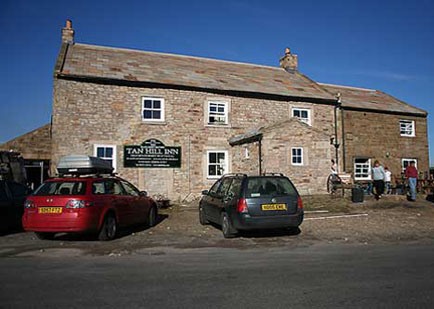
The first eleven miles were all uphill, to the highest point on the ride at the Tan Hill Inn on Stonesdale Moor. The next couple of miles were easy downhill, but then we had to turn off the main road onto an unsealed road. I found this really tough going, with the heavily-laden bike hard to manoeuvre at speed through the potholes and across the stones and gravel. The bike was taking a real battering on this. Around Sleighholme Farm my back tyre went with a loud bang. I switched the inner tube okay, but the tyre wall was burst with the tube clearly visible. We used plastic tape to seal it as best we could, and kept the tyre very lightly inflated so as not to burst again, and struggled on to Bowes. Bowes felt like a ghost town—the pub only opened in the evenings or for pre-bookings; the post office was shut; there were no shops that we found. We did see a cyclist who suggested calling Spitfire Cycles in nearby (7 miles) Barnard Castle. They were really helpful, and actually drove out to us with a new tyre which was quickly fitted. He recommended a really nice place in Barnard Castle for lunch—The Nest—which is also a gallery and studio.

At Barnard Castle the route splits, with a northern branch through Hamsterley Forest, and a less hilly southern one through Bishop Auckland. We took the southern one, and reached Bishop around 5pm. We’d done quite a lot of miles already but Bishop is only about 10 miles from our home, so we didn’t feel like staying that close. We carried on to the outskirts of Durham, but the rain was starting again, and we had to stop for another flat on Susan’s bike, so at Brandon I left Susan with her bike and the panniers in a pub and cycled home to pick her up in the car. I knew I’d be faster that way, and we’d pick up the route the next day.

53 miles Susan, 61.5 miles me, 53 miles on the route, 1840m ascent, 1835m descent

Day Five

An easy last day – back out to the route near Durham, and across to Sunderland. The route ends on a path at the edge of the shore, but we went down to the water, and then out to a lighthouse at the end of the pier.
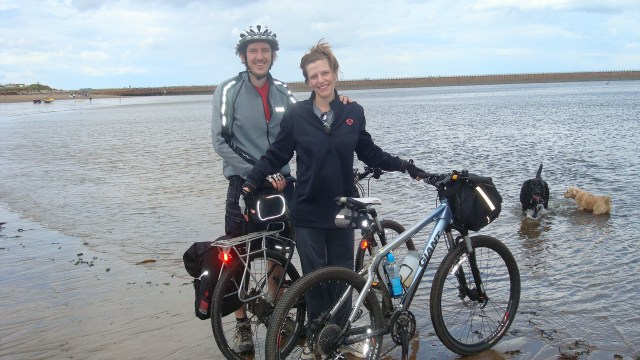
We got the train back to Durham, and I cycled home to get the car. Last job – giving the bikes a really good clean.

26.92 miles Susan, all on the route, 33.64 miles me, 828m ascent, 886m descent

Posted in Cycling, Travel | 2 Comments

Holiday

I’m off on holiday for a week. I’m planning on being completely offline, so there will be no posts here in that time. I’ve just realised that 1,000 people subscribe to this blog in some form (email, facebook, twitter, or Google Reader). I’m sure there is some duplication there, but that’s far above what I ever imagined, and I have no idea who most of you are or how you ended up here. Very many thanks for reading and there will be more when I return.

Posted in Uncategorized | Leave a comment

Space, geometry and the imagination – conference in Berlin

In the comments to the Leibniz post, Felix Driver writes

On a quick search, incidentally, I came across this interesting-looking conference on “Space, geometry and the imagination” at the Max Planck later this month at which Farinelli is speaking – see http://www.mpiwg-berlin.mpg.de/PDF/2012-08-27%20Space.pdf – if anyone is going, it would be good to see a report somewhere.

I’ve reposted here as it does look interesting and may be of more general interest – and more likely to be seen as a post rather than in comments.

Posted in Uncategorized | Leave a comment

Leibniz and Geography references

Thanks for the comments on the previous post on this. As a couple of people asked, I’ve uploaded the bibliography for the paper. It’s not a reading list on the topic, because there are things referenced that are not directly on either Leibniz, geography or both, but it is a list of everything currently referenced in the draft paper.

Posted in Gottfried Leibniz | Leave a comment

Society and Space Vol 30 No 4 now out

Posted in Uncategorized | Leave a comment

Harman, Morton and Bennett papers now available

The Harman, Morton and Bennett papers I mentioned yesterday on Object-Orientated literary criticism have been uploaded here.

Posted in Graham Harman, Jane Bennett, Timothy Morton | 1 Comment