Beyond Walls and Cages

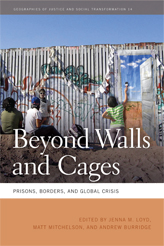
Important collection forthcoming later this year, edited by Jenna M. Loyd, Matt Mitchelson, and my Durham IBRU colleague Andrew Burridge.

The crisis of borders and prisons can be seen starkly in statistics. In 2011 some 1,500 migrants died trying to enter Europe, and the United States deported nearly 400,000 and imprisoned some 2.3 million people—more than at any other time in history. International borders are increasingly militarized places embedded within domestic policing and imprisonment and entwined with expanding prison-industrial complexes. Beyond Walls and Cages offers scholarly and activist perspectives on these issues and explores how the international community can move toward a more humane future.

Working at a range of geographic scales and locations, contributors examine concrete and ideological connections among prisons, migration policing and detention, border fortification, and militarization. They challenge the idea that prisons and borders create safety, security, and order, showing that they can be forms of coercive mobility that separate loved ones, disempower communities, and increase shared harms of poverty. Walls and cages can also fortify wealth and power inequalities, racism, and gender and sexual oppression.

As governments increasingly rely on criminalization and violent measures of exclusion and containment, strategies for achieving change are essential. Beyond Walls and Cages develops abolitionist, no borders, and decolonial analyses and methods for social change, showing how seemingly disconnected forms of state violence are interconnected. Creating a more just and free world—whether in the Mexico-U.S. borderlands, the Morocco-Spain region, South Africa, Montana, or Philadelphia—requires that people who are most affected become central to building alternatives to global crosscurrents of criminalization and militarization.

Posted in Books, Boundaries, Politics, Territory | Leave a comment

(In)determinate Subjects: Indeterminacy & Justice

Conference the day after the Political Geology one, also at Lancaster. Flyer here.

(In)determinate Subjects: Indeterminacy & Justice

Thursday 22st June 2012

Lancaster University, FASS MR 2 & 3

Supported by Faculty of Science & Technology

Increasing attention has been given to exploring how to account for entities that are both between time and between natures, such as subject/objects, forms of biotic, technoscientific and inhuman life. This conversation will ask: In what ways can indeterminate entities be observed within (and in excess of) the material/practical conditions of their emergence? How do these conditions create different kinds of responsibility (and new vocabularies which trouble and expand the contours of ‘responsibility’) which we may not have yet anticipated? How can we imagine alternative forms of accounting that apprehend the ontological and temporal conditions of precarity and justice? By exploring these and further questions, we hope to develop alternative forms of experimentality with human–inhuman configurations that take account of indeterminacy and move us towards a more enduring postrelational politics.

Speakers include: Myra Hird (Queens), Rebecca Ellis (Lancaster University), Claire Waterton (Lancaster University), Nigel Clark (Open University), Natasha Myers (York University) Elizabeth Barron (Harvard University), Filippo Bertoni (University of Amsterdam), Hayder Al-Mohammad (University of Southampton), Arun Saldanha (University of Minnesota), Kathryn Yusoff (Lancaster University) with Celia Roberts (Lancaster University), Maureen McNeil (Lancaster University), and Lucy Suchman (Lancaster University).

 To reserve a place contact k.yusoff@lancaster.ac.uk

Posted in Conferences | Leave a comment

Earth book series – Waterfall and Volcano

Interesting looking series just launched with two titles out. One of the planned chapters of my The Space of the World book is on ‘earth’ and I’m interested in the relation between theories of the earth and world. But I want to do that in a way that doesn’t just engage with theory or, rather, forces the theory to engage with concrete issues. So the inter-relation of nature and culture proposed here might be interesting. Much more at the website, but here’s the series blurb:

Written by experts who are passionate about their subject, it is the first of its kind to trace the historical significance of natural phenomena and cultural history of natural resources.

By bringing together representations from mythology, religion, art, literature, science, popular culture, cinema and television, the world around us is explored and explained in an exciting new way.

Each highly accessible book is approximately 35-40,000 words in length and beautifully illustrated throughout, with c. 100 colour and black-and-white images.

Posted in Books, The Space of the World | 2 Comments

GO: On the Geographies of Gunnar Olsson

Interesting looking (though expensive) collection on the work of Gunnar Olsson – one of geography’s most original voices.

Since the early 1960s, the internationally acclaimed and highly distinguished Swedish geographer Gunnar Olsson has made substantial contributions to his own discipline. In addition, because of the transgressive nature of his work and writing, which often borders to art and philosophy, his ideas and approaches have reached a wider audience of those interested in the history and geography of ideas, culture and human reasoning.

Olsson’s recent masterpiece, Abysmal, is a minimalist guide to the territory of Western culture. In it, he investigates how cartographical reason enables people to think about and navigate the abstract world of invisible human relations, in much the same way as they are able to study and traverse the physical Earth by using maps and mapping.

This book presents a comprehensive introduction to, and overview of, the entire range of Olsson’s geography from the early days of spatial science to his contemporary engagement with, and critique of, cartographical reasoning. It includes selected samples of Olsson’s own writings, including rarities, together with a consolidated bibliography of his publications.
It also contains critical engagements from leading scholars such as Michael Dear, Michael Watts, Chris Philo and Marcus Doel, with Olsson’s geography, from a variety of perspectives, which are particularly valuable to those readers who already know his work.
It is structured and written in a way that makes Olsson’s geography accessible to a wide readership, including those who are not already familiar with Olsson’s work.

Full details here.

Posted in Books, Gunnar Olsson | Leave a comment

Scott Kirsch on State, Space, World

Another detailed review – in Antipode by Scott Kirsch. The whole review appears to be available free. Here’s two paragraphs – the second and the last:

Of course, it is not surprising that Lefebvre’s opus on space became the touchstone to his work in Anglophone geography in the 1990s. Production of Space remains an exceptional text within Lefebvre’s corpus because, through space, it drew together a wide range of Lefebvre’s engagements—with everyday life; with urban planning and politics; and, though it has thus far received less attention, in his theory of the state and of state space (but see Brenner 2001; Elden 2004:211–255). These latter concerns would culminate in the immense De l’État, Lefebvre’s wide-ranging analysis of the modern state, published in four volumes between 1976 and 1978. While that work remains largely untranslated into English, a parallel collection of Lefebvre’s essays on the state, written between 1964 and 1986, has been produced under the editorship of Neil Brenner and Stuart Elden as State, Space, World (SSW). Brenner and Elden deliver 15 chapters by Lefebvre, most of them translated for the first time, which begin to fill the void in Anglophone scholarship around Lefebvre’s more explicit state theory, along with a lengthy introduction which situates the work in terms of its heterodox influences and engagements. Drawn from a range of journal articles, lectures, and excerpted chapters, the collection becomes a kind of shadow volume for De l’État, inviting us to reconsider the state in Lefebvre’s work, perhaps even to place it at the heart of Lefebvre’s spatial theory. For Brenner and Elden, this is a serious move with implications for how we are to understand Lefebvre—and the production of space—and also for gauging the insights that Lefebvre’s understandings of the state might provide for analyses of contemporary global processes and events…

But for those, like Lefebvre himself, intent on developing new Marxisms or new forms of self-management, the broad conceptual lines laid out in this volume, refocusing attention on the classic Marxist-Leninist problematic of the state, and the reworking of that theory through both the production of space and the mode of production, offer rewards. In State, Space, World, Brenner and Elden have assembled a highly suggestive intervention which deepens our understanding of both the fragility and the durability of state forms in an age that translates, closely enough, to globalization. Lefebvre’s writings on the state, reaching from across three eventful decades, provide a powerful feeling of possibility—and of dread. If the state mode of production is itself only a historical condition, are we still “in it”? What would Henri Lefebvre think? He might ask whether the state “still asserts itself as the sole organizational, the sole rational, and the sole unifying moment of society”? (SSW:149). Notwithstanding the shrinkage experienced by the social democratic state, the question remains as relevant today as the day it was written. Nonetheless one senses in reading this book that the transformation of the State is not just always on the horizon but always already occurring somewhere, and Lefebvre continues to provide insight.

Posted in Books, Henri Lefebvre, Neil Brenner | Leave a comment

I previously posted about this review but now Mark has posted the whole thing. Many thanks Mark!

Mark Purcell's avatarPath to the Possible

I recently did a book review of State, Space, World, a collection of Henri Lefebvre’s work edited by Neil Brenner and Stuart Elden (who blogs at Progressive Geographies).  The review is in Social & Cultural Geography 13(2), edited by my friend Michael Brown.  In the interest of promoting the book, which is great, I will just paste the review below, hoping the copyright militia doesn’t come after me…

Lefebvre, Henri. (2009) State, Space, World: Selected Essays. Edited by N. Brenner and S. Elden. Translated by G. Moore, N. Brenner and S. Elden. Minneapolis, University of Minnesota Press. 330 pp. $28.50, paperback (ISBN 978-0-8166-5317-1)

Let me say this plainly: this is an excellent book. There two main reasons for this excellence.  The first is the enduring quality and originality of Lefebvre’s work, and the second is the evident abilities of the editors, Neil Brenner and Stuart Elden…

View original post 991 more words

Posted in Books, Henri Lefebvre, Neil Brenner | Leave a comment

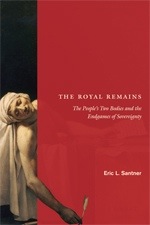
Eric Santner – The Royal Remains

20120511-112137.jpg

I previously knew Santner’s work from his study of Sebald, On Creaturely Life. This more recent book covers similar ground to the Manow book I mentioned a few days ago – the persistence of the ‘two bodies’ idea explored by Kantorowicz – but in a more theoretical register. there are interesting discussions of Agamben, Foucault, Esposito, Heidegger, Schmitt, Shakespeare and others.

Posted in Carl Schmitt, Giorgio Agamben, Martin Heidegger, Michel Foucault, Roberto Esposito, William Shakespeare | 1 Comment

Clare O'Farrell's avatarFoucault News

Cet inédit de Michel Foucault est publié en encadré dans “Stratégie judiciaire. Face à la répression il n’est pas interdit de se défendre”, Courant alternatif, mai 2012.

Voici un texte écrit par Michel Foucault pour les premières assises de la défense libre, à La Sainte Baume, en 1980. Foucault en est le seul auteur mais il a été cosigné par Jean Lapeyrie, Dominique Nocaudie et les avocats du réseau défense libre, Henry Juramy, Christian Revon et Jacques Vergès.

Se défendre

1-Evitons d’abord le problème ressassé du réformisme et de l’anti-réformisme. Nous n’avons pas à prendre en charge les institutions qui ont besoin d’être transformée. Nous avons à nous défendre tant et si bien que les institutions soient contraintes de se réformer. L’initiative doit donc venir de nous, non pas sous forme de  programme mais sous forme de mise en question et sous forme d’action.

2-Ce n’est pas parce qu’il…

View original post 380 more words

Posted in Uncategorized | Leave a comment

More on the Political Geology workshop – this time with a link to the flyer.

Posted in Uncategorized | Leave a comment

Interesting in itself, but also because it says Du gouvernement des vivants will be published in a few months, with Subjectivité et Vérité to follow soon.

Clare O'Farrell's avatarFoucault News

For full details and the conference poster please visit the Conference website

Colloque international

MICHEL FOUCAULT

DU GOUVERNEMENT DES VIVANTS AU COURAGE DE LA VÉRITÉ

Université Paris-Est Créteil/Université Paris 1 Panthéon-Sorbonne


21-22 juin 2012

 ——

ED « Cultures et sociétés »/EA 4395 « Lettres, Idées, Savoirs » (UPEC)

EA 3562 « Philosophies contemporaines »/<EXeCO (Université Paris 1 Panthéon-Sorbonne)

Revue en ligne « materiali foucaultiani »

——

Parler du « dernier Foucault » est devenu depuis quelques temps à la mode. Mais à quoi correspond ce « dernier » Foucault ? La publication des cours au Collège de France des années 80 arrive à son terme. Le cours de 1981-82, L’herméneutique du sujet, avait été publié en 2001 ; mais c’est à partir de 2008 que l’on a assisté à une véritable « accumulation » de textes auparavant inédits, écrits et prononcés par Foucault pendant les cinq dernières années de sa vie. Le cours de 1982-83, Le gouvernement…

View original post 1,167 more words

Posted in Michel Foucault | 3 Comments