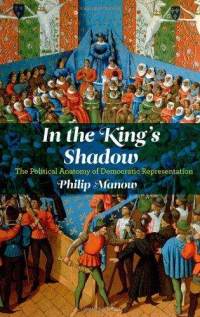
Philip Manow, In the King’s Shadow

I picked up this 2010 book from Polity as part of the recompense for a reader report. I’m glad I did – it’s a very interesting examination of the political body after the end of the medieval King’s Two Bodies idea explored by Ernst Kantorowicz back in the 1950s (which Foucault discusses in Discipline and Punish). The subtitle ‘The Political Anatomy of Democratic Representation’ describes Manow’s book pretty well, but here’s the blurb from Colin Crouch:

This is a brilliant piece of historical and political analysis, tracing how imagery derived originally from the importance of the corporeal presence of monarchs continues to shape our ways of thinking about political institutions today. The design of parliamentary assemblies, the importance of the personal appearance of political figures and the value of continuity of persons occupying roles can all be seen afresh in the light of this central theme. It is probably the most original contribution to democratic theory for several years. 

Posted in Michel Foucault | Tagged , , | 1 Comment

Eyal Weizman – The Least of All Possible Evils

Out soon Now out with Verso:

The principle of the “lesser evil”—the acceptability of pursuing one exceptional course of action in order to prevent a greater injustice—has long been a cornerstone of Western ethical philosophy. From its roots in classical ethics and Christian theology, to Hannah Arendt’s exploration of the work of the Jewish Councils during the Nazi regime, Weizman explores its development in three key transformations of the problem: the defining intervention of Médecins Sans Frontières in mid-1980s Ethiopia; the separation wall in Israel-Palestine; and international and human rights law in Bosnia, Gaza and Iraq. Drawing on a wealth of new research, Weizman charts the latest manifestation of this age-old idea. In doing so he shows how military and political intervention acquired a new “humanitarian”acceptability and legality in the late twentieth and early twenty-first centuries.

Posted in Books, Eyal Weizman, Politics | 4 Comments

Foucault – Wrong-Doing, Truth-Telling

University of Chicago Press finally have a page up for the translation of Foucault’s 1981 lectures at Louvain – Wrong-Doing, Truth-Telling. They are due out in January 2013.

Three years before his death, Michel Foucault delivered a series of lectures at the Catholic University of Louvain that until recently remained almost unknown. These lectures—which focus on the role of avowal, or confession, in the determination of truth and justice—provide the missing link between Foucault’s early work on madness, delinquency, and sexuality and his later explorations of subjectivity in Greek and Roman antiquity.

Posted in Books, Michel Foucault | 2 Comments

Posts at Durham

Durham University has advertised a large number of senior level appointments across the university. Details here. Areas include conflict, security and borders; engaged humanities; visual culture; public policy and health; and medieval and renaissance studies.

Posted in Boundaries, Medieval Studies, Politics, teaching, Universities | Leave a comment

Judith Butler, Parting Ways

Judith Butler’s long-awaited book on Jewish and Zionist thought is forthcoming in July. Parting Ways: Jewishness and the Critique of Zionism will be published by Columbia University Press.

Judith Butler follows Edward Said’s late suggestion that through a consideration of Palestinian dispossession in relation to Jewish diasporic traditions a new ethos can be forged for a one-state solution. Butler engages Jewish philosophical positions to articulate a critique of political Zionism and its practices of illegitimate state violence, nationalism, and state-sponsored racism. At the same time, she moves beyond communitarian frameworks, including Jewish ones, that fail to arrive at a radical democratic notion of political cohabitation. Butler engages thinkers such as Edward Said, Emmanuel Levinas, Hannah Arendt, Primo Levi, Martin Buber, Walter Benjamin, and Mahmoud Darwish as she articulates a new political ethic. In her view, it is as important to dispute Israel’s claim to represent the Jewish people as it is to show that a narrowly Jewish framework cannot suffice as a basis for an ultimate critique of Zionism. She promotes an ethical position in which the obligations of cohabitation do not derive from cultural sameness but from the unchosen character of social plurality. Recovering the arguments of Jewish thinkers who offered criticisms of Zionism or whose work could be used for such a purpose, Butler disputes the specific charge of anti-Semitic self-hatred often leveled against Jewish critiques of Israel. Her political ethic relies on a vision of cohabitation that thinks anew about binationalism and exposes the limits of a communitarian framework to overcome the colonial legacy of Zionism. Her own engagements with Edward Said and Mahmoud Darwish form an important point of departure and conclusion for her engagement with some key forms of thought derived in part from Jewish resources, but always in relation to the non-Jew.

Butler considers the rights of the dispossessed, the necessity of plural cohabitation, and the dangers of arbitrary state violence, showing how they can be extended to a critique of Zionism, even when that is not their explicit aim. She revisits and affirms Edward Said’s late proposals for a one-state solution within the ethos of binationalism. Butler’s startling suggestion: Jewish ethics not only demand a critique of Zionism, but must transcend its exclusive Jewishness in order to realize the ethical and political ideals of living together in radical democracy.

Thanks to Chathan Vemuri for the news.

Posted in Judith Butler, Politics | Leave a comment

Agamben, Highest Poverty draft preface

Adam Kotsko has made available the preface to Agamben’s Highest Poverty: Monastic Rules and Forms of Life He previously made the preface to Opus Dei available. Both books are being translated for Stanford UP. More here.

Posted in Giorgio Agamben | 1 Comment

‘Palestinians and the End of the Peace Process’

Interesting looking report from the International Crisis Group – The Emperor has no Clothers: Palestinians and the End of the Peace Process.

Does anybody still believe in the Middle East Peace Process? Nineteen years after Oslo and thirteen years after a final settlement was supposed to be reached, prospects for a two-state solution are as dim as ever. The international community mechanically goes through the motions, with as little energy as conviction. The parties most directly concerned, the Israeli and Palestinian people, appear long ago to have lost hope. Substantive gaps are wide, and it has become a challenge to get the sides in the same room. The bad news is the U.S. presidential campaign, Arab Spring, Israel’s focus on Iran and European financial woes portend a peacemaking hiatus. The good news is such a hiatus is badly needed. The expected diplomatic lull is a chance to reconsider basic pillars of the process – not to discard the two-state solution, for no other option can possibly attract mutual assent; nor to give up on negotiations, for no outcome will be imposed from outside. But to incorporate new issues and constituencies; rethink Palestinian strategy to alter the balance of power; and put in place a more effective international architecture…

Posted in Uncategorized | 1 Comment

Sloterdijk – You Must Change Your Life

The English translation of Sloterdijk’s book is scheduled for November – full details here.

Posted in Peter Sloterdijk | Leave a comment

Revista Urban issue 3 and call for papers

The Spanish journal Revista Urban issue 3 is now out. It’s a theme issue on Conflicts of contemporary cities. It includes articles by Don Mitchell, Alain Bertho, Fabrizio Bottini & Maria Cristina Gibelli, Cristina Fernández & Fernando Roch, Julio Soria & Luis Valenzuela and Imanol Zubero.

The current call for papers is on Critical Landscapes. There is also a permanent call for papers on free topics.

While the journal requires subscription, I’ve been told you can contact the journal if you want to get hold of an individual piece.

[update: second link now fixed – sorry]

Posted in Publishing, Revista Urban | 2 Comments

Geographica Helvetica relaunch

The venerable Swiss geography journal Geographica Helvetica is being relaunched next year with a new editorial team – Francisco Klauser, Ola Söderström and Benedikt Korf. I’ve accepted an invitation to be part of the new editorial board. The plan is that the journal is available on paper and online in an open access format (using the Copernicus portal). It will be a multi-lingual journal – papers in French, German, English and Italian. There will be a conference on 19th October 2012 in Neuchâtel which will be a sort of informal launch (unfortunately I can’t attend due to teaching commitments). More details as they become available.

Posted in Geographica Helvetica, Publishing | Leave a comment