

Blog Stats
- 3,776,194 hits
-
Join 12.1K other subscribers
-
Recent Posts
- Thomas Jones and Toril Moi, How Frederic Jameson became Frederic Jameson – LRB Podcast
- Alejandra Mancilla, From Sovereignty to Guardianship: Governing Antarctica, Governing the World – Oxford University Press, June 2026 (print and open access) and ABC News discussion
- Mélanie Lamotte, By Flesh and Toil: How Sex, Race and Labor Shaped the Early French Empire – Harvard University Press, January 2026 and New Books discussion
- Stuart Hall Digital: Mediations of the Stuart Hall Archive
- Leonhard Emmerling, The Idiots: The History of the Homo Nullius – trans. Parnal Chirmuley, Seagull, 2026 and New Books discussion
Archives
- October 2026
- September 2026
- August 2026
- July 2026
- June 2026
- May 2026
- April 2026
- March 2026
- February 2026
- January 2026
- December 2025
- November 2025
- October 2025
- September 2025
- August 2025
- July 2025
- June 2025
- May 2025
- April 2025
- March 2025
- February 2025
- January 2025
- December 2024
- November 2024
- October 2024
- September 2024
- August 2024
- July 2024
- June 2024
- May 2024
- April 2024
- March 2024
- February 2024
- January 2024
- December 2023
- November 2023
- October 2023
- September 2023
- August 2023
- July 2023
- June 2023
- May 2023
- April 2023
- March 2023
- February 2023
- January 2023
- December 2022
- November 2022
- October 2022
- September 2022
- August 2022
- July 2022
- June 2022
- May 2022
- April 2022
- March 2022
- February 2022
- January 2022
- December 2021
- November 2021
- October 2021
- September 2021
- August 2021
- July 2021
- June 2021
- May 2021
- April 2021
- March 2021
- February 2021
- January 2021
- December 2020
- November 2020
- October 2020
- September 2020
- August 2020
- July 2020
- June 2020
- May 2020
- April 2020
- March 2020
- February 2020
- January 2020
- December 2019
- November 2019
- October 2019
- September 2019
- August 2019
- July 2019
- June 2019
- May 2019
- April 2019
- March 2019
- February 2019
- January 2019
- December 2018
- November 2018
- October 2018
- September 2018
- August 2018
- July 2018
- June 2018
- May 2018
- April 2018
- March 2018
- February 2018
- January 2018
- December 2017
- November 2017
- October 2017
- September 2017
- August 2017
- July 2017
- June 2017
- May 2017
- April 2017
- March 2017
- February 2017
- January 2017
- December 2016
- November 2016
- October 2016
- September 2016
- August 2016
- July 2016
- June 2016
- May 2016
- April 2016
- March 2016
- February 2016
- January 2016
- December 2015
- November 2015
- October 2015
- September 2015
- August 2015
- July 2015
- June 2015
- May 2015
- April 2015
- March 2015
- February 2015
- January 2015
- December 2014
- November 2014
- October 2014
- September 2014
- August 2014
- July 2014
- June 2014
- May 2014
- April 2014
- March 2014
- February 2014
- January 2014
- December 2013
- November 2013
- October 2013
- September 2013
- August 2013
- July 2013
- June 2013
- May 2013
- April 2013
- March 2013
- February 2013
- January 2013
- December 2012
- November 2012
- October 2012
- September 2012
- August 2012
- July 2012
- June 2012
- May 2012
- April 2012
- March 2012
- February 2012
- January 2012
- December 2011
- November 2011
- October 2011
- September 2011
- August 2011
- July 2011
- June 2011
- May 2011
- April 2011
- March 2011
- February 2011
- January 2011
- December 2010
- November 2010
- October 2010
- September 2010
- August 2010
- July 2010
- June 2010
- May 2010
- April 2010
Categories
- Achille Mbembe
- Adam David Morton
- Adam Tooze
- Adrian Johnston
- Adriana Cavarero
- Adriano Prosperi
- Alain Badiou
- Albert Camus
- Alberto Toscano
- Alexander B. Murphy
- Alexandre Kojève
- Alexandre Koyré
- Allen Scott
- Alphonso Lingis
- André Leroi-Gourhan
- Andreas Knichen
- Andrew Barry
- Andy Merrifield
- Ann Laura Stoler
- Anthony Giddens
- Antoine Meillet
- Antonio Gramsci
- Antonio Negri
- Arlette Farge
- arundhati roy
- Ash Amin
- Aurel Stein
- Axel Honneth
- Étienne Wolff
- Babette Babich
- Baldus de Ubaldis
- Bartolus of Sassoferrato
- Baruch Spinoza
- Bernard E. Harcourt
- Bernard Stiegler
- Bill Martin
- Bob Jessop
- Bogislaw Philipp von Chemnitz
- Books
- Boris Porshnev
- Boundaries
- Bradley Garrett
- Bruno Latour
- C.L.R. James
- Canguilhem (book)
- Caren Kaplan
- Carl Schmitt
- Carlo Ginzburg
- Catherine Malabou
- China Mieville
- Chris Philo
- Christian Parenti
- Clarence J. Glacken
- Claude Lévi-Strauss
- Claude Lefort
- Claude Raffestin
- Clémence Ramnoux
- Colin Gordon
- Conferences
- Cornel West
- Couze Venn
- Cricket
- Cycling
- Daniel Defert
- Daniel Heller-Roazen
- David Byrne
- David Campbell
- David Farrell Krell
- David Harvey
- David Lachterman
- David N. Livingstone
- Deborah Cowen
- Derek Gregory
- Derek Parfit
- Didier Eribon
- Don Mitchell
- Doreen Massey
- E. P. Thompson
- Ebola
- Edgar Allan Poe
- Edmund Husserl
- Eduardo Mendieta
- Edward Casey
- Edward Gibbon
- Edward Said
- Edward Soja
- Elizabeth Grosz
- Ellen Meiksins Wood
- Emile Benveniste
- Emmanuel Levinas
- Engin Isin
- Enrique Dussel
- Eric Hobsbawm
- Ernesto Laclau
- Ernst Cassirer
- Ernst Kantorowicz
- Erwin Panofsky
- Etienne Balibar
- Eugen Fink
- Events
- Eyal Weizman
- Felix Guattari
- Ferdinand de Saussure
- Fernand Braudel
- Football
- Fossils
- Foucault's Last Decade
- Foucault: The Birth of Power
- François Delaporte
- François Ellenberger
- Francisco de Vitoria
- Franco Moretti
- Frantz Fanon
- Franz Kafka
- Fredric Jameson
- Friedrich Engels
- Friedrich Nietzsche
- Friedrich Wilhelm Joseph Schelling
- Gaston Bachelard
- Gaston Gordillo
- Geographica Helvetica
- Georg Lukács
- Georg Wilhelm Friedrich Hegel
- George Lawson
- Georges Bataille
- Georges Canguilhem
- Georges Dumézil
- Giacomo Marramao
- Gilles Deleuze
- Gillian Rose
- Giorgio Agamben
- Giovanni Botero
- Gottfried Leibniz
- Graham Harman
- Grégoire Chamayou
- Gunnar Olsson
- Guy Debord
- H.P. Lovecraft
- Haim Yacobi
- Hannah Arendt
- Hélène Legotien
- Henri de Boulainviller
- Henri Lefebvre
- Herbert Marcuse
- Horace Kallen
- Hugo Grotius
- Ian Bogost
- Ian Hacking
- Immanuel Kant
- Institute of Advanced Study
- Irnerius
- Isaac Newton
- Isabelle Stengers
- Italo Calvino
- J.G.A. Pocock
- Jacob Klein
- Jacob Taubes
- Jacques Derrida
- Jacques Lacan
- Jacques Rancière
- Jakob von Uexküll
- James Harrington
- Jane Bennett
- Jürgen Habermas
- jean baudrillard
- Jean Bodin
- Jean Cavaillès
- Jean de Menasce
- Jean Gottmann
- Jean Hyppolite
- Jean Jacques Rousseau
- Jean Wahl
- Jean-Luc Nancy
- Jean-Paul Sartre
- Jeff Malpas
- Jeffrey Jerome Cohen
- Jenny Edkins
- Jeremy Bamber
- Jeremy Bentham
- Jeremy Crampton
- Jodi Dean
- Johannes Althusius
- Johannes Hertius
- John Agnew
- John Locke
- John Protevi
- John Rawls
- John Sallis
- John Urry
- Jonathan Simon
- Journal of Urban Cultural Studies
- Judith Butler
- Julia Kristeva
- Juliet Fall
- Karl Jaspers
- Karl Marx
- Klaus Theweleit
- Kostas Axelos
- Lauren Berlant
- Léopold Lambert
- Léopold Sédar Senghor
- Lee Braver
- Levi Bryant
- Louis Althusser
- Louise Amoore
- Luce Irigaray
- Lucien Febvre
- Lucien Gerschel
- Ludwig Binswanger
- Luiza Bialasiewicz
- Maja Zehfuss
- Manuel deLanda
- Mapping Indo-European Thought in Twentieth Century France
- Mapping the Present
- Marc Bloch
- Marc Crépon
- Marcel Detienne
- Marcel Mauss
- Marie-Eve Morin
- Marie-Madeleine Davy
- Mark Neocleous
- Martin Heidegger
- Martin Luther
- Mary Beard
- Massimo Cacciari
- Matthew Hannah
- Matthias Stephani
- Maurice Blanchot
- Maurice Merleau-Ponty
- Maximilien Robespierre
- Medieval Studies
- Mehdi Belhaj Kacem
- Michael Dillon
- Michael Hardt
- Michael Mann
- Michael Watts
- Michel Foucault
- Michel Serres
- Mircea Eliade
- Music
- My Publications
- Naomi Klein
- Nathan Widder
- Neil Brenner
- Neil Smith
- Niccolò Machiavelli
- Nicholas Blomley
- Nicholas of Cusa
- Nicos Poulantzas
- Nigel Thrift
- Nina Power
- Noam Chomsky
- Novels read
- Paolo Virno
- Paul Veyne
- Paul Virilio
- People
- Peter Brown
- Peter Gratton
- Peter Hallward
- Peter Sloterdijk
- Philip Steinberg
- Philipp Melanchthon
- Pierre Bourdieu
- Pierre Hadot
- Pierre Klossowski
- Pierre Macherey
- Politics
- Publishing
- Quentin Meillassoux
- Quentin Skinnner
- Ralph Miliband
- Ray Brassier
- Raymond Ruyer
- Raymond Williams
- Reinhart Koselleck
- Remarkable Research
- René Descartes
- René Girard
- Revista Urban
- Robert Filmer
- Roberto Esposito
- Roger Caillois
- Roland Barthes
- Roman Jakobson
- Samuel Pufendorf
- Sara Ahmed
- Saskia Sassen
- Setha Low
- Shakespearean Territories
- Sigmund Freud
- Simon Critchley
- Simon Schama
- Simone de Beauvoir
- Simone Weil
- Slavoj Zizek
- Society and Space
- Speaking Against Number
- Stanley Cavell
- Stefanos Geroulanos
- Stephen Graham
- Stephen Greenblatt
- Stuart Hall
- Sunday Histories
- Suzanne Bachelard
- T.S. Eliot
- Tariq Ali
- teaching
- terrain
- Territory
- Terror and Territory
- Terry Eagleton
- The Archaeology of Foucault
- The Birth of Territory
- The Early Foucault
- The Space of the World
- Theodor Reinking
- Theory
- Theory, Culture and Society
- Thomas Hobbes
- Thomas Pynchon
- Timothy Morton
- Travel
- Trevor Paglen
- Tristan Garcia
- Troy Davis
- Udalricus Zasius
- Umberto Eco
- Uncategorized
- Understanding Henri Lefebvre
- Universities
- urban/urbanisation
- Vladimir Nabokov
- Walter Benjamin
- Walter Ralegh
- Wendy Brown
- William E Connolly
- William Shakespeare
- Writing
- Wu Ming
Meta
-
John Updike’s 6 Rules for Constructive Criticism
In The Atlantic. While these are intended for reviews of fiction, many apply to the review of academic books. They were written in the 1970s, so perhaps that explains his use of male pronouns alone. Here are the first three – the others, and the introduction, are longer:
1. Try to understand what the author wished to do, and do not blame him for not achieving what he did not attempt.
2. Give him enough direct quotation—at least one extended passage—of the book’s prose so the review’s reader can form his own impression, can get his own taste.
3. Confirm your description of the book with quotation from the book, if only phrase-long, rather than proceeding by fuzzy precis.
This was added in comments to a previous post, but worth greater visibility.
Posted in Uncategorized
1 Comment
Political Theology and Early Modernity
 Interesting looking collection edited by Graham Hammill and Julia Reinhard Lupton, with a postface by Etienne Balibar.
Political theology is a distinctly modern problem, one that takes shape in some of the most important theoretical writings of the twentieth and twenty-first centuries. But its origins stem from the early modern period, in medieval iconographies of sacred kinship and the critique of traditional sovereignty mounted by Hobbes and Spinoza. In this book, Graham Hammill and Julia Reinhard Lupton assemble established and emerging scholars in early modern studies to examine the role played by sixteenth- and seventeenth-century literature and thought in modern conceptions of political theology.
Political Theology and Early Modernity explores texts by Shakespeare, Machiavelli, Milton, and others that have served as points of departure for such thinkers as Schmitt, Strauss, Benjamin, and Arendt. Written from a spectrum of positions ranging from renewed defenses of secularism to attempts to reconceive the religious character of collective life and literary experience, these essays probe moments of productive conflict, disavowal, and entanglement in politics and religion as they pass between early modern and modern scenes of thought. This stimulating collection is the first to answer not only how Renaissance and baroque literature help explain the persistence of political theology in modernity and postmodernity, but also how the reemergence of political theology as an intellectual and political problem deepens our understanding of the early modern period.
Pirate Radical Philosophy?
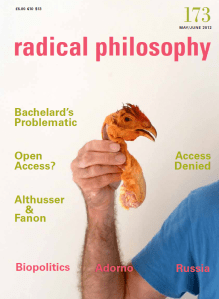 The latest issue of Radical Philosophy has an interesting piece entitled ‘Pirate Radical Philosophy’, which is free to download. It raises questions about open access, piracy, copyright and the digital humanities. It is followed by a brief statement from the editorial collective:
Access to Radical Philosophy: principles and policy
As an independent journal of the Left, collectively self-published in A4 magazine form, and non-profit-making, Radical Philosophy has always aimed to maximize access while generating sufficient revenue to fund production. Currently, we do this by keeping the cover and individual subscription prices as low as possible, giving individual subscribers free access to our forty-year archive in electronic form on the web, and making more than 50 per cent of the archive available open access. We charge university libraries for full web access, in order to make up the deficit on sales to individuals. Downloads of individual articles that are unavailable to those without university or individual subscriptions cost £3 each – about 20 per cent of commercial rates.
But why isn’t Radical Philosophy freely available in its entirety to all on the web? Because we would not then be able to produce it as a hard copy magazine, since we would not generate sufficient income from institutional subscriptions. Much of what is intellectually and culturally distinctive about Radical Philosophy,we believe, is connected to its format and low-priced availability in bookshops and to individual subscribers. However, we are also exploring the possibilities of new formats.
We are interested to hear readers’ views on these issues and to debate them in the journal. Email short pieces to mark.neocleous@brunel.ac.uk or write to us at admin@radicalphilosophy.com.
RP
Posted in Publishing
Leave a comment
Political Geology: Stratigraphies of Power
I’ll be speaking at a conference on Political Geology: Stratigraphies of Power on 21 June at Lancaster University – I’ll be giving an abbreviated version of the ‘Fossils’ paper I gave in Canberra and Macau last year. Thanks to Kathryn Yusoff for inviting me. In part this is a continuation of the conversation with Elizabeth Grosz at the AAG – audio available at the Society and Space open site.
With what language can we describe the politics of the Earth? ‘Geopolitics’ should be the name of that language; yet the geopolitical lexicon is strangely lacking in any reference to the Earth System, to its structures and resistances, its deep time and its sudden upheavals. In recent decades, social and political theory has undertaken a number of biological turns, giving rise for example to political ecology, ecological economics and theories of biopolitics. But, despite Deleuze and Guattari’s exploration of ‘geophilosophy’, and Elizabeth Grosz’s recent discussion of ‘geopower’, there has been no comparable geological turn: no concerted inquiry into the ways that the geophysical, as much as the biological, conditions what politics is and can be.
However, debates around the advent of the Anthropocene epoch seem to mark a growing recognition of humankind as a geological force. At the same time, unregenerate seismic, volcanic and other geomorphological forces attest to the limits of the human, and point to our eventual mineral fate – but also can be seen as powers that propel and incite human agency, not least in the form of fossilised hydrocarbons.
This workshop will explore the possibilities for a political vocabulary that can articulate the geophysical dimensions of politics and the political dimensions of the geophysical. We will touch on domains and structures such as tectonic plates and rock, fossils and soil, air and water, life and bodies, and on phenomena such as erosion, (de)stratification, flow and viscosity, in order to think the politics of an Earth that is constantly in becoming and in formation.
Speakers will include: Nigel Clark (Open University), Deborah Dixon (Aberystwyth University), Stuart Elden (Durham University), Myra Hird (Queen’s University, Canada), Arun Saldanha (University of Minnesota), Bronislaw Szerszynski (Lancaster University) and Kathryn Yusoff (Lancaster University).
Mark Purcell on Lefebvre, State, Space, World
There is a very generous review of Lefebvre’s State, Space, World collection by Mark Purcell in the new issue of Social and Cultural Geography (requires subscription). [Update: Mark has posted the whole thing here]
Let me say this plainly: this is an excellent book. There are two main reasons for this excellence. The first is the enduring quality and originality of Lefebvre’s work, and the second is the evident abilities of the editors, Neil Brenner and Stuart Elden. Both are important factors, but let me begin with the editors. A significant element of the editors’ contribution is the translation of the works, for which they were joined by Gerald Moore…
In addition to the excellent translation, the editors’ introduction is extremely substantive, well written, and makes an excellent guide to the theoretical contents of the book. Their scholarship is meticulous; this is clearly not a book that was rushed in any way. It is patiently crafted and is the work of serious scholars who care very deeply about the material they are working with.
Much of the review is, naturally, taken up with Lefebvre’s ideas, notably the notion of autogestion, which he ties, entirely appropriately, to the much better idea of the right to the city.
Very much related to this political agenda is the concept of autogestion. The term is extraordinarily important for Lefebvre, though it has been subjected to relatively little attention in geography scholarship. It forms the basis of his understanding of politics and his hope for the future. It also draws him toward an anarchist position, which is articulated with the Marxist–Leninist position on the state and capitalism, into an exciting and complex political vision. Lefebvre imagines people reappropriating control over the conditions of their own existence so that they create a world in which no one is governed by outside authority, a world in which power is no longer alienated from people to institutions like the state or the corporation, but remains with the people themselves…
Lefebvre is very clear here: he is offering a vision for radical democracy. It is easy to imagine how we can connect that larger political vision with Lefebvre’s writings on cities to imagine urban inhabitants reappropriating control over the production of urban space, a vision which helps us to more fully specify, and understand far more radically, the concept of the right to the city.
Overall then, I would say this book is not only required reading for anyone interested in Lefebvre but also it should be the starting point for those who want to engage his work on the state, politics, Marxism, and autogestion. Especially if it is paired with The Urban Revolution, I think this book is a powerful weapon in the struggle against the neoliberal city, and a source of great strength as we build another world.
Posted in Henri Lefebvre, My Publications, Neil Brenner, Politics
Leave a comment
Deborah Cowen website
My friend and co-editor of Society and Space, Deborah Cowen, has a nicely designed website about her work.
My work is concerned with the politics of space and questions of citizenship. I am captivated by the ways groups claim space, organize and design space, interpret space, fight over space, govern space, and share space, particularly in cities. In all of my work I am interested in how territory is fashioned and how the political is remade through conflict. I investigate these broad themes through three research trajectories – militaries, logistics, cities.
Posted in Politics, Society and Space, Territory
Leave a comment
Ed: This blog post from the French newspaper Le Monde has a very large number of comments attached and provides a very interesting account of the background to the recent decision to declare the Foucault archives a national treasure. With thanks to Nicolae Morar for alerting me to this item.
August 2025 update. The article, which I have reproduced in full below, (without the attached comments) is now only available on the Wayback machine. This is the capture from January 25th 2013.
A qui les archives de Michel Foucault ?, Le monde, La république des livres. Le blog de Pierre Assouline, 29 avril 2012
Ce n’est peut-être pas le premier dossier que le nouveau ministre de la Culture aura bientôt à traiter, n’exagérons rien ; mais le deuxième, probablement. Sinon, l’affaire s’éternisera dans les arcanes des administrations qui se renverront la balle, et on pourra dire adieu aux archives…
View original post 1,074 more words
Posted in Uncategorized
Leave a comment
Outside Territory in Nottingham
After the Paris event we were up early the next morning to get the Eurostar to London, and then a train to Nottingham – made a little trickier by the ASLEF strike action (but a strike that doesn’t disrupt things isn’t a very effective strike). This was a long-arranged talk to the School of Geography, on the invitation of Stephen Legg.
The talk was a longer version of the one given the previous day in Paris, this time with the Richard II discussion included, and a slightly longer introduction linking it to my previous work. I slightly misjudged the timing, and so had to cut some later parts short so as not to go on too long. There were some excellent questions that will give me much to think about, on time, being lost, enclosure, scale and liminality. As this is part of a probable longer project, this is exactly why it is worth giving such talks. I did record the talk with the intention of posting it up here, but for some reason the recording cut off part-way through. Good evening out later with Steve, Stephen Daniels, and André Reyes Novaes.
Posted in Conferences, Territory, Travel, William Shakespeare
Leave a comment

