Harvard memo on journal pricing

This has been posted on a few places, i.e. New APPS. The Harvard Faculty Advisory Council memorandum on journal pricing makes for very interesting reading. [Update – The Guardian reports on it here].

Last two paragraphs and options:

The Faculty Advisory Council to the Library, representing university faculty in all schools and in consultation with the Harvard Library leadership,  reached this conclusion: major periodical subscriptions, especially to electronic journals published by historically key providers, cannot be sustained: continuing these subscriptions on their current footing is financially untenable. Doing so would seriously erode collection efforts in many other areas, already compromised.

It is untenable for contracts with at least two major providers to continue on the basis identical with past agreements. Costs are now prohibitive. Moreover, some providers bundle many journals as one subscription, with major, high-use journals bundled in with journals consulted far less frequently. Since the Library now must change its subscriptions and since faculty and graduate students are chief users, please consider the following options open to faculty and students (F) and the Library (L), state other options you think viable, and communicate your views:

1. Make sure that all of your own papers are accessible by submitting them to DASH in accordance with the faculty-initiated open-access policies (F).

2. Consider submitting articles to open-access journals, or to ones that have reasonable, sustainable subscription costs; move prestige to open access (F).

3. If on the editorial board of a journal involved, determine if it can be published as open access material, or independently from publishers that practice pricing described above. If not, consider resigning (F).

4. Contact professional organizations to raise these issues (F).

5. Encourage professional associations to take control of scholarly literature in their field or shift the management of their e-journals to library-friendly organizations (F).

6. Encourage colleagues to consider and to discuss these or other options (F).

7. Sign contracts that unbundle subscriptions and concentrate on higher-use journals (L).

8. Move journals to a sustainable pay per use system, (L).

9. Insist on subscription contracts in which the terms can be made public (L).

Posted in Publishing | Leave a comment

Gielgud as John of Gaunt

The speech in the last post begins about a minute and a half in. This is from the BBC production of the late 70s. A young Derek Jacobi is Richard.

Posted in William Shakespeare | Leave a comment

Shakespeare’s anniversary

On the anniversary of Shakespeare’s death, and probably birth too, here’s one of his most powerful speeches – John of Gaunt in Richard II:

Methinks I am a prophet new inspired
And thus expiring do foretell of him:
His rash fierce blaze of riot cannot last,
For violent fires soon burn out themselves;
Small showers last long, but sudden storms are short;
He tires betimes that spurs too fast betimes;
With eager feeding food doth choke the feeder:
Light vanity, insatiate cormorant,
Consuming means, soon preys upon itself.
This royal throne of kings, this scepter’d isle,
This earth of majesty, this seat of Mars,
This other Eden, demi-paradise,
This fortress built by Nature for herself
Against infection and the hand of war,
This happy breed of men, this little world,
This precious stone set in the silver sea,
Which serves it in the office of a wall,
Or as a moat defensive to a house,
Against the envy of less happier lands,
This blessed plot, this earth, this realm, this England,
This nurse, this teeming womb of royal kings,
Fear’d by their breed and famous by their birth,
Renowned for their deeds as far from home,
For Christian service and true chivalry,
As is the sepulchre in stubborn Jewry,
Of the world’s ransom, blessed Mary’s Son,
This land of such dear souls, this dear dear land,
Dear for her reputation through the world,
Is now leased out, I die pronouncing it,
Like to a tenement or pelting farm:
England, bound in with the triumphant sea
Whose rocky shore beats back the envious siege
Of watery Neptune, is now bound in with shame,
With inky blots and rotten parchment bonds:
That England, that was wont to conquer others,
Hath made a shameful conquest of itself.
Ah, would the scandal vanish with my life,
How happy then were my ensuing death!

Posted in William Shakespeare | Leave a comment

Improper Life – Timothy Campbell

 Improper Life: Technology and Biopolitics from Heidegger to Agamben – recently out with University of Minnesota Press. The book discusses, between Heidegger and Agamben, Michel Foucault, Roberto Esposito, and Peter Sloterdijk. Campbell is one of the translators of Esposito, and his relation of Italian to German thought was good. I also appreciated the way Sloterdijk was brought into dialogue with a range of thinkers in continental thought.

Has biopolitics actually become thanatopolitics, a field of study obsessed with death? Timothy C. Campbell argues that a “crypto-thanatopolitics” can be teased out of Heidegger’s critique of technology and that some of the leading scholars of biopolitics have been substantively influenced by Heidegger’s thought. Campbell articulates a corrective biopolitics that can begin with rereadings of Foucault, Freud, and Gilles Deleuze.

Julia Reinhard Lupton says:

Broadening biopower beyond its Nazi encampments in order to build a critique of liberalism, Timothy C. Campbell argues that modern politics captures life through invasive technologies of communication and consumption that promise protection from mortality, disability, boredom, and loneliness. Campbell links mass media and bioengineering to the birth of a global petty bourgeoisie defined by a terrifying lack of distance and the relentless dismantling of community. This compelling, powerfully argued book should be read by anyone interested in the futures of collective life in the age of smart bombs and cloud computing.

There is also a review at NDPR by Ladelle McWhorter.

Posted in Books, Giorgio Agamben, Martin Heidegger, Michel Foucault, Peter Sloterdijk, Roberto Esposito | Leave a comment

The Pepper-Spray Report

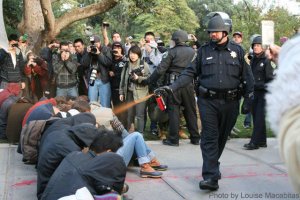
The official UC Davis report into the pepper-spray incident of November 18, 2011 is now available here. It’s damning. Some good analysis here and here for those who don’t want to read the report. The report is 190 pages, but 160 are appendices – the first 30 give more than enough information.

Posted in Politics, Universities | 1 Comment

Posted in Uncategorized | Leave a comment

‘I am a Geographer’

From the University of Kentucky – a recruitment video that shows how broad and interesting geography is today.

Posted in Universities | Leave a comment

Antipode Foundation Regional Workshop Awards

The Regional Workshop Awards are intended to support radical geographers holding regionally-based events (including conferences, workshops, seminar series, summer schools and action research meetings) which further radical analyses of geographical issues and engender the development of a new and better society.  The Antipode Foundation will explicitly privilege applicants and initiatives from historically under-represented groups, regions, countries and institutions. [more here]

Posted in Conferences, Publishing | Leave a comment

Shanghai 1990 and 2010

20120419-221023.jpg

Posted in Uncategorized | Leave a comment

Spatialising the (Geo)Political – conference

Spatialising the (Geo)Political: Political Geography and Critical Geopolitics Preconference 2012

24/25 August 2012

Campus Westend, Goethe-University Frankfurt am Main, Germany

The conference will provide a forum for exchange for political geographers prior to the IGC 2012 meeting in Cologne with the goal of moving forward current conceptual, methodological and empirical research agendas in Political Geography and Critical Geopolitics. During the conference two strands will be running parallel – Strand A: Integration and Disintegration of the Nation State and Strand B: Critical Geopolitics 2012

In addition to paper and roundtable session in each strand, there will be two plenary lectures by Alec Murphy and Joanne Sharp[more here]

Thanks to Exploring Geopolitics for the alert.

Posted in Conferences | 1 Comment