Schmitt book now in paperback

Spatiality, Sovereignty and Carl Schmitt: Geographies of the Nomos, edited by Stephen Legg, is now available in paperback. You can also preview the introduction there. The book includes a slightly revised version of my piece on Schmitt that first appeared in Radical Philosophy, available here.

Find out why he appears to be IR’s favourite Nazi…

Posted in Carl Schmitt | 2 Comments

Macherey, Hegel or Spinoza – panel discussion

The discussion of Pierre Macherey, Hegel or Spinoza at the Association of American Geographers included Keith Woodward, Susan Ruddick, Stuart Elden, Vinay Gidwani, and Warren Montag. You can find the audio recording here.

I’ve posted the following before, but you can read a brief interview I did with the translator, Susan Ruddick, here. Society and Space published a version of the introduction and first chapter of the book in advance – both still available open access.

[cross posted at www.societyandspace.com]

Posted in Baruch Spinoza, Georg Wilhelm Friedrich Hegel, Pierre Macherey | 2 Comments

Julia Reinhard Lupton, Thinking with Shakespeare reviewed

Julia Reinhard Lupton’s Thinking with Shakespeare was a book I read before the Anachronic Shakespeare conference – I wanted to be in some way prepared, and in any case it looked, and was, very interesting.

There is a review in the latest issue of Political Theory (requires subscription). It is a good review and puts the finger on what’s the real issue at stake here:

Lupton is at the forefront of contemporary Shakespeare scholars who read his plays not primarily through an historical lens (contextualizing their meaning in early modern England, seeking prior influences in Ovid, Plutarch, and Elizabethean theater) nor from a cultural-aesthetic perspective (pursuing how the plays function as dramatic works), but as open-ended texts waiting to be given contemporary valence… [Lupton incorporates] an equally variegated cadre of thinkers, including Aristotle, biblical sources, Gervase Markham, John Locke, Carl Schmitt, Alain Badiou, Giorgio Agamben, and above all Hannah Arendt. Lupton’s effort to link Shakespeare’s dramatization of politics with its theorization in such authors is no easy task. But her book is a feat of interdisciplinarity, reflecting an erudition of Shakespeare scholarship, literary theory, and political theory that is profound and deeply impressive, and written with artful prose that is playful and smart…

It should not be forgotten, of course, that it is Shakespeare who continually propels Lupton’s thinking about politics and life. Lupton persuasively claims that it is precisely in the plays’ potent, trans-generational ability to elicit thought that any claim to Shakespeare’s universality as an artist must rest: “The universality of Shakespeare’s plays . . . [consists] not as a thesaurus of eternal messages but in their capacity to establish real connections with successive worlds shared and sustained by actors and audiences over time” (18). If Lupton is right about this universality, and I would wager she is, then her book must be read not only as a leading scholar’s expert interpretation of Shakespeare but an invitation to political theorists of all types to find sustenance in the Bard.

Posted in Uncategorized | Leave a comment

Palgrave Macmillan journals open access for March

Details here – don’t be misled (as I was) by the bit about the librarian needing to get a site licence – just go to the individual journals and it looks like all papers can be freely downloaded.

Posted in Publishing | Leave a comment

Agamben translations under contract

Adam Kotsko has the news that he will be translating two pieces of Agamben’s Homo Sacer series – Opus dei: Archeologia dell’ufficio and Altissima povertà: Regole monastiche e forma di vita – details here. And here’s a link to the plan Nicholas Dahmann did so you can see how they fit into the overall project.

Posted in Giorgio Agamben | Leave a comment

China Miéville on contemporary London

Powerful writing in The New York Times. [A fuller, illustrated version is here]

London is full of ghosts — ghost walks; a city’s worth of cemeteries; ghost-advertising, scabs of paint on brick. The city invoked something, read a grimoire it shouldn’t have. Thatcher’s face recurs at every turn, not in clouds of sulfur but of exhaust, on buses bearing posters advertising Meryl Streep’s celluloid turn as our erstwhile prime minister. Cabinet reports from the aftermath of other riots across the country, 31 years ago, have been released. A policy was mooted, they suggest — the point is disputed — of “managed decline” of the troublesome areas. Leaving them to rot…

Posted in China Mieville, Politics | Leave a comment

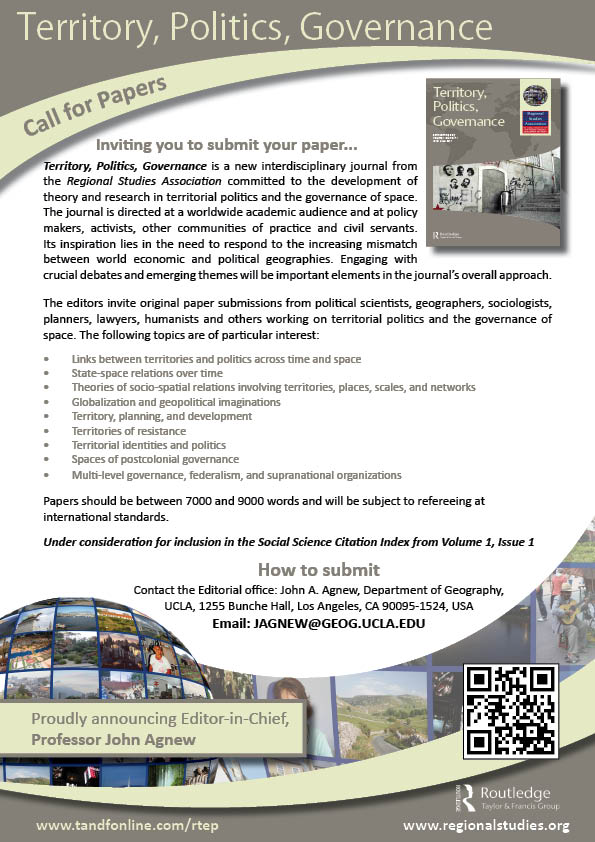
Territory, Politics, Governance – new journal

Not much on the journal site as yet – www.tandfonline.com/rtep

Posted in Publishing, Territory | Leave a comment

Luise Fischer on Reading Kant’s Geography

Nice review of Reading Kant’s Geography at H-Net. The review is freely available, but here are a couple of excerpts:

Stuart Elden and Eduardo Mendieta’s edition Reading Kant’s Geography is a masterful attempt “to remedy this glaring neglect” and to haul Kant’s geographical thought out of oblivion–at least for English-language readers (Elden, p. 4). The volume is an excellent analysis of Kant’s geographical thought and a great encouragement for further engagement beyond the relatively little existing research. An introductory essay by Elden and seventeen essays grouped into five thematic parts offer a detailed scrutiny of the themes, issues, and obstacles involved when reading and interpreting Kant’s geography lectures. Elden and Mendieta have compiled a volume that not only provides an excellent and comprehensive engagement with Kant’s geographical lectures but also sets the ground for a critical and reflected reading of the lectures’ forthcoming English translation (Kant: Natural Science, edited by Eric Watkins [May 2012]). Whilst calling for an increased attention to Kant’s geographical engagement, Reading Kant’s Geography raises awareness of the corrupted nature of the preserved German lecture notes and of various textual issues regarding the English translation…

Reading Kant’s Geography appears before the English translation of Kant’s geography lectures and yet almost two hundred years after Kant’s death. But will the edition truly become “obsolete” once the English translation has been published? This is to be doubted. The volume is a significant provision against the neglect of Kant’s forty years of geographical (and anthropological) teaching, which will hopefully draw (more) readers to the German and English texts, and perhaps even encourage translations into other languages. With its range of themes and its cautionary remarks regarding the textual and linguistic difficulties of Kant’s geography, it should long serve as reference work–even beyond the appearance of the English translation. One’s surprise about the “‘scandalously’ late” engagement with Kant’s geographical work seems to arise from the fact that this neglect is not only absolute but also relative–relative to the work on Kant’s philosophy and to his anthropology lectures. The reasons for this relative “lateness” are probably many. The noted textual issues, especially the lack of a publication by Kant himself, and the previous absence of a translation are partial explanations: the historical development of geography as a discipline and its late institutionalization might be others, as Church argues. And yet this “lateness” also touches on wider issues: it illustrates time gaps regarding (academic) interest and research agendas between different (language) spaces. Insights on whether the case of Kant’s geography lectures is an exception or an indication for more neglected cases can only–and hopefully will–be revealed by more research. When Withers argues that a better evaluation of Kant’s role in Enlightenment geographical discourse may require “knowing when exactly Kant drew upon others’ findings in amending his teaching” and knowing about his communication with “fellow philosopher-geographers,” he indicates a gap in our understanding regarding the making of geographical knowledge in the eighteenth-century German-speaking world more generally (p. 61). It is certainly unlikely (impossible, Church argues) to fully reconstruct Kant’s sources and his network of correspondents. More extensive engagement with Kant’s and other (German) scholars’ geographical thought, however, might bring further valuable insight into the limits of our understanding of German and Enlightenment geography: it will be of great value to everyone interested in the history of geography and science, and in intellectual history more broadly.

Many thanks to Luise Fischer for the generous review, and Robert Mayhew for commissioning it. Robert is also due to write a review himself for Journal of Historical Geography.

Posted in Eduardo Mendieta, Immanuel Kant, My Publications | Leave a comment

MA in Modern Philosophy

This looks an interesting attempt to teach through the analytic/continental divide in philosophy.

The Royal Holloway MA in Modern Philosophy offers a unique approach to post-graduate study of philosophy by bringing into conversation Anglo-American ‘analytical’ philosophy on the one hand and ‘European’ or ‘Continental’ Philosophy on the other. The MA is designed for students to investigate both notional traditions of philosophy, incorporating the analytical focus on technical philosophical problems and the European focus on textual exegesis, and bringing these to bear on an exploration of the future of philosophy as a means of understanding what is at stake in the social, political, and economic upheavals of today.

The MA also reflects the on the way many of the most important developments in contemporary philosophy result from a new dialogue between the established traditions, as thinkers like Richard Rorty and John McDowell, trained in the analytical tradition, place great emphasis on an engaged reading of Hegel and Heidegger, while thinkers in the European tradition, like Jürgen Habermas and Manfred Frank, engage with analytical ideas. The programme is open both to those who have studied on a predominantly analytical first degree course who wish to find out more about Kant, Nietzsche, and others, and to those who have either studied European philosophy or have become interested in philosophy via other subjects in the arts, humanities and social sciences, and who wish to gain more philosophical expertise. The MA offers both a chance to extend your study of philosophy without regard to many of the constraints present on many Philosophy courses, and will be ideal preparation for those who wish to pursue research in philosophy, offering both conceptual rigour and sensitivity to historical and textual issues.

Core Courses:

The European Philosophical Trajectory: From Kant to the Present

The Analytic Trajectory: From and Wittgenstein to the Present

Option Courses include:

Foundations of Contemporary Political Theory
Political Concepts
Contemporary Continental Political Theory
Post-Holocaust Philosophy
Identity, Power and Radical Political Theory
The Future of Phenomenology

For further details please go here or contact the course director, Prof. Andrew Bowie, on A.Bowie@rhul.ac.uk

Posted in Uncategorized | Leave a comment

Jacques Rancière collection

Just out with Continuum – Jacques Rancière and the Contemporary Scene: The Philosophy of Radical Equality, edited by Alison Ross edited by Jean-Philippe Deranty.

This book forms the first critical study of Jacques Rancière’s impact and contribution to contemporary theoretical and interdisciplinary studies. It showcases the work of leading scholars in fields such as political theory, history and aesthetic theory; each of whom are uniquely situated to engage with the novelty of Rancière’s thinking within their respective fields.
Each of the essays provides an investigation into the critical stance Rancière takes towards his contemporaries, concentrating on the versatile application of his thought to diverse fields of study (including, political and education theory, cinema studies, literary and aesthetic theory, and historical studies). The aim of this collection is to use the critical interventions Rancière’s writing makes on current topics and themes as a way of offering new critical perspectives on his thought. Wielding their individual expertise, each contributor assesses his perspectives and positions on thinkers and topics of contemporary importance. The edition includes a new essay by Jacques Rancière, which charts the different problems and motivations that have shaped his work.

Preview available here.

Posted in Uncategorized | Leave a comment