Research and the UCU action – an infrequently asked question?

Another week, another message from Sally Hunt of the UCU. This is the end of the first week of the ‘work to contract’ action of the union in response to pensions. (See my earlier scepticism here.) The message is self-congratulatory, pointing to the ‘fantastic’ response and suggesting the employers are perhaps now more open to negotiation. I obviously hope it works.

The Union’s ‘Frequently Asked Questions’ are here. And yet, they say nothing about research, publication, applying for grants, editorial work, visiting seminars, review for journals or publishers… Unless on a teaching and admin only contract, these are part of an academic’s concerns on a daily, certainly weekly, basis. And they cannot simply be forgotten for large chunks of time. Are other people not asking these questions of the UCU?

The most significant change to my own working practices over the last two weeks – one week before the action started, for comparison; and this week while the action is taking place – has been to keep a rough log of the hours I’ve worked, and on what. No great surprises. I work roughly the contract hours Mon-Thu, and then anything else is on top of that. I would probably exceed the hours if I simply did the teaching, teaching preparation, meetings, PhD supervision, management role and work-related email. But 40% of my contract is for research. So, UCU, here are a few questions that I think it would be helpful to have answers to:

– I’ve exceeded my contracted hours this week, and yet I don’t feel I’ve moved the current article I’m writing forward sufficiently. Should I leave it sitting for another week?

– a colleague has asked if I am willing to be involved in a grant application. I think this would be excellent for my research, for building links with colleagues at my institution and elsewhere. I would benefit, as would the university, if this was successful. But it would require time this weekend. What should I do?

– there is an opportunity for a research fellowship, but the deadline is very tight. Where do I find the time to apply for this unless I exceed my contracted hours?

– I edit a journal. What do you suggest?

– should I refuse to do any external review work – grants, journal articles, book proposals and manuscripts – until this dispute is over?

– should I refuse to write job/fellowship/grant references for colleagues, ex-students, people whose PhDs I have examined etc.? Who would lose out then?

I’ve sent these questions to the Union. I’ll let you know if I get a reply.


Posted in Politics, teaching, Universities | 4 Comments

The best abstract ever?

“Can apparent superluminal neutrino speeds be explained as a quantum weak   measurement?”

M. V. Berry, N. Brunner, S. Popescu and P. Shukla

Received. 13 October 2011

Last updated. 13 October 2011

Abstract.   Probably not.

Find it here (via here).

Posted in Remarkable Research | Leave a comment

Foucault Studies 12

Foucault Studies 12 has now been published. You can find the table of contents here. There is a theme section on race, some papers on neoliberalism, lots of reviews. There is also a translation of a revealing interview with Foucault’s brother, which reveals, among other things, that Foucault’s birthplace and childhood home (pictured) is now occupied by “the office of Penitential Reintegration, Probation and Judicial Youth Protection Services”…

Posted in Michel Foucault | Leave a comment

Free Downloads

I’ve added a couple of new pieces to the ‘Free Downloads’ page, and right at the bottom you can find the reading lists for teaching, as requested recently. Where I am able to do so, I will put stuff here or link to it.

Posted in My Publications, teaching | Leave a comment

Elster on Leibniz and capitalism

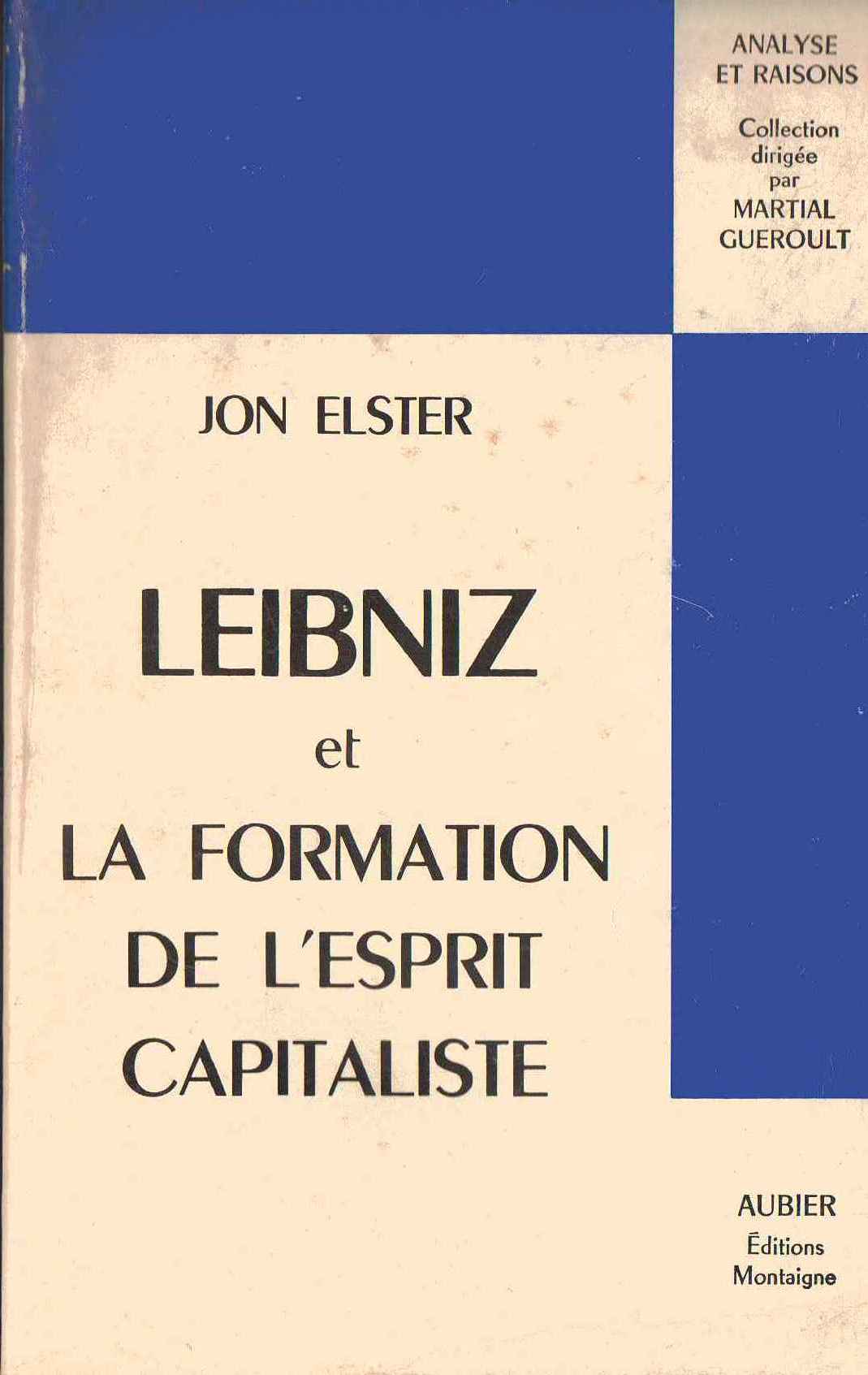
I first read Jon Elster as an undergraduate – Barbara Goodwin recommended his books Sour Grapes and Ulysses and the Sirens in her political theory class. Elster is also known as an analytical Marxist in works like Making Sense of Marx. But I’ve been trying to track down a (reasonably priced) copy of his first book, Leibniz et la formation de l’esprit capitaliste for some time. And now I have one. The internet makes this easier than it used to be, but this one was something of a challenge. In fact, the place I ordered it from charged me, and then sent a message saying they were finding it hard to track down a copy but then, instead of cancelling the order, which I’d expected, they sent another message to say that they had found one, and it was on its way.

The British Library has a copy, which I’d looked at before – it has a very good discussion of Leibniz’s work in the Harz mountains that I used when I was writing the ‘Fossils’ paper/chapter.

But as my interest in Leibniz continues, especially in what I’m calling ‘Another Leibniz’ to the dominant readings of his work, this a book I wanted to be able to refer to more often.

It was, as far as I can tell, never translated into English. There was a 1975 publication by Elster called Leibniz and the Development of Economic Rationality, but that’s only a 20 page pamphlet. A shame this isn’t better known or more widely available.

Posted in Fossils, Gottfried Leibniz, Karl Marx, Politics | Tagged , , , , | 1 Comment

Lovecraft for Beginners

Update: I originally got this from the Brooks blog, but to find the whole thing, you can go here. Thanks to Graham Harman for the link to the book as a whole.

Posted in Books, H.P. Lovecraft | Tagged | Leave a comment

Speculative Realism – Patricia Clough, Jane Bennett, Levi Bryant, Graham Harman

Patricia Clough, Jane Bennett, Levi Bryant, Graham Harman

Speculative Realism – Part One from The Center for the Humanities on Vimeo.

Speculative Realism – Part Two from The Center for the Humanities on Vimeo.

(via Larval Subjects)

Posted in Conferences, Graham Harman, Jane Bennett, Levi Bryant | Tagged , , , | Leave a comment

Henri Lefebvre – Vers un romantisme révolutionnaire

I had thought the French re-editions of Lefebvre had dried up, but the brief text ‘Vers un romantisme révolutionnaire’, first published in 1957 in Nouvelle revue française, is just out in a new edition, with a ‘présentation’ by Rémi et Charlotte Hess. Rémi Hess was one of Lefebvre’s students and his biographer; Charlotte is his daughter and a specialist on German romanticism. This piece appeared around the time Lefebvre was splitting from the French Communist Party, and produced some debate – there was a book of discussions on it published in 1958 that included contributions by Tristan Tzara and Lucien Goldmann. Kurt Meyer’s 1973 book Henri Lefebvre: Ein Romantischer Revolutionär took this text as a designation for Lefebvre as a whole. The text was reprinted in Au-delà du structuralisme; and Lefebvre returned to this later as the longest of the preludes in An Introduction to Modernity had the title of ‘Towards a New Romanticism’. What’s interesting about the title of the reprinted piece is that it is romanticism that is the key term, modified by revolutionary, and not the reverse.

The publisher page has more details.

Posted in Henri Lefebvre | Leave a comment

Jamie Peck on Neoliberalism in London

via Jane Wills on Crit-Geog-Forum

The School of Geography at Queen Mary University of London invites you to,

The EIGHTH DAVID M SMITH LECTURE to be held on 24 November 2011, 6:00 – 7:00pm at Drapers’ Lecture Theatre, Geography Building.

The public lecture “Fast policy, at the limits of neoliberalism” will be presented by Professor Jamie Peck, Canada Research Chair in Urban & Regional Political Economy at the University of British Columbia.

A wine reception will follow the lecture.

We hope you will be able to join us. Please feel free to forward this invitation as attached widely to your contacts.

RSVP: a.tan@qmul.ac.uk

Posted in Conferences | Tagged , | Leave a comment

First week teaching

Back to teaching, and good to be back in the classroom. In the first term our weeks run Thursday-Wednesday (which is confusing) so as my teaching is on Friday, Tuesday and Wednesday this means I’ve just finished the first week. Given the number of years I’ve been away from undergraduate teaching, I had a few comments suggesting I might be dreading it, or would find the transition hard. I am finding the administrative work and meetings difficult; but the actual class contact with students is great. I’ve always enjoyed that part. And I don’t feel like I’ve been out of touch entirely – I’ve regularly done seminars with students on my travels and when in a visiting post elsewhere. And I’ve done a lot of invited seminars, lectures etc. over the past few years.

This year I’m teaching a full-year module on Territory and Geopolitics; blocks of lectures in Political Geography and Theory and Geography; and a few other bits. In Political Geography we have four people teaching four week blocks – I do the ‘key concepts’ bit up front, on politics, geography and political geography; on power and the state; space and territory; and boundaries and frontiers. In Theory and Geography we have four thinkers covered, each by a different person. This year they are Foucault, Derrida, Butler and Deleuze. I’m doing the Foucault block. This means most of my teaching is in the first half of the first term. After October is done, I’ll mainly just have the Territory and Geopolitics module. The first half of that is historical; the second half twentieth century and contemporary. I’m looking forward to working with students throughout a full year. I’m happy doing the blocks of teaching in modules run by a few people, but you do lose the sense of seeing a group of students develop over a longer time period.

I’m also taking over the co-supervision of two PhD students. One has transferred from another department in Durham and is working on the social production of space in Tehran, and the other began in January when I was in Australia and is doing a comparison of urban landownership in China and Britain. Both are using Lefebvre, among other thinkers. Obviously PhD supervision involves a lot of suggestion and guidance, but I’ve learnt a lot from my PhD students in the past, and I’m sure Iman and Chaoqun will be no exception. So looking forward to that too.

Posted in Henri Lefebvre, teaching | 5 Comments