Nigeria

I was in Nigeria for nearly two weeks. It’s a direct flight from Amsterdam to Abuja, and the plane stops there for between 1 and 2 hours and then goes onto Kano. I arrived at about 11pm. Immigration and passport control was a bit difficult to understand – lots of people asking to check the passport and visa, and then lots more people asking to check that it had been checked okay. I then went onto baggage claim, and customs. I was asked to lift up my ‘box’ and one man rummaged through my case. He said it was okay to go, so I zipped it up, put it back down and went to leave. The woman next to him tutted loudly and asked me to lift it back up so she could look into it too. I’m not entirely sure why. By this point Susan had arrived and was laughing at them asking why they were giving her “Maigida” a hard time. It seems laughter and smiling usually gets you further here than annoyance.

I was barely in Kano before I left again, to go back to Abuja. After I’d booked my flight Susan had had to arrange meetings in Abuja. So we had an early morning call and back to the airport. Abuja is the capital and one of those slightly strange capitals that isn’t an especially big city, but is the centre of stuff just because it’s the capital. We went straight to the hotel, and just as we arrived at the hotel a bomb went off fairly close by at the police headquarters. The Boko Haram group have claimed responsibility. Reading the previous day’s papers – where the police chief had promised to crush them now that he had some new armoured personnel carriers – gave me a bit of background on the situation. But I also had a call to the hotel from Susan, instructed by her bosses to check I was okay and advised not to leave the hotel in the current situation. Things were fine, but I didn’t go out until that evening for dinner.

We stayed the rest of the time in Abuja with colleagues of Susan’s, and had various dinners, meals and a fun trip out to a large reservoir and to a small pottery factory where we had a great lunch. It was good to get out of the city.

Then back to Kano. It took a long time to get back, partly because the plane went via Sokoto – not exactly a straightline, but a triangular Abuja-Sokoto-Kano route that inevitably gets later and later as the day goes on. It was only then that I really got to see Kano, which is where Susan is living and working. Kano is a big city – the second biggest in Nigeria after Lagos – and stretches for what seems like miles.

Nigerian driving is pretty dangerous. I am full of admiration for anyone who can cope with it. There are no traffic lights at major junctions; roundabouts either don’t have rules or they are completely ignored; there are massive potholes and ditches in the road; and a mix of heavily laden trucks, bicycles, tuk-tuks and lots and lots of motorbikes all together, often on the wrong side of the road, and trying to avoid people, goats and the rubbish. The rubbish is not piled as much as spread – spread out in thin layers so it can be picked through by scavengers, and then burnt. Susan told me it was better now it was the rainy season as the grass grew up and hid some of it. The smell of this and the sewage is pretty strong.

The one walk we took in Kano in the early evening was along some old railway tracks. There was a lot of rubbish there too, and it was also a very public bathroom (open defecation in development speak). One of the major sights along the way was a goat tannery. Unsurprisingly they have problems with rats, and we saw a few. There are more lizards here than anywhere I’ve been. But the other wildlife is nicer – lots of beautiful birds, and lizards and rodents feed the owl, black kite and several hawks we saw. There are also the herds of cattle being moved across the country by nomadic Fulani people, often young boys. It’s interesting to see the mix of old livestyles somehow continuing.

Everyone said if you want things to work, get somewhere quickly, or expect efficiency you will find it very hard. So, I tried to manage. Much of the time I was staying at Susan’s home, working. More on what I did – mainly reading Foucault and writing on that – in another post at some point [update: see here]. But there was almost no internet for the first five days here, and regular powercuts. Simply going to get a loaf of bread could be quite an operation. The supermarket has a seemingly large array of food, but often out-of-date and frequently unbelievably expensive. Much better to eat more as Nigerians do, or at least with stuff that is natural here rather than imported, which is why Susan has been working hard on her garden.

Bribery and corruption are rife. I wish it wasn’t that way, as I don’t want to continue the prejudice, but it just seems to be true. We got stopped by some pretty shady looking police at one point in Kano. No reason, just a spontaneous stop. They wanted the papers. Susan didn’t have them because the last time she was stopped they confiscated them, awaiting the bribe, and didn’t get them back. So they said we should pull over and they would impound the car. Susan has diplomatic plates, so this is not supposed to happen. She got on her phone and called the British High Commission – well, actually a colleague, but this is what she told the policeman. She was arguing with the policeman and the advice she had over the phone was to refuse to stop the engine and instead drive off. Assessing that the officer didn’t have a gun and was a long way from his parked car we did just that. He jumped out of the way to avoid having a toe run over and hit the car pretty hard.  But they didn’t follow us – seemingly thinking it was less effort to try to pull the same deal on the next person they saw drive by.

I did get to meet some very nice and fascinating people, both development workers and local Nigerians. Saturday night was a party for colleagues who were leaving. An interesting mix of people came along. Susan lives on a compound with four houses, and there are several people employed to garden, clean, cook, drive and guard. They were exceptionally kind and – I think – simply curious about me. I found it hard to see how friendly almost everyone was here with the terrible state of the country. I can’t quite explain it, but there is a sense that the ties that keep things together here are pretty fragile. While Susan was with me in Australia there was a lot of violence in Kano in the wake of the presidential election. One of the guards at the compound was killed, as were friends and relatives of other people I met, and a lot of houses were burnt down. Somehow things carried on after it died down, and it seems to have returned to a state of normalcy. But I get a strong sense it could quickly return. There are lots of racial and religious divisions here, many of which I found hard to see until they were pointed out.

Although Susan has been here since October this was my first visit, as we’d previously met up in London or Egypt, plus her trip out to Australia. It won’t be the last.

Posted in Travel | Leave a comment

AHRC and ‘Big Society’ – action needed

Posted on behalf of Thom Brooks. Please read and consider writing:

Dear friends and colleagues,

My thanks again for your support in the campaign to persuade the UK’s Arts and Humanities Research Council (AHRC) to remove the “Big Society” from its current delivery plan. Please take a moment to read this important message.

We have widespread support for our campaign. Our petitions have attracted over 4,000 signatures from across disciplines and political divisions. Signatories include Fellows of the British Academy and Royal Society. More than 30 learned societies agreed a joint statement in support of the petition. Hundreds of emails and letters of support have been sent to Rick Rylance, the AHRC CEO. The UCU has supported our campaign and the Rt Hon David Willetts (Minister of State for Universities and Science) has recently remarked on the “hazard” of including political campaign slogans in research council delivery plans. The support has been truly unprecedented and the issue has received much media coverage. This includes new articles published in the Guardian recently: http://www.guardian.co.uk/education/2011/jun/19/academics-quit-over-big-society

This has encouraged the Shadow Universities minister, Gareth Thomas MP, to write to Willetts to demand action: http://www.guardian.co.uk/education/2011/jun/20/labour-steps-into-big-society-row?CMP=twt_fd

The AHRC response has been disappointing. They continue to reject calls for this brief, but important, change to the AHRC Delivery Plan. We argue a point of principle, not politics: political campaign slogans have no place in research council delivery plans for strategic funding priorities. Period. I believe we are now at a critical moment and I request your help:

1. AHRC PEER REVIEW COLLEGE MEMBERS

I am a member of the AHRC Peer Review College. If you are also a member, then please contact me ASAP by THURSDAY MORNING, 24th JUNE to confirm whether you are willing to join me with many others and resign on MONDAY, 27th JUNE if no action is taken on amending the AHRC Delivery Plan. I will offer a press release later this week. Resignation is surely a last resort, but I believe that all avenues have been explored without success. While I hope we need not act on our threat, it is clear that we must now come together and show the strength of our support for our principled position. I hope all AHRC Peer Review College members will accept this call — and please circulate this message to anyone on the College.

2. NON-MEMBERS

Please write to the AHRC and voice your continued support for our campaign. The AHRC appears to believe our opposition is fading: in fact, it is growing and recent publicity in the Guardian confirms this. Contact information includes the AHRC CEO Professor Rick Rylance (r.rylance@ahrc.ac.uk) and AHRC Chairman Professor Sir Alan Wilson(executive@ahrc.ac.uk).

3. FOR EVERYONE

Please write to David Willetts and voice your support. You might use the following template:

david@davidwilletts.co.uk

Dear Rt Hon Willetts,

I want to share my support for the campaign to remove the “Big Society” from the Arts and Humanities Research Council’s Delivery Plan. This is a position of principle, not politics: political campaign slogans should have no place in research council delivery plans. This position is endorsed by over 4,000 academics and 30+ learned societies as well as the UCU.

Petitions (see http://www.ipetitions.com/petition/thebigsociety/) have drawn support from across disciplines and political divides. Please communicate to the AHRC the importance of taking action and removing this campaign slogan immediately.

Yours sincerely,

[Name]

I believe that the momentum is on our side and positive action likely, but only if we act together and we act fast. I hope I can look forward to your support one last time. We are very close to achieving our goal and defending an important principle.

Sorry for the formatting errors earlier; hopefully now fixed.

Posted in Politics, Universities | Leave a comment

Carl Schmitt workshop audio files

Audio files for a conference on Carl Schmitt recently held in London are now available, here.

Posted in Carl Schmitt | Leave a comment

Foucault Effect first panel

Thanks to Justin Choi for the picture – this is from the first panel (left to right: me, Colin Gordon, Daniel Defert, Peter Fitzpatrick, Maria Carolina Olerte).

Posted in Conferences, Michel Foucault | Leave a comment

Free Downloads page

I’ve added a page with links to all the material I know that is available online without subscription.

Posted in My Publications, Publishing | Leave a comment

Oecumene Symposium: Citizenship after Orientalism

Engin Isin’s fascinating Oecumene project has details of their first symposium, on the theme of ‘Citizenship after Orientalism’ here. The events run from Feb 6-11, and keynote speakers are a stellar lineup of Judith Butler, Paul Gilroy, Bryan Turner and Engin himself. The site also has links to lots of other info, including a blog. More details below.

The Oecumene project is pleased to announce its first
Symposium
Citizenship after Orientalism
6-11 February 2012, The Open University, Milton Keynes

The Symposium will include:
A Conference ‘Opening the Boundaries of Citizenship’ [6-7 February], An International PhD School ‘Tracing Colonialism and Orientalism in Social and Political Thought’ [8 February],
A series of workshops addressing specific topics on critical new ways of conceptualising citizenship [9-11 February].

Keynote speakers: Judith Butler (University of
California, Berkeley), Paul Gilroy (LSE), Bryan Turner (CUNY), Engin Isin (The Open University). 
PhD School Conveners: Ian Almond (Georgia State
University), Roberto Dainotto (Duke University).

The first Symposium will explore what it means to open up the boundaries of citizenship. How can we give an account of other ways of being political? Which political practices have
been rendered inarticulable as political by exclusionary ideas of citizenship? These questions seem most relevant today, in light of the contemporary re-articulation of orientalist and colonial projects, the increasing popular discontent towards renewed exclusionary logics, and the contested meanings of
democratic politics across boundaries.

The call for papers and
applications are now open
.
For further details please visit our website: http://www.oecumene.eu

Posted in Conferences, Engin Isin, Judith Butler | Leave a comment

Harman on Meillassoux

A very interesting piece by Graham Harman on Quentin Meillassoux is available open-access here.

Posted in Graham Harman, Quentin Meillassoux | Leave a comment

Roundup – St. Paul, Heidegger, Peter Gratton, Thinking Nature, Levi Bryant

Since I arrived in Nigeria on Wednesday evening, internet access has been a bit erratic. Will hopefully post something about being here soon. In the meantime, here’s a roundup of interesting stuff out there.

Adam Kotsko makes the suggestion of a collected writings of Paul here:

In the last ten years or so, there has been a growing interest both in liberation readings of Paul within the biblical studies and theological guilds and in secular reappropriations of Paul by radical philosophers. Hence, I think that the time is perhaps ripe for a new presentation of the works of Paul: a volume that includes only the undisputed Pauline corpus, in a fresh translation carried out by biblical scholars of a liberation bent.

The volume would first of all need to downplay that traditional
trappings of biblical texts: for instance, the chapter and verse breaks could be banished to the margins or even excluded altogether. It should obviously include introductions to each letter and an appropriate level of annotations, along with
a general introduction laying out the overall mission and self-understanding of Paul. Ideally these would all proceed as though the “traditional” reading of Paul simply did not exist, though that may be difficult to pull off in practice — at the very least, the apparatus should avoid getting bogged down in
“disproving” previous readings (continues).

In contrast, Tim Morton is critical of the turn to Paul, which he says no longer is simply Agamben, Badiou and Zizek, but also now includes Simon Critchley.

Speaking of Critchley, he is one of those whose Heidegger Colloquium talks at Stony Brook are now available on video. Also includes Eduardo Mendieta, Daniel Dahlstrom, Don Ihde and many others.

Peter Gratton is moving to Memorial University, but will be spending a bit of time in the next academic year at the Australian National University’s Humanities Research Centre, where I spent a very happy few months. They are lucky to have him; and I’ll sure he’ll enjoy it there.

The first issue of the new online, open access journal, Thinking Nature, is now available.

And finally, Levi Bryant’s book The Democracy of Objects is up on the Open Humanties Press site. The book will be out soon, available in a couple of open-access formats and in printed form. Levi offers some thoughts on the book and the publishing model here.

Posted in Alain Badiou, Eduardo Mendieta, Giorgio Agamben, Levi Bryant, Publishing, Slavoj Zizek | Leave a comment

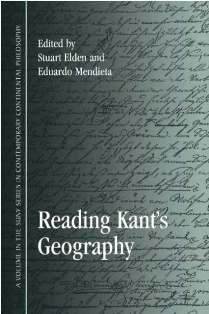
Reading Kant’s Geography out

Finally! Reading Kant’s Geography, the collection I co-edited with Eduardo Mendieta is out. I’ve not yet seen a copy, but Eduardo has. You can download my introduction for free here.

Contributors include Robert Bernasconi, Jeff Malpas, Onora O’Neill, Charles Withers, Walter Mignolo, David Harvey, Edward S. Casey, etc. Full contents list and endorsements from David N. Livingstone and Chris Philo on the SUNY Press page.

Yes, the price is very steep, but a paperback should be out in a year. SUNY Press have a form for journal review copies to be ordered here.

Posted in Books, David Harvey, David N. Livingstone, Eduardo Mendieta, Edward Casey, Immanuel Kant, My Publications | Leave a comment

2012 Telos Conference – Space: Virtuality, Territoriality, and Relationality

This conference looks really interesting – but not sure I can cope with three transatlantic flights in early 2012.

CALL FOR PAPERS:

The 2012 Telos Conference:
Space: Virtuality, Territoriality, and Relationality

January 14-15, 2012
New York City

Every day we see examples of how the Internet has released us from the bounds of our spatial rootedness and opened up new virtual landscapes for people all over the world. Everything near and far has become equally accessible, and spatial distance is no longer the limitation that it once was. But as much as the Internet and new forms of social networking have transformed our relationship to physical space, both political events and economic crises have also reaffirmed the importance of territory, sovereignty, and land in determining the conditions in which people live their daily lives. The preeminence of the struggle for territory is as unmistakable in the continuing conflict in Afghanistan, the street fighting of the Arab Spring, and the agonizing border negotiations of the Israeli-Palestinian conflict as it is in the geographical parameters of the European debt crisis and the role of real estate in the U.S. financial crisis. These conflicts between opposing nations, rulers and ruled, creditors and debtors, have been about holding one’s ground in a very literal way, and the differing outcomes in various countries have demonstrated how a virtual reality still awaits a transformation into the physicality of the neighborhood and the street. By the same token, land claims are based on a virtual system of relations imbedded in a particular conception of order. Such a virtual system might be itself a kind of colonizing force, turning the landscapes of the mind into territory to by occupied and defined by a particular system. So the concept of space is both eminently concrete as the struggle over land and exceedingly abstract as the conflict between conceptual systems. In addressing the theme of space, the 2012 Telos Conference in New York invites papers that deal with the variety of ways in which space defines our social, economic, political, and conceptual reality. Topics could include: the virtualization of space by the Internet and social networking, issues of land appropriation and sovereign space, questions about real estate markets and finance, and the imagination of relationality as the metaphysical essence of space.

Please submit conference paper proposals with a 200-word abstract and a short CV by August 31, 2011, to telos@telospress.com. (Mark the subject line “Telos conference proposal.”)

Posted in Conferences, Territory | Leave a comment