Heidegger – Introduction to Philosophy

The first book I’ve read by Heidegger in some years was the English translation Introduction to Philosophy-Thinking and Poetizing (Indiana UP, 2011). At $30 for 74 pages it’s not exactly cheap. Part of the reason is that this was a 1944 lecture course which was not completed because Heidegger was drafted into the Volkssturm in the final stages of the war. After the war Heidegger was banned from teaching because of his involvement with the Nazi regime. The course has some interesting moments, but there is a lot of filler here – variants from the manuscript, a different version of a course review, Heidegger’s notes on the course, etc. 

In addition, the translation is only of half of volume 50 of the Gesamtausgabe. The other part of that volume is the undelivered lecture course ‘Nietzsche’s Metaphysics’, drafted in 1940 and planned for 1941-42 but not delivered. The reason that this is not translated here is because it was included in volume 3 of the Nietzsche book David Farrell Krell edited. In a sense this appears fair enough. But the German version of the Nietzsche book, which originally appeared in 1961, appeared in the Gesamtausgabe as volumes 6.1 and 6.2. (Note that the English Nietzsche does not exactly replicate the German Nietzsche – some texts are not included; other ones are.) The editors of the Gesamtausgabe decided, apparently following Heidegger’s own instructions, that volume 50 should include the undelivered Nietzsche course too. There are minor differences between ‘Nietzsche’s Metaphysics’ in 6.2 and 50. The German editors of 50 say there are two reasons for the inclusion of Thinking and Poetizing with the Nietzsche text: “due to the thematic relation; [and] due to its brevity, it would not have sufficed for a single volume”. What’s amusing is that this editorial line is translated in the English version, but without the paired text that was a thematic relation and a justification for it being a single volume.

This is a grumble about an incomplete translation, rather than the cost of a very slim book. It now means that there is little-to-no chance of the Vol 50 variant of  ‘Nietzsche’s Metaphysics’ being translated into English. I don’t recall the extent of the variations, but they were substantial enough to justify two versions in the Gesamtausgabe. But they were not presumably enough to convince Indiana UP to translate them here. More seriously, the lecture courses that form the basis of the four volumes of the English Nietzsche book appear in the Gesamtausgabe twice too – in volume 6.1, and in volumes 44, 45, 46 and 48. But here the variations are really substantial, and the courses as actually delivered are quite a bit longer than the versions Heidegger chose to publish in 1961. What chance those volumes will ever be translated?

Update – to clarify, the Nietzsche course is the real centre of Vol 50 in the Gesamtausgabe. Its intended delivery date of 1941/42 means that it is chronologically the right place; had ‘Thinking and Poetizing’ been the course that determined its placing it should have come after the Heraclitus volume (GA55). What we have here is a course deemed too insubstantial to be a volume in its own right translated as a standalone book in English. I wonder if part of the reason is that the numbering of the Gesamtausgabe is a bit of a mess. The few double volumes are sometimes because two courses are combined in one volume – i.e. GA36/37 (recently translated as Being and Truth) -and sometimes because a course that was intended for a volume turned out not to be extant – i.e. GA29/30 (The Fundamental Concepts of Metaphysics) covers for a missing course that was supposed to be in GA29. They then found a summary of that course which was printed as an appendix in GA28. GA46 on Nietzsche’s second Untimely Meditation was, if I have the story right, thought to be a lecture course, which is why it was assigned a place in the lecture division of the Gesamtausgabe, but turned out to be a seminar. It was published there anyway, separate from the other Nietzsche seminars that appear in GA87. Theodore Kisiel wrote some interesting pieces about the dubious textual strategies employed in the Gesamtausgabe, but there is potentially a good research project on the politics and strategies of publishing decisions using this as a focus. I think the initial prospectus was quite rushed, right toward the end of Heidegger’s life, and was clearly based on incomplete records.

Posted in Friedrich Nietzsche, Martin Heidegger | 1 Comment

Foucault on Heterotopias and the Body

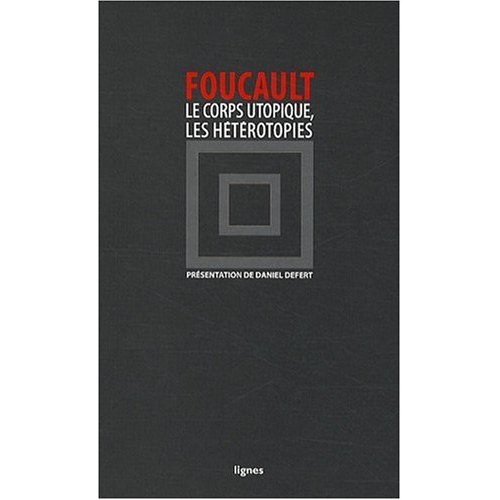
A few years ago two radio addresses by Foucault on heterotopias were made available on a cd entitled ‘Utopies et hétérotopies’. In 2009 they were transcribed and published as a little book in French called ‘Le Corps Utopique – Les Hétérotopies’. The book includes the two pieces by Foucault and a piece by Daniel Defert situating them. Defert’s piece had appeared in a slightly different form in the cd booklet. The piece entitled ‘Les hétérotopies’ is a version of the second half of the piece known as ‘Des espaces autres’, which has been translated as ‘Of Other Spaces’ (a variant translation is in the Aesthetics volume as ‘Different Spaces’). ‘Les hétérotopies’ doesn’t include the material on the history of space at the beginning of the other text, but gives some different examples of heterotopias and expands some of them. The piece entitled ‘Le corps utopique’ is different and doesn’t relate to any other Foucault text, as far as I can tell.

The heterotopias idea has been picked up by a number of geographers and others interested in Foucault’s work on space. I don’t find it especially useful in thinking about space, and think there is much more useful work in Foucault’s historical writings for those interested in spatial analysis, but there are some interesting discussions here. These texts date from 1966, and ‘Le corps utopique’ is important in terms of Foucault’s intellectual trajectory, because he talks about the body in a way that antipates work of the 1980s. He’s interesting in  the physical nature of the body, our ways of rendering our own body visible, and the situation of the body in relation to our world. Only at the very end does the body become sexual.

Full details of the book can be found here. Foucault’s piece on the body was translated in a collection called Sensorium a few years back. (I’ve not seen that translation.) As far as I know there are no plans for an English translation of the book as a whole, but there might be enough here to justify one, especially if Defert’s piece was included. It could be partnered with a re-translation of ‘Des espaces autres’, which especially in the history of space part of the lecture is not very reliable.

Posted in Michel Foucault | Tagged , , | 3 Comments

Crampton, Cartography, Calculation, Territory

Jeremy Crampton responds to the Latourian argument about maps here; and notes in his previous post that his paper “Cartographic calculations of territory” is now published in Progress in Human Geography.

Posted in Bruno Latour, Jeremy Crampton, Territory | Leave a comment

Foucault on Politics, Security and War in paperback

Michael Dillon and Andrew Neal (eds.), Foucault on Politics, Security and War, which was previously only available in hardback, is now available in paperback. Details here. I have a chapter in this on the collaborative projects Foucault was involved in during the mid 1970s, largely drawing on materials archived in Paris and works unavailable in English.

Posted in Michel Foucault, My Publications | Leave a comment

Bruno Latour at the Architecture Association

Thanks to Stephen Legg for the alert.

Do objects reside in res extensa and if not where are they located?

Date: 22.02.2011; Time: 18:00:00; Place: Architecture Association

Experience of space is supposed to be divided into an objective reality that is not “really lived” and a “lived” reality which, on the other hand, is not objectively real… The lecture will explore this apparently philosophical question by surveying several topics which have been deeply renewed by the digital techniques: the experience of using digital cartographies; the mapping of scientific controversies and the reinvention of originals through fac similes by the British artist Adam Lowe and his Madrid studio Factum Arte.
Bruno Latour is professor in Sciences Po Paris and references to his work may be found on www.bruno-latour.fr
Paper 1 Paper 2

More details here.

Posted in Bruno Latour | 1 Comment

David Harvey reviewed in the LRB

A review of his recent books The Enigma of Capital and the Companion to Marx’s Capital, but going back to his earlier writings. Find it here (free access).

Posted in David Harvey | Leave a comment

Cahier Foucault

Just received this invitation. Looks like the book being launched (almost no details there yet) might be interesting.

Posted in Michel Foucault | Leave a comment

PhD studentships at Nottingham

The School of Geography at the University of Nottingham holds two AHRC doctoral studentships to be awarded for doctoral research commencing in September 2011 (subject to confirmation by AHRC of this year’s Block Grant Partnership allocation). Reference LSS/265. Closing date: 18 February 2011.
 
Details of research in the School are available on the department website; and more details here

Posted in Universities | Leave a comment

PhD studentships at Queen Mary

Some good funding opportunities for PhD students in geography at Queen Mary, University of London. Details here. I spent a term as a visitor at QM a couple of years ago, and it is a very strong department in an interesting part of London.

Posted in Universities | Leave a comment

Transparency in refereeing

A interesting proposal here, trading on here.

Accepted, refereed papers and books should be accompanied with the name of the referees and, ideally, their reports, if only, in the online edition. (Note rejections can still be done anonymously.)

I hope this will have four positive consequences:

1. People can get credit (including for tenure and grants) for work done and this should increase number of responsive referees. Given the increased reliance on objective performance metrics (and the ongoing, general expansion of higher education in the world with Brazilian and Chinese universities soon sporting there own research orientation), there is an avelange of papers joining the refereeing pipeline.  This alone is putting stress on the system. The most likely referees are being overwhelmed with requests. (Short of charging submission fees and paying referees, this is probably best way to improve the system.)

2. It should increase transparency about intellectual networks. Small groups of incrowds have a tendency (perhaps unconsciously) to favor work done by friends or that cites them.

3. With publicity becoming the norm referees have an incentive to do diligent work, that is, try to catch plagiarism, make sure that relevant scholarship is cited, objections are raised, etc.

4. It makes the role and choices of of the editor subject of more careful scrutinity. Now they often appear as a neutral clearinghouse–but in their choice of referees and their interpretations of them they have considerable leeway.

Right now refereeing is organized like a secret priestcraft. The underlying message is, ‘trust us.’ But this will not do anymore. We should not give up on expert review, and we should promote the gift-giving culture that is a quickly vanishing within academia. Some mild transparency may actually go a long way here.

I’m open to the idea, because as I’ve said before (here and here), the current system is not working well. But, as an editor, my biggest concern is the difficulty in getting reports, and getting them in a timely manner, so we can process papers efficiently.

But I’m sceptical of the benefits here. I am not sure that 1 will work in the way intended; 2 and 3 sound good with cautions; 4 is the most interesting though has several problems.

1. Many journals already post lists of referees used in a year, so there is already one record of thanks. I keep a log of journals I’ve reviewed for, which is on my cv. Do we need to make the direct link between a single paper and a named referee to give appropriate credit? And, put crudely, are the benefits from being a referee under this model really likely to increase willingness to referee? I think that some pretty serious benefits would be needed to tilt things away from the place they are now.

2. This is a potential problem, but is dependent, in part, on editors to stop this. Transparency might make this better. But if you can reject anonymously, does the argument not fall down from the other side if this author isn’t part of the club, or is challenging a dominant position that referees wish to protect?

3. Perhaps, but is knowing that your report may become public going to improve things? Yes, in one respect, because if you agree to do it, you may do it more thoroughly, carefully and responsibly. At the very least, some referees may learn to spellcheck and proof their reports. It might also stop referees insisting that authors reference the referee’s own work. It might stop the needlessly negative (though not if rejections are still anonymous). But equally, more conscientious reports will take more time. And so, even good referees may end up saying no to more requests in order to spend more time on those they do, which would be counterproductive.

4. I have no problem in principle with my, and my co-editors, suggestions for referees on a paper being made public. But this cannot simply be the ones who actually did the review. It would need to be those who were asked, because the ones who actually do the reports might, to an outside observer, look a slightly odd mix. Why them, and why did you not ask Professor X who is the world expert on the case study, or Dr Y whose theoretical work would fit the aims of the paper? Well, maybe we did, maybe they said no, for whatever reasons, or maybe they didn’t reply. Maybe we asked five or six excellent referees before we found ones who were willing to do it. Unless the whole process is made public – which has serious downsides – then the view from the outside on the editors’ choices risks being seriously skewed.

Most generally, do editors have to secure agreement from all referees that their reports will become public? And what happens if an otherwise willing referee refuses that permission? Do we disqualify them from being a referee? Would we need to abolish the practice of reports for an editor and separate comments for an author? (I’m actually in favour of this generally, but there are exceptions.) Would junior scholars worry that their comments might count against them if they are critical of more senior scholars?

With books I see fewer problems, but again, there might need to be some careful thinking here. I’ve suggested books be rejected by presses that have then been published. I’ve been asked to endorse books, agreed, and then when I’ve read the ms. said that I’m not able to give a truthful, positive comment, and indeed recommended the book is substantially revised before publication. But by that point it’s usually too late and the book appears anyway. How much of that is made public?

I’m sure there are more issues. I’m really glad this is being discussed, and don’t want to dismiss suggestions like this out of hand. But there are some serious problems with the proposals. Most significantly it gets rid of the idea of anonymous peer-review. Anonymity is only for a limited period – until acceptance. The benefits that come from anonymity are going to be lost. That needs careful thought.

Posted in Publishing | Leave a comment