The lecture I gave in Nijmegen in September last year is now available on video here. You can find my own reflections on how the lecture went here.
You can find the other lectures in the series here.
The lecture I gave in Nijmegen in September last year is now available on video here. You can find my own reflections on how the lecture went here.
You can find the other lectures in the series here.
Today is the last day of my Leverhulme major research fellowship. As of tomorrow I am on research leave.
The Leverhulme award was to work on the history of the concept of territory project. I’d already been working on that topic, on and off, for several years before I got the Leverhulme award, but have been devoted to it full time since. Well, I’ve also been editing Society and Space, which is a lot of work, and the Terror and Territory and Reading Kant’s Geography books, which were both supposed to be complete before it begun, spilled into it a bit. (Neither was exactly in my control.) And the Sloterdijk Now collection has keep me busy just recently. But I rarely work a standard working week, and I am confident that I’ve done what I said I wanted to do in the proposal, and have a near complete manuscript entitled The Birth of Territory as a result.
It’s been quite a journey – intellectually and literally. Just in the fellowship time it’s taken me to Singapore, London and Seattle for visiting posts, and there have been talks in a range of places – Ireland, Italy, Holland, Finland, Sweden, Denmark, Germany, Israel, Canada, the USA, Macau, and Japan. A whole host of amazing places have been seen along the way.
Although the earliest talk on this project dates back to 2000, I began seriously thinking about just what kind of project I had on my hands in early 2006. This was just after Speaking Against Number had appeared and I arrived in Tasmania for research leave with no deadline, no plan to write, but some time to read and think. I applied for the Leverhulme award shortly after my return. At that point I knew much better what I wanted to do, and what I needed to do it, namely time. Obviously things developed as I dived into this work full-time, and the lack of other pressures meant that I could do things differently than I could have done otherwise. The specific content, and the arguments within, have changed dramatically. But essentially the book I’ve delivered follows the contours of the outline I sketched in 2006.
So today was a day of transition. The manuscript lacks only an introduction and conclusion, and these will largely be shaped from material I’ve already drafted. That’s the task for the next couple of weeks.
I fly to Australia in mid February (via Singapore), for the fellowship at ANU, and the intention is again to read and think, without a looming deadline, about the next book, tentatively entitled The Space of the World…
‘The people want the regime to fall’ – in its own words
This blog is a collection of comments, contributions and visual media from the Egyptian uprising. It is sent out from one of the few locations in Cairo with an internet connection. Mubarak’s regime cut the internet to the country ahead of a call for a day of rage. The consequences of this day have gone beyond any expectations.
“The people want the regime to fall” has been the most common chant on the streets.
Only a couple of posts so far, but the one of graffiti, with translations, is especially interesting. (Thanks to Stalin’s Moustache for the link.)
Interesting review of Mehdi Belhaj Kacem, L’esprit du nihilisme: Une ontologique de l’Histoire by Alexander R Galloway here. Thanks to An und für sich for the pointer.
Galloway notes the relation of Badiou and Agamben that is going on in his work, and also that as well as needing an English translator he needs an editor. Sounds like a job pitch to me, but it’s a good one.
Bit late linking to this – it’s been around for a few days – but The Atlantic has translated some of the leaflet which makes for interesting reading – with some background in The Guardian here.
Because of the London weather just before Christmas I was only in Cairo itself for a very short while, but it’s still fascinating to watch when you know some of the places.
For interesting accounts that go beyond the mainstream media, see Juan Cole’s Informed Comment and Lenin’s Tomb. China Miéville provides some sharp comments on the attitude of the media and Western governments, interspersed with other things, here. I should also note that Graham Harman’s blog is interesting for a more personal account – he’s currently in Bombay, and unable to return home to Zamalek. He has had some interesting pieces sent by his friends, colleagues and students. US nationals are being told to leave the country, so I wish him well if he is able/choses to get back.
The first book I’ve read by Heidegger in some years was the English translation Introduction to Philosophy-Thinking and Poetizing (Indiana UP, 2011). At $30 for 74 pages it’s not exactly cheap. Part of the reason is that this was a 1944 lecture course which was not completed because Heidegger was drafted into the Volkssturm in the final stages of the war. After the war Heidegger was banned from teaching because of his involvement with the Nazi regime. The course has some interesting moments, but there is a lot of filler here – variants from the manuscript, a different version of a course review, Heidegger’s notes on the course, etc.
In addition, the translation is only of half of volume 50 of the Gesamtausgabe. The other part of that volume is the undelivered lecture course ‘Nietzsche’s Metaphysics’, drafted in 1940 and planned for 1941-42 but not delivered. The reason that this is not translated here is because it was included in volume 3 of the Nietzsche book David Farrell Krell edited. In a sense this appears fair enough. But the German version of the Nietzsche book, which originally appeared in 1961, appeared in the Gesamtausgabe as volumes 6.1 and 6.2. (Note that the English Nietzsche does not exactly replicate the German Nietzsche – some texts are not included; other ones are.) The editors of the Gesamtausgabe decided, apparently following Heidegger’s own instructions, that volume 50 should include the undelivered Nietzsche course too. There are minor differences between ‘Nietzsche’s Metaphysics’ in 6.2 and 50. The German editors of 50 say there are two reasons for the inclusion of Thinking and Poetizing with the Nietzsche text: “due to the thematic relation; [and] due to its brevity, it would not have sufficed for a single volume”. What’s amusing is that this editorial line is translated in the English version, but without the paired text that was a thematic relation and a justification for it being a single volume.
This is a grumble about an incomplete translation, rather than the cost of a very slim book. It now means that there is little-to-no chance of the Vol 50 variant of ‘Nietzsche’s Metaphysics’ being translated into English. I don’t recall the extent of the variations, but they were substantial enough to justify two versions in the Gesamtausgabe. But they were not presumably enough to convince Indiana UP to translate them here. More seriously, the lecture courses that form the basis of the four volumes of the English Nietzsche book appear in the Gesamtausgabe twice too – in volume 6.1, and in volumes 44, 45, 46 and 48. But here the variations are really substantial, and the courses as actually delivered are quite a bit longer than the versions Heidegger chose to publish in 1961. What chance those volumes will ever be translated?
Update – to clarify, the Nietzsche course is the real centre of Vol 50 in the Gesamtausgabe. Its intended delivery date of 1941/42 means that it is chronologically the right place; had ‘Thinking and Poetizing’ been the course that determined its placing it should have come after the Heraclitus volume (GA55). What we have here is a course deemed too insubstantial to be a volume in its own right translated as a standalone book in English. I wonder if part of the reason is that the numbering of the Gesamtausgabe is a bit of a mess. The few double volumes are sometimes because two courses are combined in one volume – i.e. GA36/37 (recently translated as Being and Truth) -and sometimes because a course that was intended for a volume turned out not to be extant – i.e. GA29/30 (The Fundamental Concepts of Metaphysics) covers for a missing course that was supposed to be in GA29. They then found a summary of that course which was printed as an appendix in GA28. GA46 on Nietzsche’s second Untimely Meditation was, if I have the story right, thought to be a lecture course, which is why it was assigned a place in the lecture division of the Gesamtausgabe, but turned out to be a seminar. It was published there anyway, separate from the other Nietzsche seminars that appear in GA87. Theodore Kisiel wrote some interesting pieces about the dubious textual strategies employed in the Gesamtausgabe, but there is potentially a good research project on the politics and strategies of publishing decisions using this as a focus. I think the initial prospectus was quite rushed, right toward the end of Heidegger’s life, and was clearly based on incomplete records.
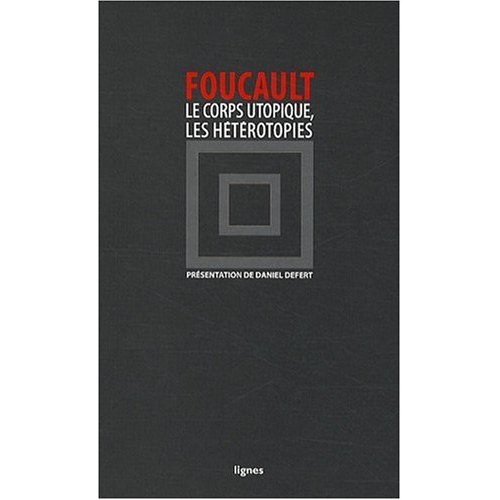
A few years ago two radio addresses by Foucault on heterotopias were made available on a cd entitled ‘Utopies et hétérotopies’. In 2009 they were  transcribed and published as a little book in French called ‘Le Corps Utopique – Les Hétérotopies’. The book includes the two pieces by Foucault and a piece by Daniel Defert situating them. Defert’s piece had appeared in a slightly different form in the cd booklet.
 The piece entitled ‘Les hétérotopies’ is a version of the second half of the piece known as ‘Des espaces autres’, which has been translated as ‘Of Other Spaces’ (a variant translation is in the Aesthetics volume as ‘Different Spaces’). ‘Les hétérotopies’ doesn’t include the material on the history of space at the beginning of the other text, but gives some different examples of heterotopias and expands some of them. The piece entitled ‘Le corps utopique’ is different and doesn’t relate to any other Foucault text, as far as I can tell.
The heterotopias idea has been picked up by a number of geographers and others interested in Foucault’s work on space. I don’t find it especially useful in thinking about space, and think there is much more useful work in Foucault’s historical writings for those interested in spatial analysis, but there are some interesting discussions here. These texts date from 1966, and ‘Le corps utopique’ is important in terms of Foucault’s intellectual trajectory, because he talks about the body in a way that antipates work of the 1980s. He’s interesting in the physical nature of the body, our ways of rendering our own body visible, and the situation of the body in relation to our world. Only at the very end does the body become sexual.
Full details of the book can be found here. Foucault’s piece on the body was translated in a collection called Sensorium a few years back. (I’ve not seen that translation.) As far as I know there are no plans for an English translation of the book as a whole, but there might be enough here to justify one, especially if Defert’s piece was included. It could be partnered with a re-translation of ‘Des espaces autres’, which especially in the history of space part of the lecture is not very reliable.
Jeremy Crampton responds to the Latourian argument about maps here; and notes in his previous post that his paper “Cartographic calculations of territory” is now published in Progress in Human Geography.
Michael Dillon and Andrew Neal (eds.), Foucault on Politics, Security and War, which was previously only available in hardback, is now available in paperback. Details here. I have a chapter in this on the collaborative projects Foucault was involved in during the mid 1970s, largely drawing on materials archived in Paris and works unavailable in English.
Thanks to Stephen Legg for the alert.
Do objects reside in res extensa and if not where are they located?
Date: 22.02.2011; Time: 18:00:00; Place: Architecture Association
Experience of space is supposed to be divided into an objective reality that is not “really lived” and a “lived” reality which, on the other hand, is not objectively real… The lecture will explore this apparently philosophical question by surveying several topics which have been deeply renewed by the digital techniques: the experience of using digital cartographies; the mapping of scientific controversies and the reinvention of originals through fac similes by the British artist Adam Lowe and his Madrid studio Factum Arte.
Bruno Latour is professor in Sciences Po Paris and references to his work may be found on www.bruno-latour.fr
Paper 1 Paper 2
More details here.