review of State, Space, World

There is a brief review of the Lefebvre collection State, Space, World in the new issue of Contemporary Sociology. Although the book has been out for eighteen months, this is the first review to be published to my knowledge (leaving aside a few things on websites).

Lefebvre combined an urbane realism with sociological awareness, along with a dedication to the sanest aspects of the Marxist tradition, that still makes him uniquely valuable… Originating mostly from the 70s, this essay collection covers virtually every aspect of spatiality and state-formation that one would need to know about as a sociologist, plus essays on Kostas Axelos and revolutions. It is not a simple introduction to an important thinker’s ideas, but rather a useful corollary to his earlier works in English—most of which are themselves in need of rediscovery by a new generation of urban and political theorists.


Posted in Books, Henri Lefebvre, Neil Brenner | Leave a comment

Student Protests – K-Punk on the media; Wu Ming on the literature

K-Punk offers a sharp analysis of last week’s events here, along with some good discussion of the mainstream media’s take on it all. I particularly enjoyed this line:

It looks as if the situation might be starting to dawn on Clegg, who increasingly has the cheated and desperate look of a man who has sold his soul to the devil at the very moment the devil went out of business.

Wu Ming offer a reading of the literature of the struggle in Italy here.

It could be interesting to look closely at the classics the students chose to put on their shields. Let’s look at the frontline.
Boccaccio’s Decameron, which is about people sharing stories while waiting for the plague to end.
Asimov’s The Naked Sun, which is the description of a world where humans no longer touch each other.
Melville’s Moby Dick, which is an epic tale of obsession.
Cervantes’ Don Quixote, ie the story of a proud, noble man led astray by an obsolete ideology (the chivalrous one).
Petronius’ Satyricon, that is, the description of a greedy, decadent power.
Henry Miller’s Tropic of Cancer, that is, a piece of «auto-fiction», a scandalous mix of autobiography and fiction.
Lenin’s What Is To Be Is To Be Done?, which deals with the problem of organization.
Deleuze & Guattari’s
A Thousand Plateaux, that is, the theme of nomadism, the nomadic war machine… (continues)

In an earlier post they gave us an image of the shields – they don’t quite match the list above – but it includes Plato’s Republic, Machiavelli’s The Prince and their own Q (under the earlier ‘Luther Blissett’ identity).


Posted in Politics, Uncategorized, Universities, Wu Ming | 2 Comments

Roundup – WW2 maps, Right-Badiouians, and the End of the World

At his Open Geography blog, Jeremy Crampton mentions an interesting GSU magazine story on his research on the history and politics of maps here 

Graham Harman engages with some criticisms of object-orientated philosophy here, and ends with an interesting suggestion about the relation of politics and philosophy:

I’ll never be fully convinced about Badiou until we see the emergence of Right Badiouians just as we’ve seen Left Heideggerians and Left Nietzscheans. (And I’m afraid my “wager” is that it’s not going to happen. Too many people are drawn to Badiou because they find his explicit political content appealing. Which is fine, but it’s not a strictly philosophical commitment. It’s Badiou as use-value.)

Until the other side of the political aisle finds some use for you, I’m not yet convinced that what you’ve done is entirely philosophical. Philosophy is not the handmaid of Leftism (or Conservatism) any more than of theology– or of natural science. You know you’ve reached a philosophical insight when you stumble across an idea that flatters no discipline and no Party.

And Alessandro Scafi is giving at talk at at Durham on ‘Apocalypses in Medieval and Renaissance Cartography’ – details here

Depictions of apocalypse – understood as revelation and/or the end of the world, in both religious and secular discourses – serve a variety of functions, ranging from the political to the scientific, and the theological to the anthropological. They can reinforce or subvert power structures, interrogate what it is to be human, and figure the future in order to reflect on the present.

This interdisciplinary seminar series brings together experts from a number of disciplines to reflect on two intertwined themes. The first explores the functions served by end-of-world narratives and pictures, that is, it focuses on why apocalyptic stories are told rather than on what particular stories are told. The second analyses the ways in which the apocalyptic is characterized by a relationship with particular sorts of form, language and image, for example, metaphors and fictions, pictures, performances, and poems.

Intellectual and art historians, when dealing with the medieval iconography of the Last Things, do not seem to have paid much attention to world maps. The end of the world is depicted or alluded to on medieval maps in different ways. The visual imagery offered by cartographic material sheds light on the complex conception of time and space that developed in medieval Christianity.

Posted in Alain Badiou, Graham Harman, Jeremy Crampton, Medieval Studies, Politics | Leave a comment

I-Perception

The publisher of Society and Space, Pion, is a small independent operation – something that is increasingly rare. I was speaking to them about the article based publishing model I discussed a few posts back, and they told me they are doing just this for a new journal called i-Perception. Perception is a journal Pion have been publishing for many years, and i-Perception is an open-access twin journal – same editorial team, but different publishing model. There is an editorial explaining things here.

Posted in Publishing | Leave a comment

Really Blind Review

The comments following the post on referee etiquette on the Leiter Report blog are worth reading.

One theme in particular is worth reflecting on. Would the process of double blind review – referees don’t know the author; authors don’t know their referees – be improved by editors not knowing whose papers had been submitted? Either by manuscript handling software, or by people acting as journal managers or administrators, it would be possible to make that stage of the process anonymous.

The positive reason that it would take away any bias editors might have in the process – presumably things like picking perceived soft or hard referees, how they handle conflicting reports, what decision they make, what they ask of the authors, etc.

But there are downsides as well.

– In selecting referees we avoid author’s colleagues, research collaborators, known friends, etc. This is much harder if the author is not known and these names are entered into a machine. I wonder how many times, working blind, we would pick the author of a paper to review their own work? A person doing the role of administrator could catch some – such as colleagues – but by no means all of the referees we might chose not to use if we knew author identity. There is an lot of editor knowledge that would be lost this way.

– Authors would then not be able to have any contact directly with the editor. Initial queries about potential papers, suitability, encouraging people at conferences to send their work to the journal, etc. – all would need to be prohibited.

– Just as referees can sometimes guess author identies, so too would editors. This can happen simply by knowing the field, attending conferences, etc., but the process of finding referees would exacerbate it. I might remember hearing a paper at a conference and think that person would be a good referee. A bit of online searching later I might put a name to that memory. But wouldn’t I likely stumble upon the author? If authors genuinely made their papers anonymous – a large number still don’t – what chance I would realise their identity simply because their own work was not cited? All these are true of referees too, but I think the average editor has a much better sense of these things than the average referee.

– With people early career I tend to show what might be called a generosity of process, not outcome. In other words, papers need to meet the same standard to get accepted, regardless of career stage, but I might be more forgiving of some things up until decision with someone who is learning the system. So I might suggest that authors do a few things to the paper before review, or suggest that they rework it more throughly before second-round review after a revise and resubmit decision. That would be very difficult without knowing the author identity. Similarly with issues over language competency.

There may be other problems too. But the idea seems to rest on the assumption that editors carry biases. I’m sure we do, but at Society and Space we work quite hard to try to minimise their impact. There are four co-editors and an editor – we work collectively and so I’d hope that would highlight and/or stop any unfairness or unreasonable generosity. We each have a policy of keeping out of decisions on colleagues, close friends or students (current or ex-) and leaving it to others in the team.

I also worry that it would take away from the role of editor. With the volume of submissions it can be hard to give each paper a personalised touch as it goes through review, but I think we try. Take away the author identity and it becomes just another piece of paper. Editors should edit, not just manage, a journal and I think this idea would reduce that ideal still further.
Posted in Publishing, Society and Space | 1 Comment

Nitzan and Bichler’s Capital as Power free download

Capital as Power: A Study of Order and Creorder by Jonathan Nitzan and Shimshon Bichler

In our book contract with Routledge, we gave up our royalties in return for the publisher pricing the paperback at less than $40 and for allowing us to post a free PDF copy 18 months after the original publication date (May 22, 2009). In line with this agreement, the complete book is now freely available in PDF format (subject to the Creative Commons License).

FREE DOWNLOAD: here

Looks good, and very interesting publishing model too.

Posted in Politics, Publishing | Leave a comment

Chapter Eight

Chapter Eight is now done. It needed work in two main areas – expanding and developing the treatment of Luther; and dramatically cutting down the discussion of King Lear. The Lear material might make a journal article in its expanded form.

The chapter begins with the 1494 Treaty of Tordesillas, and runs through some broader contexts for fifteenth to sixteenth century European theory – discoveries of the new world, Ptolemy’s Geography, the use of the astrolabe, practical uses of geometry (Leonard Digges, John Dee), Renaissance cartography, and so on.

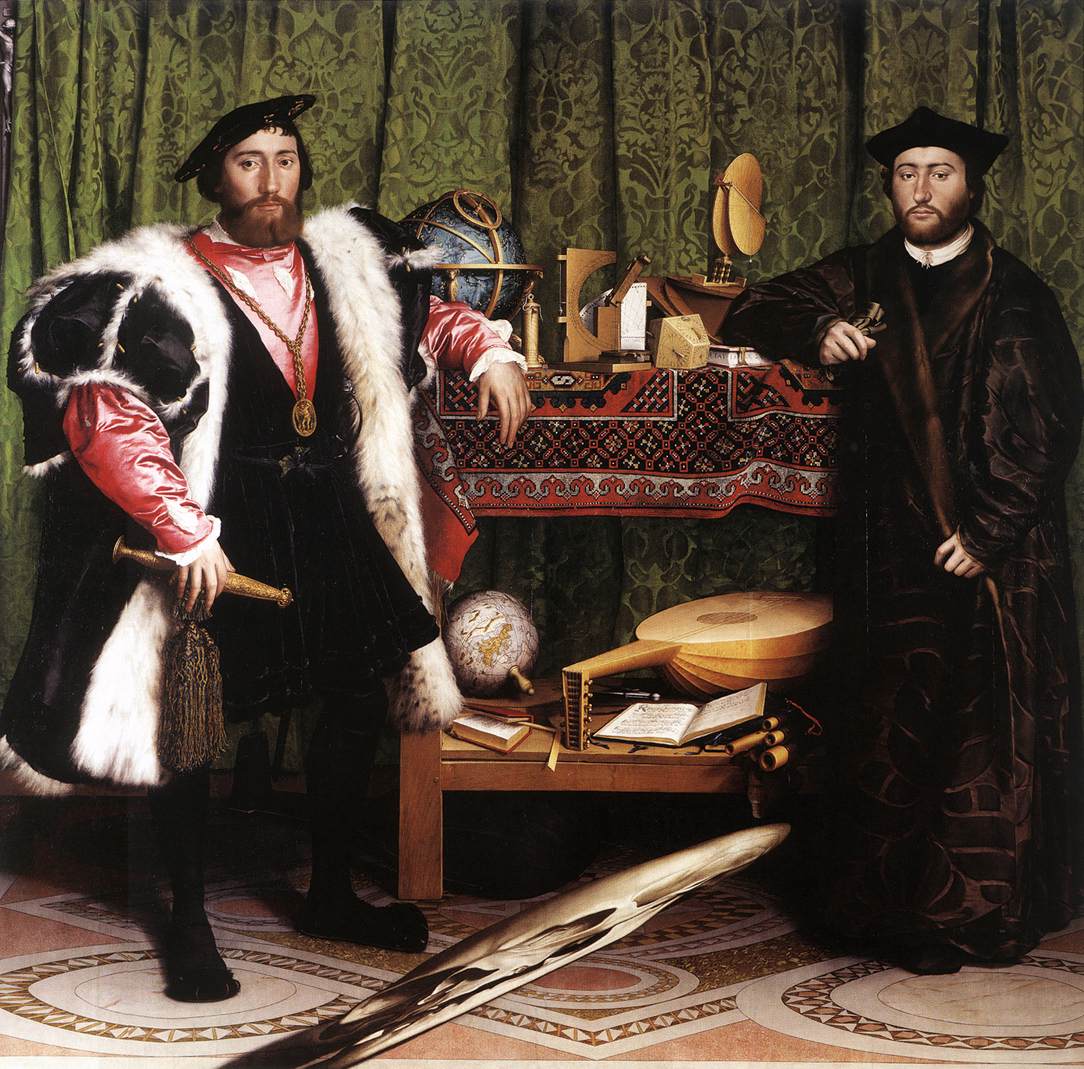
The first major thinker I discuss here is Niccolò Machiavelli, through The Prince, the Discourses and various other writings. I tackle Foucault’s reading of Machiavelli head-on, and indeed more mainstream readings, through a reading of the Italian texts, and try to show how his object of rule was rarely geographical. The next section is on the politics of religious reform, discussing Erasmus, More, Luther, Melanchthon, Calvin and a few others. There’s a brief reading of Hans Holbein’s Ambassadors in here too – I’m most interested in the objects between the two figures, rather than the ambassadors themselves or the skull at the bottom. (Clicking on the the image will take you to a larger version).

I then try to work through the complications of Jean Bodin’s Six Books on the Republic in their French and Latin versions, as well as a near contemporaneous English translation which is revealing in terms of English vocabulary, rather than as a guide to Bodin. I then turn to Giovanni Botero’s famous work on ‘reason of state’, and try to situate it in relation to his lesser-known works on cities and the world. The latter is a synthesis of what was known of the world at the time. I found Romain Descendre’s recent book L’état du monde: Giovanni Botero entre raison d’état et géopolitique, helpful here. The chapter ends with the reading of Shakespeare’s King Lear, with a focus on the politics of land that runs through the play. 

This chapter didn’t need that much work, but then most of it was written earlier this year while I was in London. The main texts read tend to exist in modern editions – with minor exceptions of those by Guillaume de la Perrière, Thomas Elyot, some of François Hotman, Justus Lipsius, and Charles de Grassaille.  I don’t remember many problems of actually finding the texts; though there were lots of problems in the texts. The Lear section was expanded from some brief comments I made in the my inaugural lecture and the Companion to Human Geography piece. The bulk of that section was written in New York in April, while staying at Neil Brenner’s apartment, and making use of the wonderful collection at Columbia University library, and then completed while stuck in Vienna, Virginia after the AAG because of the Iceland volcano.

Posted in Giovanni Botero, Jean Bodin, Martin Luther, Michel Foucault, Neil Brenner, Niccolò Machiavelli, Philipp Melanchthon, The Birth of Territory | 1 Comment

Sidaway on Terror and Territory

James Sidaway’s very generous review of my Terror and Territory in the Annals of the Association of American Geographers is now available here.

This is a compact and sharp book. It is also one that, as a geographer, I am able (and can feel rather proud) to recommend, not only to my students but to peers in other disciplines. It is a good example of the potential for geographical analysis of the political cultures and international relations of the present, showing how these intertwine…

A broader argument about the interactions of sovereignty, terror and violence, and territory can be glimpsed here and in other studies by this author (see especially Elden [forthcoming], a truly agenda-setting study). I expect that his next book… could well prove a landmark survey. In the meantime, Terror and Territory paves the way and will reach wider audiences.

There are some criticisms, of course, particularly in terms of the maps, and the lack of a historical geographical specification of some of the sites covered. The review also highlights the partiality of the coverage, which is fair, although I’d still claim I range far more widely historically and geographically than many accounts.

In short, there are many other terrors, other contested territories, and other ways to comprehend them… Stuart Elden has written a brilliant but also a very particular engagement with the problematics of terror and territory. As such he leaves plenty of room for others.

Posted in My Publications, Territory, Terror and Territory, The Birth of Territory | Leave a comment

Understanding the Changing Planet

Understanding the Changing Planet: Strategic Directions for the Geographical Sciences is a report for the National Research Council by a team of geographers, led by Alexander Murphy of University of Oregon. Alec kindly gave me a copy when I visited earlier this month. There is a lot in the report, and it discusses a broad set of issues which include food security, bio-diversity, climate change, geopolitics, migration, health, economics and so on. It does so by raising questions – both in terms of the chapter titles and also within each chapter.

How Are We Changing the Physical Environment of Earth’s Surface?

How Can We Best Preserve Biological Diversity and Protect Endangered Ecosystems?

How Are Climate and Other Environmental Changes Affecting the Vulnerabilities of Coupled Human–Environment Systems?

How and Where Will 10 Billion People Live on Earth?

How Will We Sustainably Feed Everyone in the Coming Decade and Beyond?

How Does Where People Live Affect Their Health?

How Is the Movement of People, Goods, and Ideas Transforming the World?

How Is Economic Globalization Affecting Inequality?

How Are Geopolitical Shifts Influencing Peace and Stability?

How Might We Better Observe, Analyze, and Visualize a Changing World?

What Are the Societal Implications of Citizen Mapping and Mapping Citizens?

It’s well-worth reading, and illustrated with a range of diagrams, tables and maps. There is a bit of tendency to pull back on some of the controversial aspects, but it’s worth remembering what constraints the authors were working under. I understand from Alec that there will be a set of critical responses coming out in one of the main geography journals. I can see it being helpful in teaching, and in terms of setting some research agendas – not so much for academics, perhaps, but in terms of those who fund them. It also has an aim of feeding into policy discussions and informing citizens in their encounters with geographical questions. If it helps to develop debates within the discipline about what its purpose is, and to help push a message of what geographers do outside of the discipline, then it is to be applauded. I’d certainly see it as a start, rather than any kind of last word. 

Both the paper and pdf versions of the report are available to purchase, but are quite expensive, but you can read quite a few bits online. It’s a shame that the whole pdf isn’t open-access, given its aim of increasing awareness of the geographical dimensions of these crucial questions.

Posted in Politics, Publishing | Leave a comment

UK student occupations and protests

Alex Vasudevan does a good job of rounding up news on UK student occupations at his blog Experimental Geographies here. Being outside of the UK at the moment means I’ve been following what’s been happening on news sites and, increasingly blogs. Alex mentions Infinite Thought and Lenin’s Tomb; I’d also add the University for Strategic Optimism. K-Punk has been quiet recently, but is worth a look – his Capitalism Realism remains a must-read.

Posted in Events, Politics | 1 Comment