Two updates on Middlesex

A report on the rally and some photos here; Nina Power at Infinite Thought on the student hearings here

Nina’s piece is really interesting, and gives some positive thoughts about the events so far. I can’t see Middlesex University coming out of this with any credibility left – at least as long as the senior management involved are still in post.

Posted in Universities | Leave a comment

Middlesex UCU action; plus ‘I occupied Middlesex’

Middlesex UCU have finally made a move against management.

an emergency meeting of Middlesex University’s UCU branch voted to condemn the disciplinary action against staff and students, demand the immediate reinstatement of postgraduate philosophy programmes and recruitment – and go into official dispute with the management if the staff suspensions are not lifted by 12 noon on Wednesday

Fuller report here. I think this is a necessary stage in the branch asking the national union for support.

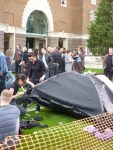
You may have seen the photos of some of  the c.200 who made it to the rally on Thursday. Those of us there were asked to pose with an ‘I occupied Middlesex’ sign. Various photos here.

Now the ever active John Protevi has suggested that this be extended for those who were not physically able to be there… The ‘I am Spartacus’ moment of the campaign…

John Protevi and Todd May are here; and some distinguished colleagues here

Both also have one of those lolcats

Posted in Universities | 1 Comment

The End of Aaaarg.org?

Update: please note this post dates from 2010. I am not sure that links or information below is accurate.

Aaaarg doesn’t exist – so says their webpage. The academic fileshare site was starting to get ‘cease and desist’ letters from publishers, and then apparently Mark Taylor of Macmillan went for them. His experience in the music industry apparently helped in the task. Fuller report here.

I heard this news on the Immanence site, which has some commentary and links…

The site has had this before – and then pops up again with a slightly different address. Go here, for instance, to see the last redirect.

I have mixed feelings about aaarg. I first came across it when Jeremy Crampton, the co-editor of Space, Knowledge and Power: Foucault and Geography told me that the book had been uploaded. Given that the book was only just out, and that we’d fought quite hard to get it as paperback immediately, we were pretty annoyed by this. It was also no amateurish scan, but the file of the e-book that Ashgate themselves were selling. I wrote to aaaarg, and got a letter back saying that they would take the book down immediately if we, as authors/editors, asked for it. They said that this hadn’t happened before (I found that a little hard to believe). We decided not to request that, in part to see what happened.

Then a little while later someone told me that there was a ‘Stuart Elden essay collection’ up there. This was a zip file of 20+ pieces – mainly journal articles – of my work. This didn’t bother me at all – journal articles as pdfs are pretty easily available if you have access to an institutional library; if you don’t have such access there should be a way to get hold of stuff, perhaps after an embargo period; and I’ve always sent copies of pdfs of my work to anyone who has asked for them.

And then someone uploaded a file of Speaking Against Number. I was actually quite pleased about this. The book was originally intended to come out in paperback as well as hardback, but EUP changed their mind when it was in production. It wasn’t in the contract so I had no leg to stand on – lesson learned for future books. EUP priced the book very high – originally £55 and now it’s £65. It’s not a long book – 80,000 words, although it’s pretty dense stuff. They then said it needed to sell 450 copies before they could consider a paperback. It was never going to reach that level – library sales in north America might help to push it to c.200, and when I last asked it was approaching 300. So the book is pretty much inaccessible to most people; the royalties were always small and have now completely dried up; and like most authors – academic ones at least – I want my work to be read. So a means of having the book available to a wider audience seemed a good thing to me.

Clearly the pdf market is increasing, with the rise of interest in things like Kindles and books on i-pods and i-phones and now this new i-pad, so instead of this being a small, word of mouth operation that provided access to texts for an audience that surely comprised mainly graduate students and possibly people outside of the Western academic mainstream, it is now in danger of taking away some of the market of big business.

I’m sure it will pop up again somewhere else soon.

Posted in My Publications, Publishing, Speaking Against Number | 9 Comments

Tariq Ali at Middlesex video

http://www.youtube.com/watch?v=p2fmvKkEy98&feature=related

http://www.youtube.com/watch?v=_PM7VVkmX3o&feature=related

etc. – seven parts in total

thanks to Infinite Thought – as ever a useful place to go for updates

Posted in Universities | Leave a comment

Middlesex Rally 27 May

I made it up to the rally in support of the suspended staff and students for a while this evening. A few photos follow…

Lots of good speeches and a positive yet relaxed atmosphere.

There is also a very good letter from the students to the Dean at the heart of this whole thing…

Compare that to the latest in a UCU newsletter

Save Middlesex Philosophy:

A reminder that you can add your name to the growing campaign to save Philosophy at Middlesex University here. If a department which produces world-class research and teaching can be closed because it is a humanities subject and not vocational, then arguably no humanities department anywhere is safe. UCU is calling on members to get involved in this campaign.

*WHAT YOU CAN DO*: sign and circulate the link for the petition. This already has almost 15,000 signatures, but more are needed. Sign here: http://www.gopetition.com/petitions/save-middlesex-philosophy.html. 

[Update 28th May – the shots of those who occupied are here]

Posted in Universities | Leave a comment

Letter from publishers to The Guardian on Middlesex

http://www.guardian.co.uk/world/2010/may/27/middlesex-university-philosophy-department-closure

Good to see so many of the presses and/or editors I’ve worked with signing up to this.

[update 11.14 – see also the report in The Bookseller]

Posted in Publishing, Universities | Leave a comment

Jane Bennett – the proper question

Given that my brief question has already been linked to by Peter Gratton (thanks!), here’s a more fully worked through question on Jane’s book.

As I said I have read the book and found it very interesting, beautifully written and full of ideas.

The question I have is an odd, and perhaps indulgent, one because it focuses on how the book should impact on my own work. I’m also thinking of the blurb for The Speculative Turn that says “the new currents of continental philosophy depart from the text-centered hermeneutic models of the past and engage in daring speculations about the nature of reality itself”.

I’m well aware that I have a tendency to focus on texts and not things, whatever kind of work I do. Given that most what I do falls under the broad banner of ‘history of ideas’ this is perhaps not surprising. Nonetheless I’m increasingly interested in the relation between words, concepts and practices, and the interplay that that produces between the semantic, thought and materiality, but in historical work I’m finding it hard to see how that can be done without mediation through texts. The big project I am currently working on is a history of the concept of territory, where the main focus is a rereading of Western political thought with a focus on the question of the relation between place and power.

If I am looking at objects such as an astrolabe, Gunter’s chain or a compass, and seeing how those made possible particular ways of thinking about land or made possible political control of land, then even though I could look at the material object in a museum, the way into thinking about them would always be mediated by texts talking about their design, their use and so on. This historical question seems to be different from Jane’s own encounter with the objects in the storm drain (on p. 4).

In terms of books, the materiality of their production is something that is of interest, especially in terms of the shifts to knowledge when printing became possible. Then there are discussions of particular landscapes or battle terrain—I have a reading of Caesar’s De bello gallico on this, for instance—but what we know is through the medium of a text. Similarly even though we know that certain rivers or mountain ranges formed borders between kingdoms or tribal areas, there is a necessary distance between them as historical objects and the way we can experience or speak of them today. I can see the point when Jane claims that the ‘territory of Iraq’ is an actant (p. 81), but even if Gaul or Germania were too, do we have the same mode of access to them?

I suppose a similar question could be asked for what we know of the body historically. In the case of Foucault’s reading of Damians or Herculine Barbin, for instance, this is through what written records exist. So, though the body is the focus, it is mediated through a text.

I wonder if similar issues came up for Jane when she was reading Aeschylus on matter, or when she was tracing the history of some of the ideas she discusses in the book. I liked the mention of the traffic jam occasioned by Bergson in NYC (p. 64), but I wondered how the material aspect of the history of ideas complicated the stories she told.

Posted in Jane Bennett | 5 Comments

Jane Bennett – Vibrant Matter reading group

The blog reading group on Jane Bennett’s new book Vibrant Matter has begun. Links below

The Overview.

An Interview with Jane Bennett

Preface.

Chapter 1, Section I.

Chapter 1, Sections II-V.

Chapter 1, Section VI.

Adrian Ivakhiv has added some thoughts here.

I’ll be interested to see how this develops. I have read the book and found it very interesting, beautifully written and full of ideas. But I am not sure how it should impact on my own work in the history of ideas. This is one of the reasons why the conference on Speculative Medievalisms will be interesting. I may post some more thoughts on this (I’m currently rereading the book).

You can find the rest of the schedule here

Posted in Jane Bennett, Medieval Studies | 2 Comments

Middlesex academic boycott called

John Protevi has started a petition…

Online petition – Academic Boycott of Middlesex University until restoration of philosophy program

On April 26 Middlesex University announced the closure of its highly-ranked and well-respected philosophy program. This closure has no philosophical or pedagogical rationale, and in fact it has no economic justification either: far from losing money, after covering its salary and administrative costs the program contributes more than 50% of its revenue to the central management of the university. But the management unilaterally decided that it could make more money by investing its funds elsewhere. (For an overview of the situation see http://savemdxphil.com/about/).

Despite wide-spread international protest of the closure in the form of thousands of letters and petition signatures, the management has shown no signs of reconsidering its decision. Instead it seems dedicated to censoring all dissent: on May 21 it suspended three faculty members and several students for the ‘crime’ of campaigning to save their own courses and jobs.

It is time, then, for supporters of Middlesex Philosophy to take a more active stance.

Petition:
We the undersigned therefore commit ourselves to an academic boycott of Middlesex University until it shows evidence of full reinstatement and continued support for its philosophy program.

Prior to such reinstatement, we will refuse to act as external examiners or to deliver talks at the school. We will encourage colleagues to reject job offers at Middlesex. We will refuse to visit campus for any reason other than to protest the decision to close the philosophy program. We will, in short, cease to engage with Middlesex as a legitimate academic institution.

There is a general update on the situation here

Posted in Universities | Leave a comment

Etienne Balibar on the EU crisis

http://www.guardian.co.uk/commentisfree/2010/may/25/eu-crisis-catastrophic-consequences

Posted in Politics | Leave a comment