Eighteen months old, but still interesting, discussion of cycling, doping and Mont Ventoux…
http://www.spiegel.de/international/europe/0,1518,565111,00.html
Eighteen months old, but still interesting, discussion of cycling, doping and Mont Ventoux…
http://www.spiegel.de/international/europe/0,1518,565111,00.html
http://savemdxphil.com/2010/05/13/campaign-news-130510/
Interesting on a number of fronts. The University doesn’t seem to have grappled with some of the key issues at stake – what staff usually in the building are supposed to be doing; and what this means for their research strategy. And good that other senior staff at the University have openly challenged this, rather than supporting it but wary of doing so publically.
I’d not intended this blog to be quite so contemporary and political, but the British election and the Middlesex situation have dominated the posting so far. These events and the conferences and workshops I’ve attended over the past couple of weeks have pushed my key concerns somewhat to the background.
The main thing I am working on at the moment is Chapter Eight of my ‘history of territory’ book which looks at the Renaissance and Reformation. In this chapter, at the moment, there are readings of Machiavelli, Botero, Bodin, Lipsius and Shakespeare’s King Lear. The bit on King Lear is far too long, and might actually work as a standalone article, in the manner of the piece I published on Beowulf, that could then be dramatically cut down for the book.
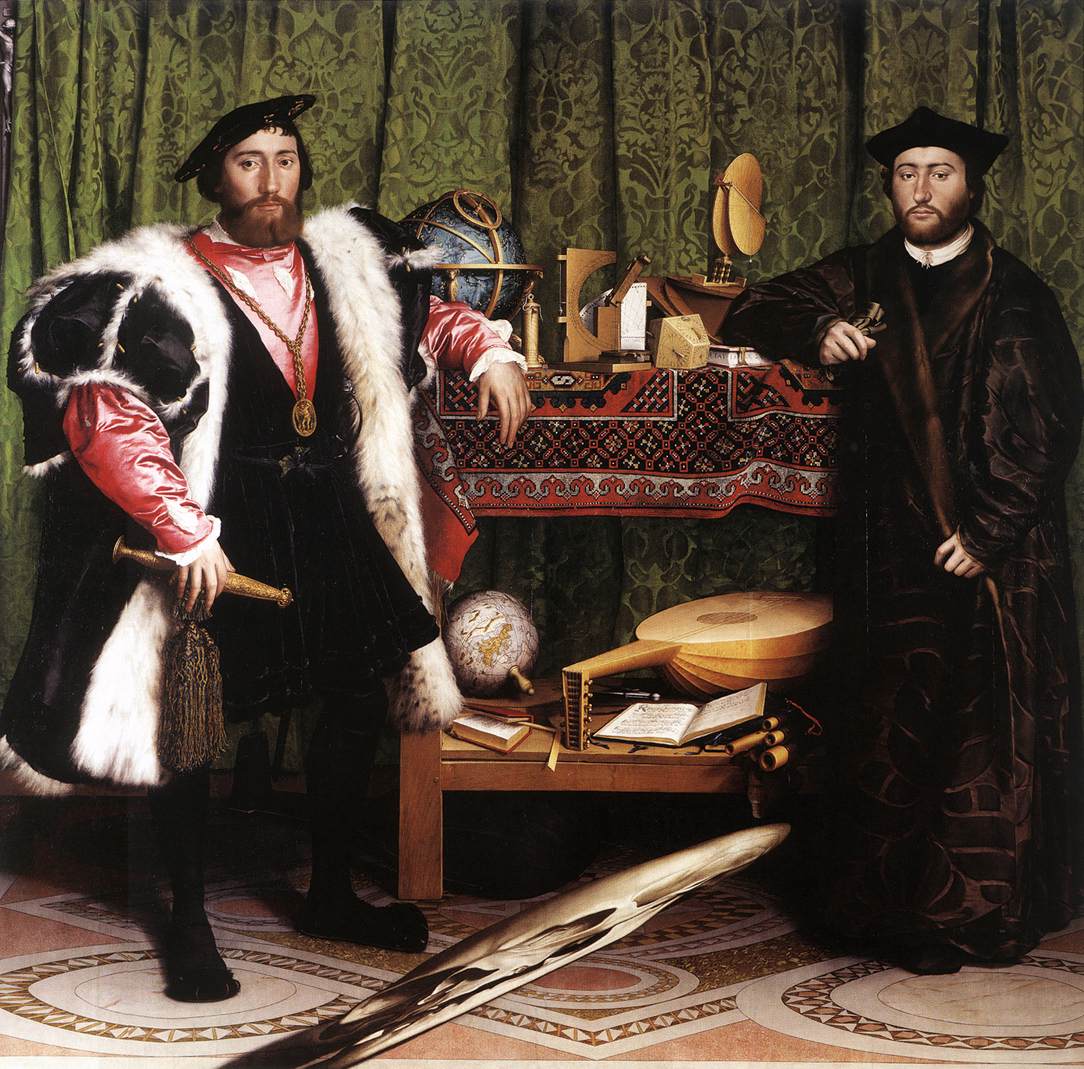
I have sections on ‘The Politics of the Reformation’ and on the New World which need further work before being slotted in. The former has a discussion of Thomas More, Erasmus, Holbein’s The Ambassadors, and a bit on Henry VIII, but needs more on Luther and possibly Calvin. The latter I’m much less sure about, partly because I think there is little I can say that hasn’t already been said. (While the other things are also widely written on, I think I’m at least asking different questions.) But the discovery, mapping and territorial division of the new world seems too important to the story to leave out, so I’m struggling a bit there. I think I also need to work a reading of Richard Hooker into this chapter somehow, and part of me is wondering if I could use a reading of Shakespeare’s The Tempest (perhaps instead of the one of King Lear) as a way into the colonial questions.
I’m a bit impatient to get going on Chapter Nine, which is the only chapter I’ve yet to work on. This will have readings of obvious political thinkers (Hobbes, Locke) and less obvious ones (Descartes, Leibniz, Althusius, Bacon), alongside readings of legal thinkers (Grotius, et. al.) and issues (such as the Treaties of Westphalia, and the Treaty of the Pyrenees) and more on practices of cartography and land-surveying. I’d like to include discussions of the actual tools that were used to put these into practice, such as Gunter’s chain.
In writing these sections I’ve also been reading lots of writings by the ‘new historicism’ movement and looking at the links this has to cultural materialism. I’m finding all this quite helpful in terms of working out some of the larger ‘methodological’ issues this project has thrown up. It is intended as something of a genealogy, but has definite links to the German tradition of Begriffsgeschichte, and makes use of the analyses of the Cambridge school of contextual history (Quentin Skinner et. al.). I may end up writing something on all these issues, at least for self-clarification.
I’ve also been reading Peter Sloterdijk’s book Rage and Time which is newly translated into English. I’d muddled through the German before. I’m editing a book on Sloterdijk with Polity, due out next year, and his work is slowly coming into English. It’s an interesting book, and I may post some more thoughts on it here at some later point.
Territory and Justice Conference – Dublin 12-13 July 2010
http://eis.bris.ac.uk/~plcdib/territory.html
There has been a real interest in the relation between political theory and territory recently, although what it tends to do is take territory as a relatively straight-forward notion, and then apply debates of justice to it. This was the case in some of the books recently appearing on this topic which I reviewed here. I fear this conference will be similar, though it is surely a good thing that political science and philosophy is thinking about such issues at all.
The Conservative-Liberal Democrat deal is here. Lots of things to comment on. But just one part for now…
The parties agree to the establishment of five year fixed-term parliaments. A Conservative-Liberal Democrat coalition government will put a binding motion before the House of Commons in the first days following this agreement stating that the next general election will be held on the first Thursday of May 2015. Following this motion, legislation will be brought forward to make provision for fixed term parliaments of five years. This legislation will also provide for dissolution if 55% or more of the House votes in favour.
Fixed term parliaments are surely a good thing. Instead of it being the choice of the incumbent, giving him or her the power to decide when to go to the country, everyone knows when to plan for. It probably should have been four not five years – PMs confident of winning go after four (Thatcher, Blair); those fearing defeat drag it on as long as possible (Major; Brown). But the deeply alarming part is the idea that 55% is needed for dissolution. Up until now, 50% + 1 was enough for a government to fall on a vote of no confidence. A PM continued – and was appointed in the first place – because they could command a majority of the House of Commons. So now they can command less – 45% only?
Even if the Liberal Democrats leave this government after this bill passes, then Cameron remains PM. He has 306 MPs to date (likely 307 after the Thirsk by-election) and needs only 293 to prevent dissolution. How can this be right? What happens if he is unable to command a majority, cannot pass legislation, can’t be voted down by a dissolution motion, but equally can’t admit defeat and call an election because the power has been taken away from the PM?
Sounds like this needs a bit more thinking through – but more fundamentally a rethink. I can see why they are doing this, otherwise Cameron fears the Lib Dems could threaten to derail him at every moment, but it can’t be a good thing, either now and certainly not to enshrine in law.
A pretty comprehensive analysis with links, from the campaign group.
Graham Harman has an interesting post about the age of Cameron and Clegg here. His point is that he and they are near contemporaries and could have been at school together – Harman was born in 1968, Cameron 1966 and Clegg 1967. I’m a little younger than the three of them, being born in 1971, but George Osborne was born the same year (May, compared to my December). The Miliband brothers were born in 1965 and 1969; Ed Balls in 1967; the new Foreign Secretary William Hague – once derided for his youthful enthusiasm and inexperience – in 1961.
Blair was born in 1953, but was only 44 when he took office, not much older than Cameron is now. As Cameron said, in one of his best taunts at Blair, “you were the future once”.
Dear Board,
I am writing, as so many others, to urge you to use your power to reconsider the decision to close the philosophy department at your University. As I wrote to your Dean, Vice Chancellor and Deputy Vice Chancellors on the 29th April, I was trained in political theory and philosophy before moving into geography, and in my view Middlesex is one of the strongest philosophy departments in the country. This is certainly the case in the areas I worked in. You have some terrific members of staff, including many of the best philosophers in the UK, and have trained and are clearly training the next generation. Philosophers across the world have studied in the department, spoken there or otherwise benefitted from its research excellence that would be entirely lost were this decision to go ahead.
I can see no basis for this policy of closure – it’s a successful department, providing high quality education and delivering excellence in research. It would seriously harm Middlesex’s reputation within the UK and the wider academic community.
I strongly urge you to reconsider this decision.
Yours sincerely
Stuart Elden
Geography Department, Durham University
You can find details of how to help, who to write to, etc. here – http://savemdxphil.com/how-you-can-help/
Rather than simply sit and watch this on TV, I decided to go for a walk round Westminster.
I timed it pretty well – saw Gordon Brown leave Downing Street, saw the Tory delegation leave the Cabinet Office (William Hague, George Osborne and Oliver Letwin) and then round to the Labour HQ on Victoria Street where Alastair Campbell and Peter Mandelson were just heading inside.
Some photos below – very hard to get these, due to the media scrum…