In Secularism as Misdirection, Nivedita Menon traces how the discourse of secularism fixes attention to and hyper-visualizes women and religion while obscuring other related issues. Showing how secularism is often invoked to serve capital and antiminority politics, Menon exposes it as a strategy of governance that is compatible with both democracy and authoritarianism, capitalism and socialism. Secularism also delegitimizes the nonindividuated nonrational self, Menon argues, and exploring this aspect, tracks the journey of psychoanalysis in the global South. Menon further examines the interconnectedness of religion, caste, the state, and women, showing how the discourse of secularism can also be mobilized by Hindu supremacist politics in India. Menon puts Latin American decolonial theorists in conversation with Asian and African thinkers to examine twenty-first-century global reimaginings of selfhood, constitutionalism, citizenship, and anticapitalist existence. Through a feminist and global perspective, Menon suggests that transformative politics is better imagined by stepping out of the frame offered by secularism and focusing on substantive values such as democracy, social justice, and ecological justice.
Jonathan Wolff & Avner De-Shalt, City of Equals – Oxford University Press, December 2023 (print and open access)
When we think about equality in the city, we are very likely to think first of the wide and growing divide between rich and poor, in material terms. Yet when we think more about a ‘city of equals’ it becomes apparent that how people feel treated by the city and those around them, and whether they can live according to their values, are much more central. Accordingly, combining their own reflections, a multi-disciplinary literature review, and, distinctively, more than 180 interviews in 10 cities in 6 countries, Wolff and de Shalit have derived an account of a city of equals based on the idea that it should give each of its city-zens a secure sense of place or belonging.
Four underlying values structure this account. First, access to the goods and services of the city should not be based purely on the market. Second, each person should be able to live a life they find meaningful. Third, there should be diversity and wide social mixing. Fourth, there should be ‘non-deferential inclusion’: each person should be able to get access to what they are entitled to without being treated as less worthy than others. They should be able to enjoy their rights without bowing and scraping, waiting longer than others, or going through special bureaucratic hurdles. In sum, in a city of equals each person is proud of their city and has the (justified) feeling that their city is proud of (people like) them.
As another year is drawing to a close, we are looking back on some of the highlights we have published over the course of 2023. We warmly thank all our authors, editors, and readers!
Available in print and e-book – and good to see the e-book priced much lower than the physical book.
A revelatory and wide-ranging series of interviews with award-winning writer Arundhati Roy, touching on US empire, Indian nationalism, a writer’s work, and more.
As a novelist, Arundhati Roy is known for her lush language and intricate structure. As a political essayist, her prose is searching and fierce. All of these qualities shine through in the interviews collected here by David Barsamian.
This newly reissued and expanded edition, featuring interviews from 2001 to 2022 and a moving foreword by Naomi Klein, explores Roy’s evolving political thought and commitments across the tumultuous twenty-first entry.
The Architecture of Modern Empire is a searing reckoning with the mechanics of power, in all its forms, and the role of imagination and creative expression in envisioning a radically different world.
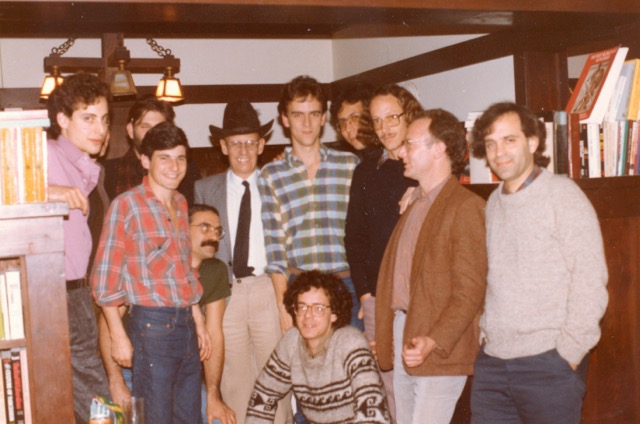
left to right – Mark Maslan; Eric Johnson (hidden); Thomas Zummer (part-hidden); Stephen Kotkin; Kent Gerard (crouching); Michel Foucault; David Levin (seated); David Horn; Jonathan Simon; Arturo Escobar; Paul Rabinow; Jerome (Jerry) Wakefield. Photograph from David Horn.
This article is a transcript of a conversation between Michel Foucault and Jonathan Simon in San Francisco in October 1983. It has never previously been published and is transcribed on the basis of a tape recording made at the time. Foucault and Simon begin with a discussion of Foucault’s 1977 lecture ‘About the Concept of the “Dangerous Individual” in 19th-Century Legal Psychiatry’, and move to a discussion of notions of danger, psychiatric expertise in the prosecution cases, crime, responsibility and rights in the US and French legal systems. The transcription is accompanied by a brief contextualizing introduction and a retrospective comment by Simon.
The discussion has recently been published as a book in Turkish – Tehlike, Suç ve Haklar, 2023: Michel Foucault ile Jonathan Simon’ın Söyleşisi, trans. Utku Özmakas, Ayrıntı Yayınları, October 2023. I was asked to contribute a new preface. The English text of the Turkish preface is not available elsewhere, so with the permission of Utku I’m sharing it here.
Turkish Preface to ‘Danger, Crime and Rights’
Archives of Foucault’s work are in several places. By far the most significant are the papers left in his Paris apartment when he died, now held at the Bibliothèque nationale de France. That library also holds another fonds of material found in Foucault’s mother’s house, dating from the late 1940s and early 1950s. The papers of the Centre Michel Foucault are at the IMEC archive in Normandy, which also holds the archive of the Groupe d’Information sur les Prisons. Many of Foucault’s letters are in the archives of his correspondents, scattered across the world and not yet systematically catalogued. Another important source of material is found at the Bancroft Library of the University of California, Berkeley. Its collection largely relates to Foucault’s teaching at Berkeley, and to a lesser extent elsewhere in the Americas, in the second half of the 1970s and the first half of the 1980s. Some of the material there is related to the work Paul Rabinow and Hubert Dreyfus did with Foucault. In particular, their co-authored book from 1982 had an important appendix of two paired Foucault texts, and its second edition had a long interview edited from several working discussions. Rabinow went on to edit The Foucault Reader in 1984, which contained other previously unpublished material.
The Berkeley archive has a limited amount of material on paper, but also a more extensive archive of recordings, originally on tape and now – often poorly – transferred to compact disc. Some of these recordings have been made available online. Much of this material is in the process of being edited for publication, including some important 1975 lectures on sexuality from Brazil. The text transcribed here of a discussion with Jonathan Simon also comes from this archive, and it was one I was pleased to find when doing research in Berkeley. I had met Jonathan at ‘The Foucault Effect 1991-2011’ conference in London, and we met again when I was in Berkeley. Jonathan kindly allowed me to have the interview transcribed, which I supplied with a brief Introduction and a few notes. He generously agreed to write its illuminating, even incriminating, afterword – although, as he notes, it took some persuading to get him to complete it.
My Introduction provides some more contextualisation of the encounter, and how it can be situated within Foucault’s Berkeley teaching of 1983 – which was intended to be continued the next year, but which was cut short by his untimely death in June 1984.
Revisiting this text after a few years distance is interesting. While I first listened to the recording when I was working on my book Foucault’s Last Decade, I have since completed three other books on Foucault’s career – Foucault: The Birth of Power, The Early Foucault and, most recently, The Archaeology of Foucault. Working backwards, in large part because of the availability of material, has helped me to situate some of Foucault’s ideas in new contexts.
What comes through here, for me, is how Foucault’s concerns with punishment and classification of risk run as a thread through his career. In the 1950s he was working with Georges and Jacqueline Verdeaux in the Sainte-Anne Hospital and the Fresnes prison; the History of Madness is concerned with themes of incarceration and danger; through to the major themes of Discipline and Punish and the first volume of the History of Sexuality. Many other texts and themes could be related to this interest. In the late 1970s Foucault’s project on sexuality underwent several crucial changes, and his focus shifted direction and moved further and further back into pagan and Christian antiquity. That story I try to tell in Foucault’s Last Decade – though the progressive opening up of the archive, and in particular the publication of the fourth volume of the History of Sexuality, further complicate the account.
But Foucault gives some indications in the 1980s of how he planned to move beyond this detour into antiquity and return to some of the historical periods he had addressed in earlier works. His seminar at Louvain in 1981, running alongside the course now published as Mal Faire, Dire Vrai, was concerned with the late nineteenth century and early twentieth century (Tulkens ed. 1988), and his planned collaborative project with Berkeley students would also have brought his work back to a near-present. Along with Keith Gandal, David Horn and Stephen Kotkin, Foucault planned to research governmental mechanisms in the First World War and interwar period. As with so many other planned projects throughout Foucault’s career this never happened, though in this case it was due to his death rather than a shift in focus. A piece published by Gandal and Kotkin in 1985 gives an indication of the work intended, an undated text in the IMEC archive gives some more details, and Kotkin, Gandal and Horn all eventually published works taking forward these ideas, each acknowledging Foucault’s inspiration (Kotkin 1995, xviii; Horn 1994, ix; Gandal 2008, vi). Gandal recalls that Foucault planned to return to related themes in his Paris teaching too, noting that Foucault and his colleagues there were planning projects on “‘the anthropology of punishment’: one concerning ‘recent changes… in social thresholds of tolerance in regards to criminality and the severity of penal practice’ (or the social factors that determine ‘fluctuations in the need to punish’), and another considering ‘the relations between medical and psychiatric knowledge and penal justice’ and ‘how to adjust today’s penal institutions and medical practice’” (Gandal 1986, 134 n. 34).
This 1983 discussion, although prompted by Jonathan Simon’s interests at the time, which he outlines in the afterword, gives some indication of Foucault’s enduring interests. It can be read alongside his more famous works of the 1970s, and other materials which were unpublished in his lifetime, including “Alternatives to the Prison”. A collection of materials on related themes is forthcoming in the Vrin series of texts by Foucault, edited by Gianvito Brindisi and Orazio Irrera. As Foucault indicates in his responses to Simon, and Simon underlines in his afterword, the interview helps to clarify Foucault’s understanding of the notion of rights – explored carefully in Ben Golder’s important study (2015). As Foucault says here: “I think we can fight against those disciplinary techniques in the name of rights, even in the name of the rights which have been at the root of those institutions”. It is in part for this reason that we titled this discussion “Danger, Crime and Rights”.
Additional References
Michel Foucault (forthcoming) Les mauvais sujets: Textes et conférences sur enfermement, crime et justice (1972–77) [provisional title], ed. Gianvito Brindisi and Orazio Irrera, Paris: Vrin.
Keith Gandal (1986) “Intellectual Work and Politics”, Telos, No 67, pp. 121-34.
Keith Gandal (2008) The Gun and the Pen: Hemingway, Fitzgerald, Faulkner, and the Fiction of Mobilization, Oxford: Oxford University Press.
Keith Gandal (undated) “New Arts of Government in the Great War and Post-War Period”, IMEC archives, E.1.29/FCL2.A04-06.
Keith Gandal and Stephen Kotkin, “Governing Work and Social Life in the U.S.A. and the U.S.S.R.”, History of the Present, No 1, 1985, pp. 4-14.
David Horn (1994) Social Bodies: Science, Reproduction, and Italian Modernity,Princeton: Princeton University Press.
Stephen Kotkin (1995) Magnetic Mountain: Stalinism as a Civilization, Berkeley: University of California Press, 1995.
Françoise Tulkens (ed.), Génealogie de la défense sociale en Belgique (1880-1914), Bruxelles: E. Story-Scientia, 1988.
I didn’t publish much this past year – The Archaeology of Foucault has a 2023 date but was officially published in December 2022, and the special issue of Theory, Culture and Society on Foucault was completed some time before. I only gave a couple of talks, had nothing new accepted, and made slow progress on the new writing project. Much but not all of this is due to the heart surgery I had in July, after suddenly becoming seriously unwell. I’m now doing much better, recovery going well, and steadily regaining fitness, mainly by cycling on an indoor set-up.
The middle of this year saw the longest pause here since I started Progressive Geographies in 2010, and when I got back home from hospital I mainly used the blog as a noticeboard for other people’s work, to keep things going. Some of the posts and pages that I did post about my own research or related resources might still be of interest, and some of these are listed below.
The best summary of the work I’ve done so far is in a video recording of an online talk for the Warwick Seminar for Interdisciplinary French Studies on 31 May 2023: “Indo-European Thought in Post-War France“
There is hopefully still value in some of the older resource pages which continue to be updated.
With the British Library still offline and so largely unusable, and without a trip to Paris this month, I’ve mainly been working at home, though with a few side trips to libraries and archives in the UK.
SOAS has a special collections room I’ve used before, and I went back to look at a personnel file relating to Walter Henning, about his World War Two internment, and the main personnel file for Mary Boyce. Boyce was a student of Henning’s who did a PhD at Cambridge supervised by him and Harold Bailey. Perhaps the most interesting thing in the Boyce file for me concerned the research she did after the war on the German Turfan manuscripts. These had been removed from Berlin for safe-keeping during the war, but afterwards were separated, some ending up in Mainz in West Germany, and some going back to what was now East Berlin. Some were lost at this time, and so had to be catalogued on the basis of photographs. Boyce got funding to do some of this work, but had to apply for an East German visa to travel to East Berlin direct, where she spent a few summers, rather than cross from West Berlin. She notes how this work between the two Germanies was conducted in a way that was scholarly and professional, without “consideration of country or politics”, but I suspect there is more to it than that. There’s an interesting story here about textual scholarship combined with geopolitics, though it’s some distance from the focus of what I’m doing. Henning was involved in this work in at least two periods – in the 1920 and early 1930s as a student and then editor of Friedrich Carl Andreas, and after the war as advisor to Boyce. Andreas, incidentally, was married to the psychoanalyst Lou Andreas-Salomé, whose links to Nietzsche, Freud and Rilke are well known. Henning had left Germany in the mid-1930s, in part because he was engaged to a Jewish woman.
National Archives in Kew and the SOAS special collections reading room
Working with SOAS special collections also means I have a SOAS library card, and it has got an exceptional collection in the library itself. That, UCL and the Bodleian in Oxford have allowed me to do some work with things that I think the British Library has, but which I can’t currently access. I have been to the Warburg Institute too, but the building work there has meant it is disrupted and often noisy.
I also visited a few other UK archives. For the first time I went to the National Archives in Kew. I’ve never had a reason to go before, but there were a couple of minor things I wanted to see. But the main reason was not related to this project at all. I had heard that at the start of 2023 some files relating to British prisoners of war in Germany in the Second World War had become available. These were German records, transferred to the UK. My grandfather was a POW, and so I was curious to take a look. There isn’t much there, but what there is fits with what I already knew about his two years in Germany, though adds some dates and detail which I only knew broadly before.
Balliol College, University of Oxford has some T.S. Eliot papers and books, gifted by Jean de Menasce. As I’ve mentioned before, de Menasce is an interesting figure in the story I want to tell about Benveniste. Eliot knew de Menasce from his time in Oxford, and de Menasce was one of his early translators into French. There are some books dedicated to de Menasce, some letters and manuscripts. I say a little more about that visit here. I also went back to the Royal Geographical Society to look at a bit more of the correspondence between Aurel Stein and John Scott Keltie, president of the Society. This was from 1911-20, outside the period of the second expedition which took in the Dunhuang caves. There are some interesting comments about Stein learning of the fate of Robert Scott’s south pole expedition, or about how bad a speaker Rudyard Kipling was. Since I was there, I also requested to look at two artefacts they have from Stein’s travels, including a tape measure lost by Sven Hedin near Lop Nor in Central Asia in 1901, and found five years later by Stein. Stein returned it to Hedin at an RGS dinner, and Hedin later presented it to the Society, engraved with a brief version of this story. There is a photo here.
I now have written up the accounts of the first two decades of Benveniste’s teaching, initially at the EPHE and then both there and at the Collège de France. His archive has only has a partial record of this aspect of his work, with much lost when his apartment was ransacked in the war. There are good, albeit brief, records of the courses in the Annuaires of the EPHE and Collège de France, and so I have accounts of 1927-34 in one chapter on his early career, and 1934-49 in a chapter on the mid period, where there is a break of four years when he was in exile during the war. When I turn to the later parts of his career I plan to write up an account of records of the next two decades of teaching – though with a break in 1956-57 when he was recovering from a heart attack – until 1969 when a stroke leading to aphasia prevented him from teaching in the last six years of his life.
Many of the courses were thematic, and here the loss of his notes is particularly unfortunate. Some of the classes were reading and translation exercises, where he worked with reproductions, transcriptions and critical editions, adding his commentary and corrections as he went. This was especially the case with his courses at the EPHE on Iranian. The texts Benveniste used in the classroom might have been the best ones available at the time, but they are often difficult to find today. With some it wasn’t immediately clear to me what text he actually meant, but I think I worked them all out in the end. While I do try to find a physical copy in one of the many libraries I use, sometimes I do have to resort to Warwick’s document delivery service, previously inter-library loan, but now called ‘Get it for me’. I suspect their work is made harder by the British Library problems. Usually my requests of them are difficult, as if they were easily available I’d locate them myself. But the team are very good – in the past couple of weeks they’ve tracked down an Italian edition of a Pahlavi text, and a German edition of a Hittite prayer, both about 100 years old.
A little story from the archives I found amusing. A professor wanted to take a book out from his institution’s library, but was told it was not for borrowing. Apparently, he complained, and was told to contact the institution’s Director. He did, in an excessively long letter. The librarian was called upon to respond, but said the book was indeed restricted. They noted this professor had demanded the borrowing status be changed on the spot; and added that he made several such requests. This was exacerbated, the librarian suggested, by his living so far from campus he couldn’t use the library as often as other staff. The Director agreed, revoked the professor’s special permission to live further away, and demanded that he move to within thirty miles of the institution. Grudgingly he did. Never cross a librarian!
I have some weeks in Paris in February and March. I’m hoping to finish my initial survey of the Dumézil archives, and move to a look at the Benveniste archives. From updates on the British Library website, it seems it is going to be months, at least, before service is fully resumed there. I am fortunate in that earlier in October I’d done all the work I need to do there with manuscripts – the Aurel Stein correspondence with Paul Pelliot and Robert Gauthiot. I understand manuscripts are currently unavailable, even with known shelfmarks. There are loads of printed things I’d like to consult there, but almost everything is available somewhere else. Even if it means crossing London or adding to the next Oxford or Paris visit I can manage. People using manuscripts and some rare books are really out of luck. Things have probably reached a stage where PhDs, post-docs, research projects etc. which are dependent on BL collections are going to need reassessment and institutional support.
Previous updates on this project can be found here, along with links to some research resources and forthcoming publications, including the still-delayed reedition of Georges Dumézil’s Mitra-Varuna. There is a lot more about the earlier Foucault work here. The final volume of the series, The Archaeology of Foucault, has now been out for a year; and the special issue of Theory, Culture & Society I co-edited on “Foucault before the Collège de France” is also published, with some papers available open access.
At the end of each year I’ve posted a list of academic books I liked. The criteria was that they were published in that year, and that I read and liked them. This means that good books which came out this year but which I didn’t read immediately don’t feature, and I will of course miss many. In the middle of the year, when I was unwell, I went for a while without reading anything work-related.
Some of those featured are books I reviewed or endorsed, and others are by friends and colleagues. Certain publishers, especially those I review for, feature disproportionately. It’s of course biased by my interests and prejudices. So while there are doubtless many other good books from each of these years, I can at least say that these are all worth reading.
I didn’t get to see much music live, and missed a few due to illness, but particularly enjoyed Big Big Train, Haken, The Aristocrats, Peter Gabriel, Extreme and Nik Bärtsch’s Ronin.