This photograph of professors at the Collège de France is interesting, and I’m curious about who else is in here.
Bourdieu (arriba, marcado con la letra "a") en el Collège de France. Además de PB se pueden identificar a: b. Georges Dumézil. c. Paul Veyne. d. Jules Viullemin. e. Pierre Hadot. f. Emmnauel Le Roy Ladurie. g. Georges Duby. h. André Miquel.
It was posted on Twitter by Jorge Galindo, who indicates some of the people –
a. Pierre Bourdieu
b. Georges Dumézil.
c. Paul Veyne.
d. Jules Vuillemin.
e. Pierre Hadot.
f. Emmanuel Le Roy Ladurie.
g. Georges Duby.
h. André Miquel.
He rightly indicates the male dominance of the photo. One of the replies said that the woman in the front row is Françoise Héritier – the image is also used on the cover of a book about her.
The photo apparently comes from 1985, which seems right: Héritier was elected in 1982, Hadot in 1983; and Dumézil died in 1986.
I think the tall man to the right of Héritier is Yves Laporte, who was administrator of the Collège de France 1980-1991. Yves Bonnofoy perhaps on the right of the third row back.
Anybody identify anyone else?
Update: Jacques Tits behind/to the left of Hadot; likely Julian de Ajuriaguerra to the right of Dumézil.
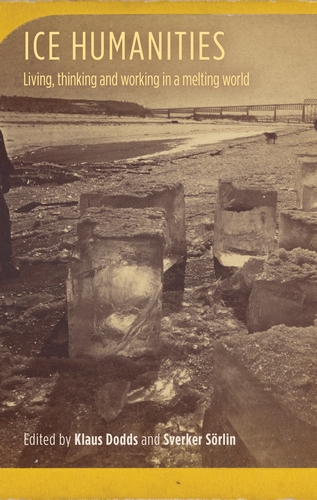
Ice humanities is a pioneering collection of essays that tackles the existential crisis posed by the planet’s diminishing ice reserves. By the end of this century, we will likely be facing a world where sea ice no longer reliably forms in large areas of the Arctic Ocean, where glaciers have not just retreated but disappeared, where ice sheets collapse, and where permafrost is far from permanent. The ramifications of such change are not simply geophysical and biochemical. They are societal and cultural, and they are about value and loss.
Where does this change leave our inherited ideas, knowledge and experiences of ice, snow, frost and frozen ground? How will human, animal and plant communities superbly adapted to cold and high places cope with less ice, or even none at all? The ecological services provided by ice are breath-taking, providing mobility, water and food security for hundreds of millions of people around the world, often Indigenous and vulnerable communities. The stakes could not be higher.
Drawing on sources ranging from oral testimony to technical scientific expertise, this path-breaking collection sets out a highly compelling claim for the emerging field of ice humanities, convincingly demonstrating that the centrality of ice in human and non-human life is now impossible to ignore.
This book is relevant to United Nations Sustainable Development Goal 13, Climate action
Ice humanities: living, working, and thinking in a melting world – Sverker Sörlin and Klaus Dodds
Part I: Living with ice 1 Writing on sea ice: early modern Icelandic scholars – Astrid E. J. Ogilvie 2 A moving element: ice, culture, and economy in northern and northwestern Russia – Alexei Kraikovski 3 Ever higher: the mountain cryosphere – Dani Inkpen 4 Glacier protection campaigns: what do they really save? – Mark Carey, Jordan Barton, and Sam Flanzer 5 Ice futures: the extension of jurisdiction in the Anthropocene north – Bruce Erickson, Liam Kennedy-Slaney, and James Wilt
Part II: Working with ice 6 White spots on rivers of gold: imperial glaciers in Russian Central Asia – Christine Bichsel 7 The many ways that water froze: a taxonomy of ice in nineteenth- and early twentieth-century America – Jonathan Rees 8 Drift, capture, break, and vanish: sea ice in the Soviet Museum of the Arctic in the 1930s – Julia Lajus and Ruth Maclennan 9 Waiting and witnessing at Larsen C Ice Shelf, Antarctica – Jessica O’Reilly
Part III: Thinking with ice 10 Imperial slippages: encountering and knowing ice in and beyond colonial India – Thomas Simpson 11 Negotiating governable objects: glaciers in Argentina – Jasmin Höglund Hellgren 12 Cryonarratives for warming times: icebergs as planetary travellers – Elizabeth Leane 13 Frozen archives on the go: ice cores and the temporalization of Earth system science – Erik Isberg
With the proofs and index of The Archaeology of Foucault complete, the next thing will hopefully be receiving an advance copy toward the end of the year. The new edition of Dumézil’s Mitra-Varuna is now in production with HAU books, and should be out in June 2023 (on the editing work, see here and here). I have a complete draft of a long overdue article too. Much of the summer has been completing projects from some time back, catching up, and finally feeling I am back on top of things. This is helped immeasurably with not teaching the coming year, otherwise I’d already be shifting focus back to that.
My work this summer on the new Indo-European thought project was intended to be background, so as well as some reading of mythology, and some books on dead languages and historical linguistics, I’ve been doing a bit of work on some of the earlier, pre- or early-twentieth century figures. With anthropology, I’ve been reading some work by Marcel Mauss beyond The Gift, though I probably need to go back to Durkheim at some point. I’m not sure I will write about any of this, but it sets the scene for what I do intend to discuss.
Ferdinand de Saussure seemed an obvious place to start for the work on linguistics. While I had read the Course on General Linguistics before, this was the first time doing anything more serious. As many people will know, there are two English translations of the Course – the older one by Wade Baskin and another by Roy Harris. While I think Harris is more reliable, Baskin’s choices for some terms seem to endure. It’s good to have two versions to compare to the French. (There is a newer edition of Baskin’s translation, but there are only a few new notes beyond a useful Introduction.)
It is also well known that the history of the French text Cours de linguistique généraleis complicated. It was compiled by two of Saussure’s students, Charles Bally and Albert Sechehaye, from different sets of student notes. Saussure gave the course three times, in 1907, 1908-09 and 1910-11, but died in 1913. Bally and Sechehaye attended the first two courses, but not the third, which was used as the basis for the edition. As they say of the editorial decision they settled on: “We would attempt a reconstruction, a synthesis. It would be based upon the third course of lectures, but make use of all the material we had, including Saussure’s own notes. This would involve a task of re-creation” (p. 11). This text was published in 1916.
The 1972 French edition of the original Cours has extensive apparatus by Tullio de Mauro, translated from the 1967 Italian edition of the text. The main text is the earlier French edition – with the pagination of the second edition in the margins, which is also in the Harris translation. The additional material includes 80 pages of “Notes Biographiques et critiques sur F. de Saussure”, along with 70 pages of notes to the text and a Bibliography. As far as I’m aware, this additional material isn’t available in English, but on this and indeed anything here I’m happy to be corrected.
As Bally and Sechehaye blended materials from across the three courses, and smoothed over the joins so that a reader doesn’t see what they did, it is easy to forget that it is a hybrid text. Ultimately it is a text of Saussure’s ideas, based on what he said, but without much of it being Saussure’s written words. Given the influence the book had, the extent to which it is an accurate reflection of Saussure’s thought is only one question. For many people the published text was important, whether or not it is really Saussure.
It is worth noting that in his lifetime Saussure published very little. The most important texts were his dissertation Mémoire sur le système primitif des voyelles dans les langues indo-européennes (1879) and his doctoral thesis Sur un point de la phonétique des consonnes en indo-européen (1881). Both these texts, along with many shorter pieces, were collected in Recueil des publications scientifiques de Ferdinand de Saussure after his death (1922). Although these are all out of print, they are available open access on Gallica (and therefore in some print-on-demand reprint editions of variable quality). I don’t think any of this work has been translated into English. A 100-year anniversary conference on the Recueil is being held in September 2022.
What’s striking about the publications is that the Mémoire appeared when he was 21, and the thesis when he was 23, but between these texts and his death at the age of just 55 he published only articles and short research notes. Of the 600 pages of the Recueil, over half are the Mémoire and thesis. However, there are a lot of resources for those that want to delve deeper into what Saussure thought.
In 1957, Robert Godel published Les sources manuscrites de linguistique generale de F. de Saussure. While the reconstructive work of the Cours was known, and the editors’ preface is explicit about it, Godel’s work demonstrated more clearly what they had done, and how, indicating the texts with which they had worked. Not all the texts Godel discussed and catalogued were included in the Bally and Sechehaye edition, though they were certainly the ones consulted. In his biography of Saussure John Joseph describes it as “a magisterial study that later discoveries have only added to, without surpassing it or rendering it outdated” (p. 648). The next important step seems to have been Rudolf Engler’s critical edition of the Cours de linguistique générale – a 500-page first volume in 1968, and a much shorter second volume, really a supplement of only 50 pages, in 1974. This edition paired the published Cours with the notes in parallel columns, showing more precisely how the 1916 Cours had been patched together.
There are also three volumes edited and translated by Eisuke Komatsu and George Wolf, or Komatsu and Harris, which present the texts of the best-preserved student notes of the three courses, in parallel French/English pages. These volumes are really helpful, but seem to be long out-of-print, and very expensive second-hand. Fortunately pdfs are available online, though Elsevier also sells the third as an expensive e-book. Warwick has these volumes, and the Godel and Engler ones, though most housed in their off-site store. The Engler edition is the one in the cardboard box in the photo. Jean Starobinski also presented some manuscripts by Saussure on anagrams in a series of articles, collected in Les Mots sous les motsin 1971 (the 1979 translation Words Upon Words is long out-of-print).
One of the reasons which Bally and Sechehaye give for compiling their edition from student notes is that Saussure’s own notes were very fragmentary, but in 1996 some previously unknown writings by Saussure were discovered. These are known as the ‘Orangery manuscripts’ because they were found in that building on his family estate in Geneva. These were published in Écrits de linguistique générale in 2002, edited by Simon Bouquet and Rudolf Engler and translated into English as Writings on General Linguisticsby Carol Sanders and Matthew Pires with Oxford University Press in 2006. That volume also includes some texts from the earlier Engler edition, including some much earlier lectures from 1891. Unfortunately, despite the English translation appearing 16 years ago, it has still not appeared in paperback or e-book, and the print-to-order hardback is currently an exorbitant £110/$145. These and other manuscripts are now in the Bibliothèque universitaire et publique de Genève, but there are also some at Harvard. (One manuscript from Harvard on phonetics was published in 1995, but it’s not easy to find copies of this. And one from Geneva, also hard to find.)
The Preface to Écrits/Writings says that a Leçons de linguistique générale will follow, but twenty years after that comment no volume of that title has been published. Engler died in 2003, which may explain this.
The situation with Saussure is therefore odd – there are editions of what seem to be the most important archival papers and some good translations of key works beyond the standard edition of the Course, but often out of print, nearly all expensive and generally difficult to find.
In terms of the secondary literature, which is enormous, I found E.F.K. Koerner, Ferdinand de Saussure: Origin and Development of his Linguistic Thought in the Western Studies of Language (1973) helpful, but the mammoth 800 page biography Saussure by John E. Joseph certainly surpasses it (2012). To get a sense of its scope, perhaps simply mentioning that Ferdinand isn’t born until page 101 is enough. There is also a biography by Claudia Mejia Quijano in French, using letters extensively, of which two volumes are published so far (2008, 2011). I haven’t seen this yet.
Engler has a good discussion of the history of the texts in The Cambridge Companion to Saussure (“The Making of the Cours de linguistique générale”). That collection also has an interesting essay by Anna Morpurgo Davies on “Saussure and Indo-European Linguistics”, which will be a useful guide for me –in terms of his own work, those that came before him (Jacob Grimm, Franz Bopp, Adolphe Pictet, etc.), and those that followed. I’m particularly interested in following the line from Saussure to Antoine Meillet, and then from him to Benveniste and Dumézil.
And it really is what Saussure does with Indo-European languages that is of principal interest to me, rather than the general linguistics. But in order to make sense of the comments on Indo-European languages in the Cours, I thought I had to get a sense of the whole, and that led into the textual issues. But it’s increasingly clear to me that the most important work he did for what I’m exploring is outside the Cours entirely.
Earlier updates on this project are here. This project is funded by a Leverhulme major research fellowship beginning on 1 October 2022. For the Foucault series of books, there is a lot more information here.
Back in 2015, when I was doing the research for Foucault’s Last Decade, I tried to identify and contact the people who had been part of Foucault’s 1983 seminar at Berkeley.
The famous photograph appeared in Didier Eribon’s biography, with Foucault in a cowboy hat, which was a gift from the students. This group met in parallel with the seminar on parrēsia that produced the unauthorised book Fearless Speech, edited by Joseph Pearson, which is now available in a critical edition as Discours et vérité / Discourse and Truth, edited by Henri-Paul Fruchaud and Daniele Lorenzini, and translated by Nancy Luxon.
The photograph was taken by David Horn, at the house of Kotkin and Gandal. I spoke to some of the people in the photograph while doing the research, and was given a copy of a second photograph, with David Horn in place of Keith Gandal.
This second photograph was first published in a Theory, Culture and Society article – “Danger, Crime and Rights: A Conversation between Michel Foucault and Jonathan Simon”. The discussion from 1983 was previously only available as a recording in the Bancroft library at UC Berkeley. Katie Dingley transcribed it, I edited it, wrote a brief introduction and Jonathan contributed a revealing commentary at the end.
What’s extraordinary is what this group went on to do – professors at Chicago, UC Berkeley, Princeton, City College of New York, Ohio State, North Carolina, UC Santa Barbara, NYU and the European Graduate School. Rabinow was of course already well known and still works at Berkeley. Cathy Kudlick (San Francisco State) and Jacqueline Urla (UMass) were also involved in discussions.
A footnote to Foucault’s career, but it seems in Berkeley he was on the verge of establishing the kind of collaborative working seminar he kept saying he wanted to have at the Collège de France. Of course, Foucault never lived to conduct his own work on France, or indeed to return to Berkeley, but the books Horn, Kotkin and Gandal published cover the other three countries. Escobar also told me that his Encountering Development book was greatly influenced by conversations with Foucault, and several of the others have published on Foucault or were also inspired by his work.
Paul Rabinow has since died, and there is a UC Berkeley tribute here.
ABOUT THIS EPISODE
Acid Horizon hosts Bernard Harcourt, a distinguished critical theorist, legal advocate, and prolific writer and editor. Bernard joins the cast to discuss the legacy of Foucault’s work, its emergence within its historical milieu, and the practical implications it offers. Bernard also offers a concise explanation of what is meant by Foucault’s genealogical method and how we can best understand the normative aspects implicit in Foucault research.
The city of Toronto is often held up as a leader in diversity and inclusion. In Fearing the Immigrant, however, Parastou Saberi argues that Toronto’s urban policies are influenced by a territorialized and racialized security agenda—one that parallels the “War on Terror.” Focusing on the figure of the immigrant and so-called immigrant neighborhoods as the targets of urban policy, Saberi offers an innovative, multidisciplinary approach to the politics of racialization and the governing of alterity through space in contemporary cities.
A comprehensive study of urban policymaking in Canada’s largest city from the 1990s to the late 2010s, Fearing the Immigrant uses Toronto as a jumping-off point to understand how the nexus of development, racialization, and security works at the urban and international levels. Saberi situates urban policymaking in Toronto in relation to…
“Foucault’s Method: Introduction to Issue”, Cindy Zeiher and Mike Grimshaw
“Notes on the Concept of Hyper-subjectivity—Foucault, Lacan, Illouz”, Rey Chow and Austin Sarfan
“Foucault v Freud: Unthought, Unconscious, and Kant’s ‘Rhapsody of Perceptions’”, Henry Krips
“Contemporary Implications of Michel Foucault”, Jean Allouch
“Post-Truth and the Controversy over Postmodernism. Or, was Trump Reading Foucault?”, Saul Newman
“Reassessing the Productive Hypothesis: How Foucault Taught us to Think About Sex and Self”, Christopher Breu
“Foucault after Baudrillard”, Rex Butler
“Flayed Bodies and the Re-turn of the Flesh: Foucault and Contemporary Gendered Bodies”, Talyor Adams and Rosemary Overell
“Lacan avec Foucault: Reflections on Monstrosity”, Leilane Andreoni, Manuella Mucury, Jorge e Adeodato, Rodrigo Gonsalves (former members of ‘Monstrosity’)
“The Glory of Nicocles: Foucault’s Greeks and the Inegalitarian Underside of the Professional-Managerial Class”, Matthew Sharpe “Caesar’s Tear; or…
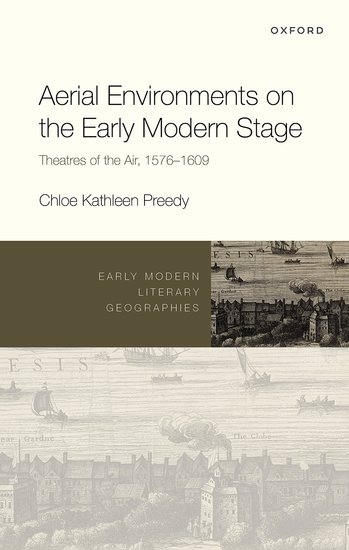
During the early days of the professional English theatre, dramatists including Dekker, Greene, Heywood, Jonson, Marlowe, Middleton, and Shakespeare wrote for playhouses that, though enclosed by surrounding walls, remained open to the ambient air and the sky above. The drama written for performance at these open-air venues drew attention to and reflected on its own relationship to the space of the air. At a time when theories of the imagination emphasized dramatic performance’s reliance upon and implication in the air from and through which its staged fictions were presented and received, plays written for performance at open-air venues frequently draw attention to the nature and significance of that elemental relationship.
Aerial Environments on the Early Modern Stage considers the various ways in which the air is brought into presence within early modern drama, analyzing more than a hundred works that were performed at the London open-air playhouses between 1576 and 1609, with reference to theatrical atmospheres and aerial encounters. It explores how various theatrical effects and staging strategies foregrounded early modern drama’s relationship to, and impact on, the actual playhouse air. In considering open-air drama’s pervasive and ongoing attention to aerial imagery, actions, and representational strategies, the book suggest that playwrights and their companies developed a dramaturgical awareness that extended from the earth to encompass and make explicit the space of air.
Gëzim Visoka and Nicolas Lemay-Hébert, Normalization in World Politics – University of Michigan Press, 2022 (open access e-book)
As we face new challenges from climate change and the rise of populism in Western politics and beyond, there is little doubt that we are entering a new configuration of world politics. Driven by nostalgia for past certainties or fear of what is coming next, references to normalcy have been creeping into political discourse, with people either vying for a return to a past normalcy or coping with the new normal.
This book traces main discourses and practices associated with normalcy in world politics. Visoka and Lemay-Hébert mostly focus on how dominant states and international organizations try to manage global affairs through imposing normalcy over fragile states, restoring normalcy over disaster-affected states, and accepting normalcy over suppressive states. They show how discourses and practices come together in constituting normalization interventions and how in turn they play in shaping the dynamics of continuity and change in world politics.
Normalization. A Discussion with Gëzim Visoka and Nicolas Lemay New Books Network, Aug 16, 2022
In this episode of High Theory, Gëzim Visoka and Nicolas Lemay-Hebert tell us about normalization in international relations. Their research applies Foucault’s social theories of the normal and abnormal to the objects of political science: states, international organizations, and practices of intervention.
In the episode (and in their book) Gëzim and Nicolas reference Foucault’s Lectures at the College de France on the Abnormal (printed in English by Verso and Macmillan). They discuss three exemplary figures from Foucault’s work on the abnormal: the monster, the incorrigible, and the onanist. Each one has a corresponding figure in international politics.
Their new book Normalization in World Politics is available as an open access text from Michigan University Press. That means you can read it for free! Check it out, and learn all about the ways we produce, impose, and maintain normal and abnormal affairs in the international order.
Identity is widely acknowledged to be a felt experience, yet questions of atmosphere, mood and public sentiments are rarely made central to understanding the global politics of nationalism. This book asks what difference it makes when we address national identity as principally an affective force? National Affects traces how ideas about ‘us and them’ take form in ordinary spaces, in ways that are both deeply felt and hardly noticeable, in studies of global events that range from the London 2012 Olympic Games to responses to acts of terror, the European refugee crisis and ‘Brexit’.
In this timely intervention, Angharad Closs Stephens addresses the affective dimensions of being together to open new angles in the study of nationalism and global politics. She asks how the nation is felt in everyday life, as well as differently experienced, and investigates different forms of enacting being together to generate new insights in the study of national identity. National Affects draws on academic theories in the study of Politics, International Relations and Human Geography, as well as stories, performance works and novels, to establish a new tone of critical enquiry. Informed by longstanding critical interrogations of the politics of ‘us and them’, this book argues that these ideas are not as stable as they are often made to seem.
Drawing on a combination of artistic and academic interventions, this book offers a refreshing approach to conceptualising the politics of nationalism, identity and citizenship. In its focus on everyday atmospheres, it identifies new registers for intervening politically. Overall, National Affects outlines other ways of imagining and practising being political together, beyond the exclusionary politics of nationalism.