Contre une lecture simpliste de l’anti-hégélianisme que Louis Althusser et Michel Foucault ont défendu dans les années 1960, l’ouvrage propose un parcours dans les textes de jeunesse de ces philosophes pour mettre au jour l’ancrage hégélien de leurs problématiques. À l’aide de nombreux documents d’archives et d’une lecture minutieuse de l’évolution intellectuelle d’Althusser et de Foucault, ce livre cherche à montrer comment ces derniers ont élaboré leur pensée à travers une critique immanente de l’hégélianisme.
La compréhension renouvelée de la raison, du sujet et de l’histoire qui s’est développée dans la philosophie française des années 1960 nous apparaît dès lors de manière nouvelle : loin de s’être construite unilatéralement contre Hegel, la formidable réinvention philosophique qui a eu lieu à cette époque est née d’un dialogue, conflictuel mais fécond, avec l’œuvre hégélienne. Le sens et la vision que nous avons de la philosophie française du second xxe siècle dans son ensemble s’en trouvent ainsi profondément transformés.
An exploration of radical megaprojects in the Ecuadorian Amazon, considering the fate of utopian fantasies under conditions of global capitalism
From 2007 to 2017, the “Citizens’ Revolution” launched an ambitious series of post-neoliberal megaprojects in the remote Amazonian region of Ecuador, including an interoceanic transport corridor, a world-leading biotechnology university, and a planned network of two hundred “Millennium Cities.” The aim was to liberate the nation from its ecologically catastrophic dependence on Amazonian oil reserves, while transforming its jungle region from a wild neoliberal frontier into a brave new world of “twenty-first-century socialism.” This book documents the heroic scale of this endeavor, the surreal extent of its failure, and the paradoxical process through which it ended up reinforcing the economic model that it had been designed to overcome. It explores the phantasmatic and absurd dimensions of the transformation of social reality under conditions of global capitalism, deconstructing the utopian fantasies of the state, and drawing attention to the eruption of insurgent utopias staged by those with nothing left to lose.
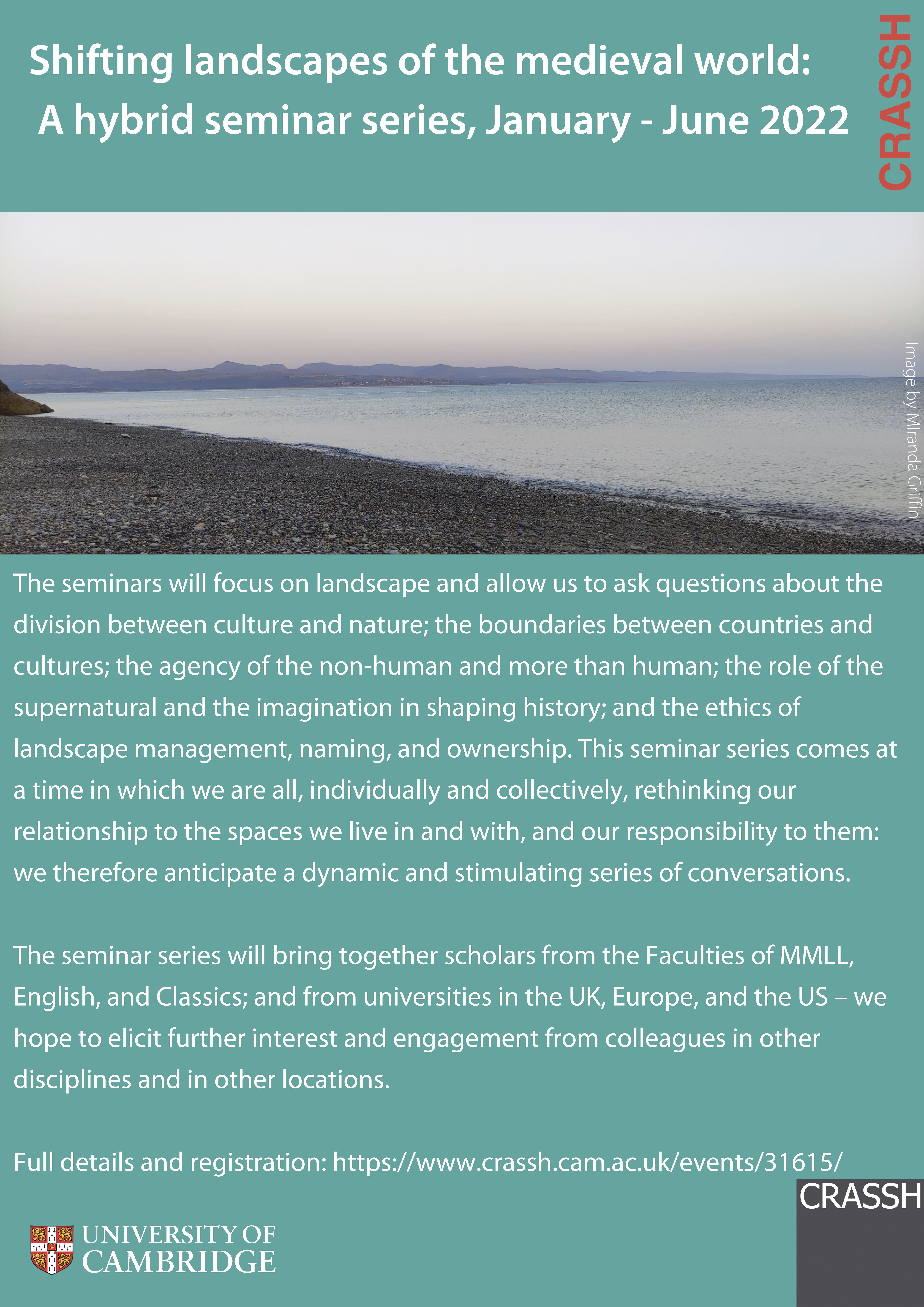
Although the word ‘landscape’ entered English in the sixteenth century, the concept of the land as it shapes and is shaped by human activity is much, much older. Much more than a backdrop to narrative, much more than a passive object of knowledge, much more than patches of space to be allocated and appropriated, landscape is revealed as playing an active part in narrative, power, and knowledge. A focus on landscape allows us to ask questions about the division between culture and nature; the boundaries between countries and cultures; the agency of the nonhuman and more than human; the role of the supernatural and the imagination in shaping history; and the ethics of landscape management, naming, and ownership. This seminar series comes at a time in which we are all, individually and collectively, rethinking our relationship to the spaces we live in and with, and our responsibility to them: we therefore anticipate a dynamic and stimulating series of conversations.
This seminar series brings together scholars from the Faculties of MMLL, English, and Classics; and from universities in the UK, Europe, and the US – we hope to elicit further interest and engagement from colleagues in other disciplines and in other locations. Although our focus is on medieval landscape (Máire Ní Mhaonaigh’s research concentrates on the history of Ireland’s literary landscapes; Miranda Griffin works on literary representations of landscape in medieval French), we aim to open out this perspective to engage colleagues working on periods both before and after the Middle Ages; and in areas beyond Northern Europe.
My optimistic idea of having a complete, even if very rough, draft of The Archaeology of Foucault before Christmas didn’t happen. I’d liked the idea of having a complete text, which I could then print and leave for a while when on holiday, and return to edit before term started again. But end of term stuff, a pile of marking, and some home renovation work which meant I couldn’t work properly derailed that plan. In addition, I was given access to some lectures which I didn’t know still existed, and that took up a lot of time – valuable, certainly, but unexpected.
I did have a good break over Christmas, without looking at the files or Foucault books, and returned to work for two weeks either side of the New Year before the start of term. The break helped get the momentum to complete the draft of the chapter on The Archaeology of Knowledge and related texts. It’s a long chapter, since it discusses all the draft material for that book and an abandoned parallel project, as well as the period in Tunisia and Foucault’s teaching there.
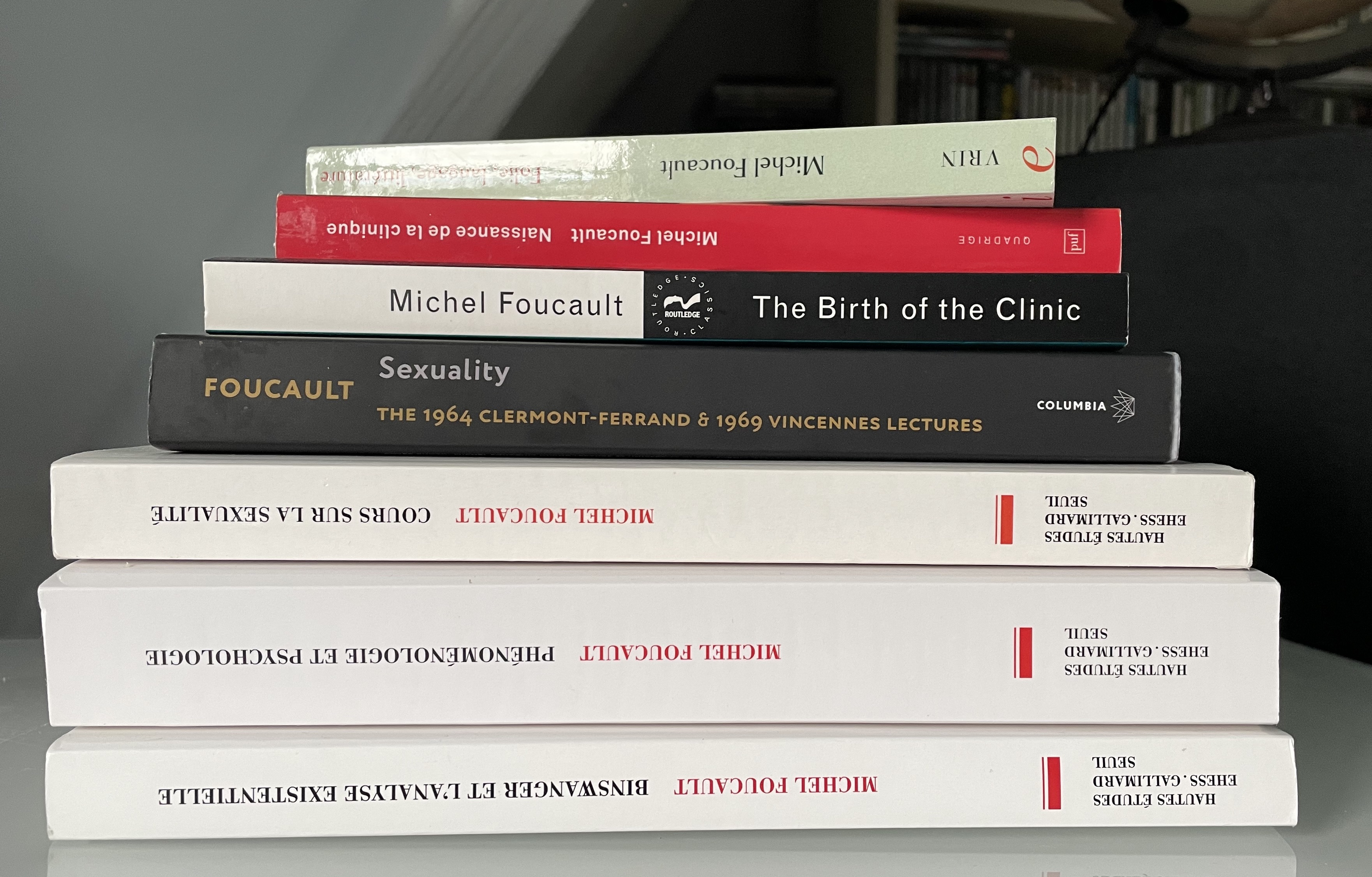
There were then two chapters which then needed a lot of work: the one on the sexuality lectures and related material, and one on Birth of the Clinic and Foucault’s work on madness after the History of Madness. The sexuality chapter was a tricky one, since the two extant series of lectures are from 1964 and 1969, and a lot happens between them, but thematically it makes sense for them to be treated together. At the moment I’ve decided to move it to after the chapter on The Order of Things, since Foucault says at one point it will be the next project. Although sexuality is still the main focus of the chapter, it also now discusses the limited sources for some related teaching on psychology and biology. I had a lot of draft material for this, and had already co-authored a review essay on the lectures with Alison Downham Moore in Theory, Culture and Society (open access here; Alison’s video abstract here). But I comprehensively reworked my discussion for this chapter, and used a lot of notes I had from Paris to supplement it, especially from Foucault’s notebooks. I think this chapter is now in fairly good shape.
The next step is working on the madness and medicine chapter. There is a lot to discuss here, though I had really hoped to get to see some archival sources in the USA to help with this. Most of these visits were ones I had booked back in March-April 2020, when they had to be cancelled. There was a brief moment in November 2021 when it might have been manageable, after UK citizens could go to the USA, but before Omicron took hold. But teaching and a wish to prioritise time in Paris meant that couldn’t happen. At the moment getting to the USA is challenging – travel is allowed, but difficult, and to use grant funds I need to go through Warwick and get insurance approval. The Paris trips were complicated enough (and at present, impossible). With teaching it’s probably March before I could imagine a transatlantic trip. So, I’ve been in touch with some archives to inquire about remote access. So far, the responses have been extremely helpful.
But there is plenty to do with this chapter which doesn’t require access. The chapter will discuss Birth of the Clinic, and the two editions of that text; a few occasional pieces on madness and some unpublished manuscripts and lectures. I already discuss the initial reception of History of Madness in Chapter 8 of The Early Foucault, but here I want to discuss Derrida and Althusser’s readings.The Foucault-Derrida debate is of course very well known, and I won’t be going into much detail about the published parts, but I hope archival sources allow me to say a little more about this and its aftermath. Althusser’s reaction to reading the book is mentioned in some of his letters and the book analysed in an unpublished seminar. IMEC has Etienne Balibar’s notes from this seminar and also has Althusser’s marked-up copy of the text – I’ve seen all of these, fortunately, and so can do the analysis without a repeat visit.
Some of the work behind this chapter is quite mechanical – the comparison of the two editions of Birth of the Clinic and the peculiar English translation which is of neither one nor the other but parts of both; and how Foucault used the library in Uppsala for the book. I had already done a lot of this, and there have been a few moments when I’ve been grateful I did some painstaking work properly in the past.
So as term begins on Monday, I have all but one chapter drafted, and substantial parts of that chapter in place. I’ll be speaking about this book in an online Modern French research seminar at the University of Cambridge on 31 January 2022, and about The Early Foucault for the Genealogy in the Humanities project (Syracuse University and Cornell University) in March. I’ll share further news on these when I have it.
Previous updates on this book are here. The Early Foucault was published by Polity in June 2021, and updates for its writing are here. A list of the resources on this site relating to Foucault – bibliographies, audio and video files, some textual comparisons, some short translations, etc. – can be found here. The earlier books in this series are Foucault: The Birth of Power and Foucault’s Last Decade, both available from Polity.
Daily Nous has the news of the death of Theodore Kisiel. The obituary linked is a good summary of his work. I met him a couple of times at conferences – in Denton, North Texas and Meßkirch. He was always very kind and supportive, and wrote a nice endorsement for my book Speaking Against Number. His book The Genesis of Heidegger’s Being and Time was important to me, and something of an inspiration for my work on Foucault.
Professor Kisiel was well-known for his work on Heidegger. Among his several books are The Genesis of Heidegger’s Being and Time (1993) and Heidegger’s Way of Thought: Critical and Interpretative Signposts (2002), a collection of some of his essays. You can browse his writings here and here.
Kisiel joined the faculty of Northern Illinois University in 1969. Prior to that, he worked Canisius College. He earned his PhD in philosophy from Duquesne University.
He died on December 25th, 2021.
You can read an obituary for Professor Kisiel here.
When I heard the geographer Clive Barnett had passed away on Christmas Eve, it took me a while to reconcile that it was the Clive Barnett who’d died, the Clive Barnett I hadn’t seen for many years yet whom I still considered one of my closest friends. I can’t believe Clive has gone. At Oxford, for three years—late ’80s/early ’90s—I’d shared with him some of the happiest moments of my life. We were doing our DPhils together, under David Harvey’s watch, became inseparable, like brothers, living in rooms next door to one another, drinking and eating together, arguing together, staying up all night together, reading the same things, almost breathing the same things.
In those days, Clive was a desperately shy lad, with a freshly minted BA from Churchill College, Cambridge. I was almost a decade older, a “mature student” from Liverpool Polytechnic. I always called him “young man”—not condescendingly…
At the end of each year I’ve posted a list of academic books I liked (2013, 2014, 2015, 2016, 2017, 2018, 2019, 2020). The criteria was simply that they were published in that year (or late the previous year), and that I read and appreciated them. Some of these are books I reviewed or endorsed, and some are by friends and colleagues. It’s of course biased by my interests and prejudices. I’m sure I’ve missed loads of other great books, and haven’t yet read all the ones I’ve bought or been sent, but I can at least say that these are all worth reading.
Alphabetical list of the music I enjoyed the most this year… Most bought on cd or blu-ray, though increasingly stuff on bandcamp too. Mostly rock, but also jazz, string quartets, ambient, solo piano, and probably the most peculiar/interesting thing I’ve heard this year – solo bass clarinet and saxophone recorded inside a box girder.
Anchor and Burden, Weigh Anchor, Clenched Brow and Folded Temple
The Anchoress, The Art of Losing
Sel Balamir, Swell
Nik Bartsch, Entendre
Big Big Train, The Underfall Yard (reissue) and Common Ground
Dream Theater, The View from the Top of the World
The Grid/Fripp, Leviathan
Robert Fripp, Music for Quiet Moments (box)
Frost*, Day and Age
Gavin Harrison and Antoine Fafard, Chemical Reactions
Peter Hammill, In Translation
Helmet of Gnats, Travelogue
Isildurs Bane and Peter Hammill, In Disequilibrium
Kali Trio, Loom
King Crimson, Music is our Friend (live)
The Kite Experiment (EP)
Kronos Quartet/Al Pari Quartet, World Dialogue (music by Stephan Thelan)
Liquid Tension Experiment, LTE3
Lunatic Soul, Through Shaded Woods
The Neal Morse Band, Innocence and Danger
Markus Reuter, Anchor and Burden
The Steve Rothery Band, Live in London
Sha, Monbijou.
J. Peter Schwalm and Markus Reuter, Aufbruch
Stephan Thelan, Fractal Guitar 2
Stephan Thelan and Jon Durant, Crossings
The Pineapple Thief, Nothing But the Truth (live)
Transatlantic, The Absolute Universe
Van de Graaf Generator, The Charisma Years 1970-1978 (box)
Steven Wilson, The Future Bites
I missed live music, seeing only a few shows, and lots of things cancelled or postponed. Streaming live concerts, especially from Nik Bärtsch’s Ronin and Mobile, helped.
Interview podcast with Kevin Thompson and Perry Zurn, editors of Intolerable. Writings from Michel Foucault and the Prisons Information Group (1970-1980), UNIVERSITY OF MINNESOTA PRESS 2021, New Books Network, Dec 20, 2021
Founded by Michel Foucault and others in 1970-71, the Prisons Information Group (GIP) circulated information about the inhumane conditions within the French prison system. Intolerable makes available for the first time in English a fully annotated compilation of materials produced by the GIP during its brief but influential existence, including an exclusive new interview with GIP member Hélène Cixous and writings by Gilles Deleuze and Jean Genet.