Les Cahiers du GRM – theme issue on Pratiques et expériences de l’enquête (open access – papers in English, French and Italian)

Les Cahiers du GRM – theme issue on Pratiques et expériences de l’enquête – edited by Andrea Cavazzini (open access)

Du XIXe siècle à aujourd’hui, l’enquête militante a souvent joué le rôle d’un retour au réel par-delà les paradigmes théoriques et politiques figés en autoreproduction idéologique : à la fois confrontation des programmes politiques et des paradigmes théoriques à la matérialité des rapports sociaux, voire à la composition économique, idéologique et politique des classes exploitées etprocessus de transformation mutuelle des enquêteurs et des enquêtés par la recherche commune d’une connaissance plus riche et d’une orientation plus efficace, l’enquête représente la sortie de la pensée et de l’action de l’auto-enfermement dans le toujours-identique des ordres discursifs et des pratiques réduites à rituels.

Ainsi, l’enquête peut apparaître comme la tentative de se réapproprier une capacité d’autonomie et d’autodétermination et comme une entreprise de connaissance indissociable de cette réappropriation – expression d’une demande de savoir et de la recherche d’une plus grande puissance d’agir, l’enquête est une pratique dont l’étude peut éventuellement fournir un contre-poison à la méditation nostalgique ou morose des vestiges du passé et des constructions intellectuelles. Autrement dit, l’enquête est le lieu où l’étude du passé révolutionnaire peut devenir autre chose que la contemplation d’une image et s’ouvrir à la réappropriation de la pensée par le réel.

Posted in Uncategorized | Leave a comment

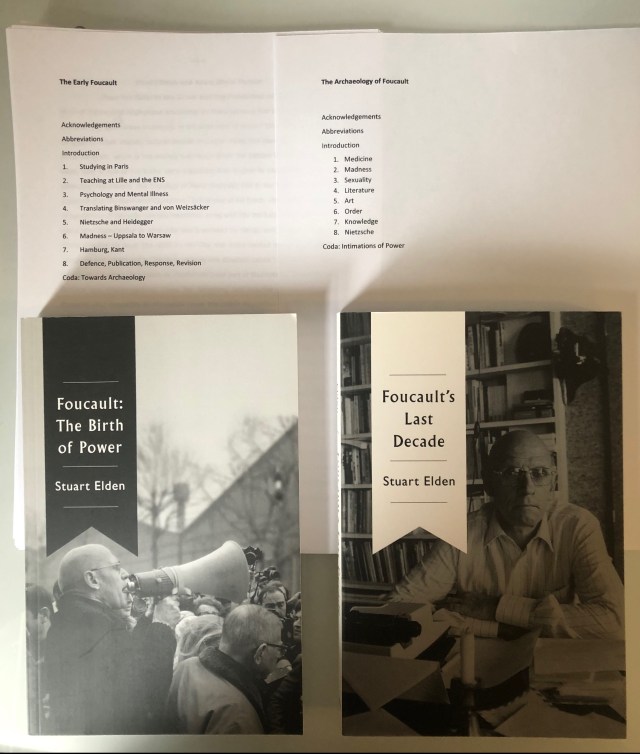
The Archaeology of Foucault update 1: Organisation, textual comparisons and a working timeline

IMG_3385 copy.jpeg

After an initial burst of enthusiasm, I’m already beginning to realise the scale of some of the tasks ahead of me with this book.

The final chapter of The Early Foucault discusses the way History of Madness was initially received, from some of the early reviews to Foucault’s interview in Le Monde and some radio programmes. That takes the story roughly up to the end of 1961, which is when Foucault finished writing Birth of the Clinic, and starts writing Raymond Roussel.  As I say in The Early Foucault, these books take the story beyond what I cover there, and already anticipate this new study. There are many more continuities between the supposed periods of Foucault’s work than are often suggested. A first draft of Birth of the Clinic was completed just six months after History of Madness was defended, and Foucault calls it the ‘out-takes’ from the earlier book. But François Delaporte’s work for the Pléiade Œuvres suggests that work on the text continued for another year, in parallel to the work on Raymond Roussel.

The first chapter of this book will be on Medicine, and Birth of the Clinic is obviously the key text. But the two editions of that text from 1963 and 1972 are quite different and as I’ve indicated before, the English translation is a peculiar hybrid of the two, rather than a consistent translation of one of them. The edition of the text in the Œuvres is unfortunately not complete in its annotation, and some way short of a critical edition. The only way I can do the work required is to sit with the two French editions, pen in hand, and mark up the differences. I have previously done this this kind of comparison for Maladie mentale et personnalité and Maladie mentale et psychologie, and for the way Histoire de la folie was abridged in 1964. I discuss the way those texts changed in The Early Foucault, and you can see the analysis of the first here. I buy additional copies of the more recent version to annotate in this way – first editions of these books are expensive.

With Naissance de la clinique it’s a bigger job than Maladie mentale, given the length of the text, and at least with Maladie mentale the English translation is consistently of the second edition. With Birth of the Clinic there will be the additional job of working out how Sheridan got from the two French source texts to the English – sometimes he switches edition mid-sentence. Additionally, the current French edition of the text has different pagination from the second edition, though there are no other changes as far as I’m aware. So, the first task was going through the most recent edition, comparing page breaks and writing the pagination of the second edition in the margins. If I can find a cheap copy of the second edition I may do the reverse. This is slow, boring work, but I’m hopeful it will save me time later.

There is some initial comparison of the texts which I did over a year ago here. Doing the whole thing is a major task. At the moment I’ve worked through the Introduction and the first five chapters, and I’m finding lots of things that hadn’t been highlighted in previous comparisons. Writing in the margins isn’t easy, and  so in a few instances I’m making copies of the first edition pages and inserting them. The plan is that I can then use this working copy to compare to the English, probably marking up a copy of that to show the way Sheridan switched between the first and second editions. He clearly had sight of some of the changes, but since he didn’t translate the second edition entirely, I can only assume he had either translated the first and then did a (not very careful) comparison to the second; or was given an (incomplete) indication of the changes to the second while that new French edition was in press.

The other mechanical task with Birth of the Clinic concerns its bibliography. When I was in Uppsala earlier this year, I was interested in how much Foucault actually used the Bibliotheca Walleriana for the History of Madness. Checking the reference list of that book to the catalogue was revealing, in that Foucault didn’t cite books held in the collection very often – contrary to his own recollection and reports in the biographies about how crucial it was. I say a bit more about that here. I’m curious about how this matches up for Birth of the Clinic too, so I’ve begun doing that checking. I have a copy of the catalogue of the Bibliotheca Walleriana, so I can do the work at home, at least initially, but again, it’s a slow process.

One of the other research tools I’ve used for writing these books is a detailed timeline. Defert provides a very helpful timeline in Dits et écrits, which is abbreviated but also emended in Œuvres. I use this as my starting point, but then as I’ve worked on different periods, I fill in details of all the things I can precisely date – lectures, press conferences, interviews, etc. I add in dates from other sources such as the biographies, news reports, memoirs of friends, notes to texts etc. I then have this as a working tool as I do the research, both to add to continually, and also to consult as I go. Among other things, it allows me to read across different registers of work. With Foucault: The Birth of Power, for example, it allowed me to see days or weeks where Foucault gave a lecture at the Collège de France, organised a press conference or attended a protest, gave an interview or signed a petition. These different types of work are often read as distinct, but I found it helpful to be able to relate them chronologically and thematically. It also allowed me to note discrepancies between various sources, which then become puzzles that I try to resolve. With The Early Foucault, where there was correspondence or other sources, I could fill in more detail. I spent a lot of time with Swedish newspapers to reconstruct the titles of public lectures for which there appeared to be no other source, for example. The years 1962-1969, the rough period of this new book, were quite empty in my working timeline, so I’m beginning to fill in detail there.

Of course, there are more interesting things to do. As well as the major books from this period – Birth of the Clinic, Raymond Roussel, The Order of Things, The Archaeology of Knowledge – there are a lot of shorter texts, most of which are in Dits et écrits, several of which haven’t been translated. There are collections of other pieces from the archive, such as Language, Madness and Desire and Folie, langage, littérature, the interviews with Claude Bonnefoy in Speech Begins After Death, and the two courses on sexuality from Clermont-Ferrand and Vincennes. While I’ve read these, I’ve not yet worked on them in detail. There is a lot more in the archive, much of which I’ve surveyed before, but need to work on much more closely as soon as that’s possible again. In particular, the draft versions of The Archaeology of Knowledge will become a major focus at some point, as well as the other lecture courses from this period, and Foucault’s preparatory reading notes. There are other questions which I want to explore which will (hopefully) lead me in different directions in terms of research. And, as ever, the point of writing a book is to find out things I don’t yet know are important.

So, the question over the next few months, before term begins, is how much I do the work with the published texts, how much I do the more mechanical work, and how much I’m able to think about archival research. I’m hopeful I can get to the archive for a week later this month to complete The Early Foucault, but I fear things will be restricted again before too long. If I can do the short trip to complete The Early Foucault without difficulty then I could get back to Paris again before term starts. But equally I’m resigned to having to wait until the Christmas break or even 2021 before I can do the next longer visit. Getting to the US to do the planned work at Yale, Princeton and possible Irvine will likely to have to wait for longer. I’ve been able to get an extension to the small grant I have for this work, so I’m not under immediate time pressure to spend or lose it. This is doubly fortunate, since internal research allowances at Warwick have been frozen for the rest of this year and next.


A little more on this book is here, and updates for The Early Foucault here. A list of the resources on this site relating to Foucault – bibliographies, audio and video files, some textual comparisons, some short translations, etc. – can be found here.

Posted in Michel Foucault, The Archaeology of Foucault, Uncategorized | Leave a comment

Geographers, sociologists, philosophers etc. on covid-19 – list updated

Geographers, sociologists, philosophers etc. on covid-19

This list continues to be updated, though less frequently than before. Recently added pieces include:-

Tim Christiaens and Stijn De Cauwer, The Biopolitics of Immunity in Times of COVID-19: An Interview with Roberto Esposito (Antipode)

Félix Tréguer, Gestion techno-policière d’une crise sanitaire (Sciences Po); translated as The State and Digital Surveillance in Times of the Covid-19 Pandemic (web version at Sciences Po; pdf at HAL Archives)

William Connolly, New Viral Crossings and Old Academic Divisions (The Contemporary Condition)

Kavita Datta and Vincent Guermond, Remittances in Times of Crisis: Reflections on Labour, Social Reproduction, and Digitisation during Covid-19 (Antipode)

Roger Keil, Maria Kaika, Tait Mandler and Yannis Tzaninis, Global urbanization created the conditions for the current coronavirus pandemic (The Conversation)

Andy Merrifield, Over the Rainbow — Pynchon and the Pandemic (blog)

Klaus Dodds , Vanesa Castan Broto , Klaus Detterbeck , Martin Jones , Virginie Mamadouh , Maano Ramutsindela , Monica Varsanyi , David Wachsmuth & Chih Yuan Woon, The COVID-19 pandemic: territorial, political and governance dimensions of the crisis (Territory, Politics, Governance)

Journal of Australian Political Economy No 85, Winter 2020 (via PPE)

James Tyner, Freedom, fatal convictions, and the face mask (University of Minnesota Press blog)

Alberto Toscano, Beyond the Plague State (Historical Materialism)

Jean-Luc Nancy and Jean-François Bouthors, ‘Only democracy can allow us to accept the lack of control over our history’ (Verso blog)

Simon Cook and Sam Hayes, Covid-19 and the changing geographies of exercise (Geography Directions)

Matthew Shaw, The untold story of university libraries in lockdown (WONKHE)

The full list is here.

Posted in Uncategorized | Leave a comment

On the Abolition of the Geography Department

Some interesting reflections from Clive Barnett on Geography as a discipline, in the light of teaching at a distance and the challenges of decolonising the curriculum.

Admin's avatarPop Theory

I’ve been working on the ‘online pivot‘ a lot just recently, thinking about the challenges of adjusting teaching and learning provision for the forthcoming academic year, starting in September, in the context of an ongoing situation in which ‘face-to-face’ forms of education will continue to be constrained and subject to ongoing disruptions. Thinking about teaching and learning at a distance, which is what all this is about, is a particular challenge for academic fields like geography, which are so heavily invested in forms of embodied, experiential learning not only in the form of ‘wet’ or ‘muddy’ labs, but especially perhaps that diffuse range of activities bundled under the name ‘the field’. At the same time as all of this, I also find myself sitting in university level meetings in which issues of equality, diversity, racism, harassment, and hate crime in UK higher education are increasingly described by…

View original post 2,139 more words

Posted in Uncategorized | Leave a comment

Michael Maidan, Review of Michel Foucault: Penal Theories and Institutions (2020)

A detailed discussion of the last of Foucault’s Collège de France courses to be published and translated (open access). As the review kindly notes, I discuss the course in detail in Foucault: The Birth of Power, but I’ve agreed to write something more on the course at some point later this year. I also wrote a review of the French edition of the course for Berfrois in 2015 (open access).

Clare O'Farrell's avatarFoucault News

Michel Foucault: Penal Theories and Institutions: Lectures at the Collège de France, 1971-1972
Review by Michael Maidan, Phenomenological Reviews, Sunday June 7th, 2020

Penal Theories and Institutions contains the lectures delivered by Foucault in his second-year tenure at the College de France (1971-2). It is also the last volume of this series, concluding a publication cycle of close to twenty years. The publication of Foucault’s lectures started mid-way with the 1976 course and then proceeded sideways, preventing us from grasping the development of his thought during the last fifteen years of his life.

Foucault did not prepare his lectures for publication, and their initial publication in 1997 was initially considered a transgression to Foucault’s last wishes for his posthumous writings not to be published. However, the proliferation of unauthorized versions of the lectures, based on transcriptions from audio recordings of unequal quality, decided the family and friends to…

View original post 5 more words

Posted in Uncategorized | Leave a comment

Beginning work on ‘The Archaeology of Foucault’

While work on The Early Foucault is just about complete, though stuck until I can get back to Paris, I’m today beginning work on ‘The Archaeology of Foucault’, the fourth and final book in this sequence. It fills in the missing years of 1962-1969, providing an intellectual history of Foucault’s entire career. During this time Foucault taught at Clermont-Ferrand, Tunis and Vincennes, and in Brazil, and while his books Birth of the ClinicThe Order of Things and The Archaeology of Knowledge are the best known outputs from this period, he did a lot of other things too. His work on literature, including the book on Raymond Roussel and lots of short pieces, and on art is also significant, and some of his lecture materials are in the process of being published. Some materials have been published already, and quite a lot is being edited. There is also a lot of unpublished material in the archive. One of the reasons for the non-chronological sequence in which I’ve written these books is the availability of materials in the archive or by publication.

More details on these books can be found here – people have seemed to like the research writing updates on the books (listed here and here), so I will continue with this one.  It’s hard to begin a new book when the last one isn’t yet complete, but next academic year at Warwick is going to be really tough, and research leave I had planned in the third term has been cancelled, so I’m going to try to make some initial progress with this over the summer months. While I can’t get to libraries just yet, and some archival work, especially in the USA, looks a long way off, I can do quite a lot with resources I have at home. I have a lot of notes from earlier work on this period, and quite a lot of draft text cut from The Early Foucault, so I’ll begin with organising that and working out where to go next.

Foucault books

There are quite a lot of Foucault resources on this site, and I expect I will add more as I do the research for this book too.

The page for this book and updates on its research is here, though not much information beyond this post just yet.

Posted in Foucault's Last Decade, Foucault: The Birth of Power, Michel Foucault, The Archaeology of Foucault, The Early Foucault, Uncategorized | 3 Comments

Alison Mountz, The Death of Asylum: Hidden Geographies of the Enforcement Archipelago – University of Minnesota Press, 2020

the-death-of-asylum
Alison Mountz, The Death of Asylum: Hidden Geographies of the Enforcement Archipelago – University of Minnesota Press, 2020

Remote detention centers confine tens of thousands of refugees, asylum seekers, and undocumented immigrants around the world, operating in a legal gray area that hides terrible human rights abuses from the international community. Built to temporarily house eight hundred migrants in transit, the immigrant “reception center” on the Italian island of Lampedusa has held thousands of North African refugees under inhumane conditions for weeks on end. Australia’s use of Christmas Island as a detention center for asylum seekers has enabled successive governments to imprison migrants from Asia and Africa, including the Sudanese human rights activist Abdul Aziz Muhamat, held there for five years.

In The Death of Asylum, Alison Mountz traces the global chain of remote sites used by states of the Global North to confine migrants fleeing violence and poverty, using cruel measures that, if unchecked, will lead to the death of asylum as an ethical ideal. Through unprecedented access to offshore detention centers and immigrant-processing facilities, Mountz illustrates how authorities in the United States, the European Union, and Australia have created a new and shadowy geopolitical formation allowing them to externalize their borders to distant islands where harsh treatment and deadly force deprive migrants of basic human rights.Mountz details how states use the geographic inaccessibility of places like Christmas Island, almost a thousand miles off the Australian mainland, to isolate asylum seekers far from the scrutiny of humanitarian NGOs, human rights groups, journalists, and their own citizens. By focusing on borderlands and spaces of transit between regions, The Death of Asylum shows how remote detention centers effectively curtail the basic human right to seek asylum, forcing refugees to take more dangerous risks to escape war, famine, and oppression.

Posted in Uncategorized | Leave a comment

The Selected Writings of Pierre Hadot, translated by Matthew Sharpe and Federico Testa, Bloomsbury, May 2020

This book is now published. There should be a pre-ordered copy waiting for me whenever I can get back in my Warwick office…

stuartelden's avatarProgressive Geographies

9781474272971The Selected Writings of Pierre Hadot, translated by Matthew Sharpe and Federico Testa, Bloomsbury, 2019

This collection of writings from Pierre Hadot (1992-2010) presents, for the first time, previously unreleased and in some cases untranslated materials from one of the world’s most prominent classical philosophers and historians of thought.As a passionate proponent of philosophy as a ‘way of life’ (most powerfully communicated in the life of Socrates), Pierre Hadot rejuvenated interest in the ancient philosophers and developed a philosophy based on their work which is peculiarly contemporary. His radical recasting of philosophy in the West was both provocative and substantial. Indeed, Michel Foucault cites Pierre Hadot as a major influence on his work.

This beautifully written, lucid collection of writings will not only be of interest to historians, classicists and philosophers but also those interested in nourishing, as Pierre Hadot himself might have put it, a ‘spiritual life’.

Table…

View original post 127 more words

Posted in Uncategorized | Leave a comment

Adam Kotsko, Agamben’s Philosophical Trajectory – Edinburgh University Press, September 2020

giorgio_agambenAdam Kotsko, Agamben’s Philosophical Trajectory – Edinburgh University Press, September 2020

Good to see this book nearly out – a major study by the key translator of Agamben into English. Adam has a great story about the project – Academic Publishing: An Odyssey – which I won’t spoil by part-quoting, but which is well worth a read.

  • Focuses on Agamben’s intellectual development
  • Offers the first study of the complete Homo Sacer series
  • Takes into account Agamben’s recently-published memoir
  • Addresses the full range of Agamben’s thought on linguistics, poetics, politics and theology

Giorgio Agamben has emerged as one of the most perceptive and even prophetic political thinkers of his era. Now that he has completed his multi-volume Homo Sacer series – his career-defining work – Adam Kotsko, one of his leading translators, shows how Agamben’s political concerns emerged and evolved as he responded to contemporary events and new intellectual influences while striving to remain true to his deepest intuitions. Kotsko reveals the trajectory of Agamben’s work and shows us what it means to practice philosophy as a living, responsive discipline.

Adam Kotsko’s brilliant study provides a chronological and systematic reading of Giorgio Agamben’s writings that allows us to see the evolution of Agamben’s thought over the years, as it responds to the varied historical contexts and philosophical problems uniquely characteristic of his oeuvre. As Kotsko is particularly attuned to the turn from the poetic to the political, he demonstrates subtle nuances often otherwise missed within Agamben’s work, making Agamben’s Philosophical Trajectory a fascinating portrait of the many twists and turns, continuities and discontinuities alike, within his philosophy. This book will most certainly serve as a definitive account of Agamben’s development for years to come.

Colby Dickinson, Associate Professor of Theology, Loyola University Chicago


Posted in Giorgio Agamben, Uncategorized | Leave a comment

Claude Lévi-Strauss, Wild Thought – a new translation of La pensée sauvage – University of Chicago Press, February 2021 (now published)

9780226413082Claude Lévi-Strauss, Wild Thought – a new translation of La pensée sauvage – translated by Jeffrey Mehlman and John Leavitt, University of Chicago Press, December 2020 [update: now listed as February 2021]

Perhaps the most influential anthropologist of his generation, Claude Lévi-Strauss left a profound mark on the development of twentieth-century thought, equal to that of phenomenology and existentialism. Through a fertile mixture of insights gleaned from linguistics and from sociology and ethnology, Lévi-Strauss elaborated his theory of structural unity in culture and became the preeminent representative of structural anthropology. La Pensée sauvage, published in French in 1962, was his crowning achievement. Ranging over philosophies, historical periods, and human societies, it challenged the prevailing assumption of the superiority of modern Western culture and sought to explain the unity of human intellection.

Unfortunately titled The Savage Mind when it first published in English in 1966, the original translation nevertheless sparked a fascination with Lévi-Strauss’s work among generations of Anglophone readers. Wild Thought: A New Translation of “La Pensée sauvage” rekindles that spark with a fresh and accessible new translation. Including critical annotations for the contemporary reader, it restores the accuracy and integrity of the book that changed the course of twentieth-century thought, making it an indispensable addition to any philosophical and anthropological library.

Posted in Claude Lévi-Strauss, Uncategorized | 1 Comment