Irus Braverman and Elizabeth R. Johnson (eds.),Blue Legalities: The Life and Laws of the Sea – Duke University Press, 2019

Irus Braverman and Elizabeth R. Johnson (eds.), Blue Legalities: The Life and Laws of the Sea – Duke University Press, 2019

The ocean and its inhabitants sketch and stretch our understandings of law in unexpected ways. Inspired by the blue turn in the social sciences and humanities, Blue Legalities explores how regulatory frameworks and governmental infrastructures are made, reworked, and contested in the oceans. Its interdisciplinary contributors analyze topics that range from militarization and Maori cosmologies to island building in the South China Sea and underwater robotics. Throughout, Blue Legalities illuminates the vast and unusual challenges associated with regulating the turbulent materialities and lives of the sea. Offering much more than an analysis of legal frameworks, the chapters in this volume show how the more-than-human ocean is central to the construction of terrestrial institutions and modes of governance. By thinking with the more-than-human ocean, Blue Legalities questions what we think we know—and what we don’t know—about oceans, our earthly planet, and ourselves.

Contributors. Stacy Alaimo, Amy Braun, Irus Braverman, Holly Jean Buck, Jennifer L. Gaynor, Stefan Helmreich, Elizabeth R. Johnson, Stephanie Jones, Zsofia Korosy, Berit Kristoffersen, Jessica Lehman, Astrida Neimanis, Susan Reid, Alison Rieser, Katherine G. Sammler, Astrid Schrader, Kristen L. Shake, Phil Steinberg

“Not a minute too early, the ‘blue turn’ finally takes pride of place in legal thinking. Blue Legalities balances the legal and the liquid in all their emanations. The contributions span from the oceanic depths of our planet to the glimmering surface of our limited comprehension, combining in an undeniably poetic whole, law, politics, science, anthropology, history, and philosophy amongst other epistemes. The feat of this book is diving headlong in the fathomless challenge of treating the material and the textual as one ontological ripple.” — Andreas Philippopoulos-Mihalopoulos, author of Spatial Justice: Body, Lawscape, Atmosphere

“Elisabeth Mann Borgese, one of the architects of the first Law of the Sea conference, argued that any approach to the ocean must be inherently interdisciplinary. Irus Braverman and Elizabeth R. Johnson have fulfilled this claim with a wonderful interdisciplinary collection. Plumbing the depths of human and more-than-human life and law at sea, this volume is a welcome and timely contribution to the field of critical ocean studies.” — Elizabeth M. DeLoughrey, author of Allegories of the Anthropocene


Posted in Uncategorized | 1 Comment

Mark Usher, ‘Territory Incognita’, Progress in Human Geography

Mark Usher, ‘Territory Incognita’, Progress in Human Geography, https://doi.org/10.1177/0309132519879492 (requires subscription)

Tracing the lineage of territorial theorization, from legal container through dialectical, strategic and rhizomatic interpretations, this paper contends that more-than-human aspects of territory have been routinely circumvented by scholars seeking to avoid its realist, imperialist intellectual past. However, with the crisis of representation in political theory precipitated by the planetary ecological crisis, territory as a material entity has sprung alive again. This paper proposes that a reinvigorated materialist approach, informed by Deleuze and Guattari’s writings on territorial assemblages as machinic, nomadic and affective, can offer a way out of the territorial trap, reclaiming nomos from its conservative, masculine heritage.

Posted in Territory, Uncategorized | Leave a comment

Selection of De Gruyter eBooks, chapters and articles – free to read, download and share until November 30, 2019 (Nietzsche, de Beauvoir, aesthetics…)

Special collection of De Gruyter eBooks, book chapters and journal articles – free to read, download and share until November 30, 2019

Thanks to dmf for the link. Looks like you need to download the books chapter by chapter…


Posted in Uncategorized | Leave a comment

Foucault audio and video recordings online – updated and links fixed

foucault1.jpgI’ve updated the chronology of audio and video recordings of Foucault online. There are some additional ones here, and I’ve tried to fix any broken links. Please let me know if any are broken – videos seem to disappear, especially from YouTube, and some online repositories change their links but don’t make it easy to find things in the new ordering.

The only one I think is missing a live link in this list is the interview with Umberto Eco and Enzo Melandri. If anyone has the link for this, I’d be grateful.

I’d also appreciate links for any that I haven’t spotted.

There are lots more Foucault resources on this site – bibliographies, audio and video files, some textual comparisons, some short translations, etc.

Posted in Michel Foucault, Uncategorized | 2 Comments

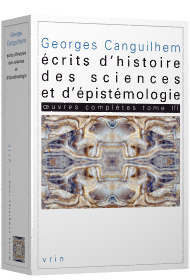
Georges Canguilhem, Œuvres complètes Tome III – Vrin, November 2019

9782711623624.jpgGeorges Canguilhem, Œuvres complètes Tome IIIÉcrits d’histoire des sciences et d’épistémologie – Vrin, November 2019

This looks interesting, especially the variant texts alongside the published works, though given previous experience with these volumes, I’ll take the November date a little skeptically…

Ce troisième tome des Œuvres complètes, réunit trois ouvrages. Le premier, Du développement à l’évolution, est issu d’un séminaire de recherche de la fin des années 1950 : il offre l’exemple alors rare d’un travail d’équipe mené en commun jusqu’à la publication des résultats. Les deux autres ouvrages, les Études d’histoire et de philosophie des sciences et Idéologie et rationalité dans l’histoire des sciences de la vie, consacrèrent la réputation d’historien des sciences et d’épistémologue de Georges Canguilhem.
Cette nouvelle édition offre une mise en contexte de chacun de ces écrits, en y adjoignant de nombreuses variantes et d’importants ajouts que Canguilhem avait destinés à la publication mais qui, par accident, restèrent inédits.
Tous ces travaux confirment l’originalité de la mise en œuvre par Canguilhem de l’épistémologie historique, qu’il définit comme la déontologie d’une histoire critique des sciences. Leur lecture corrobore la fécondité de ses contributions conceptuelles propres et le caractère pénétrant de ses analyses.
Textes édités, introduits et annotés par Camille Limoges.
Posted in Georges Canguilhem, Uncategorized | 1 Comment

Ian James, The Technique of Thought: Nancy, Laruelle, Malabou, and Stiegler after Naturalism, University of Minnesota Press, 2019 – reviewed at NDPR by Samuel Talcott

image.jpgIan James, The Technique of Thought: Nancy, Laruelle, Malabou, and Stiegler after Naturalism, University of Minnesota Press, 2019 – reviewed at NDPR by Samuel Talcott

Here’s the publisher description:

The Technique of Thought explores the relationship between philosophy and science as articulated in the work of four contemporary French thinkers—Jean-Luc Nancy, François Laruelle, Catherine Malabou, and Bernard Stiegler. Situating their writings within both contemporary scientific debates and the philosophy of science, Ian James elaborates a philosophical naturalism that is notably distinct from the Anglo-American tradition. The naturalism James proposes also diverges decisively from the ways in which continental philosophy has previously engaged with the sciences. He explores the technical procedures and discursive methods used by each of the four thinkers as distinct “techniques of thought” that approach scientific understanding and knowledge experimentally.

Moving beyond debates about the constructed nature of scientific knowledge, The Technique of Thought argues for a strong, variably configured, and entirely novel scientific realism. By bringing together post-phenomenological perspectives concerning individual or collective consciousness and first-person qualitative experience with science’s focus on objective and third-person quantitative knowledge, James tracks the emergence of a new image of the sciences and of scientific practice.

Stripped of aspirations toward total mastery of the universe or a “grand theory of everything,” this renewed scientific worldview, along with the simultaneous reconfiguration of philosophy’s relationship to science, opens up new ways of interrogating immanent reality.

Posted in Bernard Stiegler, Catherine Malabou, Georges Canguilhem, Jean-Luc Nancy, Uncategorized | Leave a comment

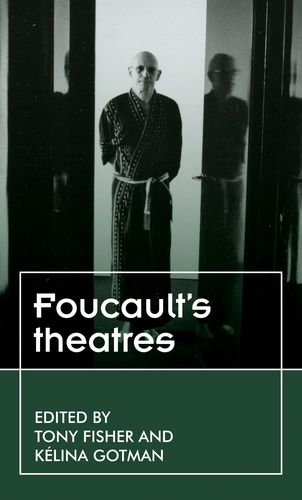
Tony Fisher and Kélina Gotman (eds.), Foucault’s Theatres – Manchester University Press, October 2019

F's Theatres.pngTony Fisher and Kélina Gotman (eds.), Foucault’s Theatres – Manchester University Press, October 2019

The volume contributes to a new articulation of theatre and performance studies via Foucault’s critical thought. With cutting edge studies by established and emerging writers in areas such as dramaturgy, film, music, cultural history and journalism, the volume aims to be accessible for both experienced researchers and advanced students encountering Foucault’s work for the first time. The introduction sets out a thorough and informative assessment of Foucault’s relevance to theatre and performance studies and to our present cultural moment – it rereads his profound engagement with questions of truth, power and politics, in light of previously unknown writings and lectures. Unique to this volume is the discovery of a ‘theatrical’ Foucault – the profound affinity of his thinking with questions of performativity. This discovery makes accessible the ‘performance turn’ to readers of Foucault, while opening up ways of reading Foucault’s oeuvre ‘theatrically’.

Introduction: theatre, performance, Foucault Tony Fisher and Kélina Gotman
1 Foucault’s philosophical theatres Mark D. Jordan
2 The dramas of knowledge: Foucault’s genealogical theatre of truth Aline Wiame
3 Foucault live! A Voice That Still Eludes the Tomb of the Text. Magnolia Pauker
4 Foucault, Oedipus, Négritude Kélina Gotman
5 Foucault’s critical dramaturgies Mark Robson
6 Heterotopia and the mapping of unreal spaces on stage Joanne Tompkins
7 Foucault and Shakespeare: the theatre of madness Stuart Elden
8 Philosophical phantasms: ‘the Platonic differential’ and ‘Zarathustra’s laughter’ Mischa Twitchin
9 Cage and Foucault: musical timekeeping and the security state Steve Potter
10 Foucault and the Iranian Revolution: reassessed Tracey Nicholls
11 Sightlines: Foucault and Naturalist theatre Dan Rebellato
12 Theatre of poverty: popular illegalism in the nineteenth century Tony Fisher
13 The philosophical scene: an interview with Moriaki Watanabe Michel Foucault (translated by Robert Bononno)
14 After words, afterwards: teaching Foucault Ann Pellegrini

Posted in Uncategorized | Leave a comment

Jeremy Black, Maps of War: Mapping Conflict through the Centuries – discussion at New Books Network

9781844863440.jpgJeremy Black, Maps of War: Mapping Conflict through the Centuries (Conway, 2016) – new discussion at New Books Network.

Thanks to dmf for the link.


Posted in Uncategorized | Leave a comment

Caliban and the Witch: A Verso Roundtable

Caliban and the Witch: A Verso Roundtable

Carrington-self-potrait-

Leonora Carrington, Self-Portrait, (c. 1937-1938), The Pierre and Maria-Gaetana Matisse Collection, 2002, © 2019 Artists Rights Society (ARS), New York

This October, Verso is hosting a roundtable on Silvia Federici’s incantatory and incendiary Caliban and the Witch: Women, the Body, and Primitive Accumulation (2004), inviting reflections from activists, writers, and scholars to discuss the provocations of Federici’s arguments on capitalism and colonialism, bodies and reproduction, race and slavery—and the powerful figure of the witch.Check back as we add more contributions over the week.

All Organizing is Magic – Sarah Jaffe examines the echoes of witchcraft in contemporary anti-capitalist discourse and practice.

Wrath, Line, and SubstancePeter Linebaugh explicates the intellectual traditions which Silvia Federici drew from and transcended in her innovative study of witchcraft and the origin of capitalism.

Learning from Witchy and Wayward WomenAlys Weinbaum shows how Federici’s work illuminates capital’s fundamental drive to dominate reporductive processes.

A Gathering Against History– Ariella Aïsha Azoulay argues that the persecution of unruly, ‘unproductive’ women in Europe during the transition to capitalism paralleled the subjection of ‘indigenous’ populations under colonial rule.


Posted in Uncategorized | Leave a comment

CFP: Interstices Journal of Architecture and Related Arts Issue 20:2020 Political Matters – Spatial Thinking of the Alternative

CALL FOR PAPERS:

Interstices Journal of Architecture and Related Arts
Issue 20:2020 Political Matters: Spatial Thinking of the Alternative

Issue Editors: Farzaneh Haghighi (University of Auckland) & Nikolina Bobic (University of Plymouth)
Deadline for paper submission:  9th December 2019 – 5:00pm NZT
https://interstices.ac.nz/index.php/Interstices/announcement/view/2

At a time when the Western political climate is synonymous with Brexit, Donald Trump and Boris Johnston, the Christchurch terrorist attack, Australia’s Manus Island detention centres, the US-Mexico border and the global refugee crisis, the urgency of addressing the relationship between politics and space is more pressing than ever. To answer the question of what it means for space to be political beyond it merely being an expression of hegemonic orders, we follow Hannah Arendt’s celebration of political action, and her stance that political questions are far too serious to be left to politicians (1970). We draw upon Chantal Mouffe’s concept of agonism and the impossibility of a final reconciliation in thinking the political (2013). We acknowledge Paul Virilio’s thinking on negative horizon whereby perception is not just dependent upon the framing and mastering of the rhetoric of media and memory, but rather this mastery is also framed and dependent upon seeing abysses (1989, 2005, 2009). Finally, we emphasise Michel Foucault’s reconceptualisation of power as being productive rather than oppressive (1980). To make sense of, and come to grips with, this contemporary landscape requires a detailed reflection and analysis at different levels – individual, social, cultural, environmental, technological, medical, economic or legal.

Comprehending the complex forms of surveillance and governance in the age of contemporaneity requires one to problematise the limits of spatial politics in the society of control (1995). Indeed, it may require a different placing and questioning of ideas, events and spaces than the norm. Questioning and disrupting the limits of the norm may enable frictions and generate new knowledge. This issue of Interstices seeks papers that address the complexity at the nexus of architecture, urbanism, sociology, human geography and political philosophy, and focuses on the following themes:

  • Power, Memory and Identity
  • The Spectacle and the Screen
  • Housing, Urban Commons and the Social
  • Events, Flows and Public Space
  • Territories, Walls and Peripheries

Discussion on the convolutedness of control societies are also oriented towards formulating the hopeful, active and productive role space may have in the formation of social movements and in transforming everyday life – in other words, where we become active participants in the cities we live in, rather than passive designers or consumers serving the interest of market economies. It is where liberating spaces for thinking differently can thrive. Likewise, it is where access to, and dwelling in, space is enabled. It is where we can engage with questions of conflict, security and territorial stability, however, not at the expense of dehumanising the Other. Moreover, the implication of these explorations for architectural pedagogy remains a fruitful opportunity for political agency and we encourage submissions on this topic as well. The thematic call on Political Matters: Spatial Thinking on the Alternative for Issue 20 of Interstices: Journal of Architecture and Related Arts seeks ambitious, innovative and rigorous scholarship of 5,000-word papers. The proposed schedule is outlined below:

14th August 2019: Call for 5,000-word papers issued
9th December 2019: Deadline for 5,000-word paper submissions
July 2020: Estimated journal publication

Please submit all papers to: susan.hedges@aut.ac.nz

For journal submission guidelines see: https://interstices.ac.nz/index.php/Interstices/Style_Guide
For all Interstices matters see: https://interstices.ac.nz/index.php/Interstices


CALL FOR Creative Design Research Projects:

Interstices Journal of Architecture and Related Arts
Issue 20:2020 Political Matters: Spatial Thinking of the Alternative

Issue Editors: Farzaneh Haghighi (University of Auckland) & Nikolina Bobic (University of Plymouth)
Deadline for submission: 31 January 2020- 5:00pm NZT
https://interstices.ac.nz/index.php/Interstices/announcement/view/3

Continuing our commitment to publishing the work of emerging designer researchers, Interstices: Journal of Architecture & Related Arts invite postgraduate or recently graduated researchers in architecture and related art and design fields to submit projects for the journal’s peer-reviewed, creative design research section. Projects should be complete at the time of submission and are to include an explanatory synopsis of 1,500 words. Project documentation and the synopsis should conform to the following requirements:

  • Be original and unpublished previously
  • In the case of visual material, include no more than eight indicative views of the proposal
  • In the case of moving image, animated sequences, or audio works, not exceed four minutes duration
  • Include a scholarly and critically situating synopsis for the project coauthored by both the project’s creator and the supervisor(s) involved (if applicable). The synopsis should bear the name of the researcher as the primary author and the supervisor (if included) as the secondary author
  • Exhibit, if feasible, a relationship with the journal issue theme. See – the current call for papers for Issue 20 | Political Matters – https://interstices.ac.nz/index.php/Interstices/announcement/view/2

Submissions will be considered for inclusion in Issue 20 of Interstices: Journal of Architecture & Related Arts, scheduled for publication in mid – 2020. All submission will be blind refereed by an invited panel.

Visit our website to view the Guidelines for Submissions for details about the reviewing process, copyright issues and formatting: https://interstices.ac.nz/index.php/Interstices/Style_Guide.
Please submit all Creative Design Research Projects to: andrew.douglas@auckland.ac.nz


Posted in Uncategorized | Leave a comment