The Selected Writings of Pierre Hadot, translated by Matthew Sharpe and Federico Testa, Bloomsbury, 2019

9781474272971The Selected Writings of Pierre Hadot, translated by Matthew Sharpe and Federico Testa, Bloomsbury, 2019

This collection of writings from Pierre Hadot (1992-2010) presents, for the first time, previously unreleased and in some cases untranslated materials from one of the world’s most prominent classical philosophers and historians of thought.As a passionate proponent of philosophy as a ‘way of life’ (most powerfully communicated in the life of Socrates), Pierre Hadot rejuvenated interest in the ancient philosophers and developed a philosophy based on their work which is peculiarly contemporary. His radical recasting of philosophy in the West was both provocative and substantial. Indeed, Michel Foucault cites Pierre Hadot as a major influence on his work.

This beautifully written, lucid collection of writings will not only be of interest to historians, classicists and philosophers but also those interested in nourishing, as Pierre Hadot himself might have put it, a ‘spiritual life’.

Table of contents

Part 1: Key Parameters
1. ‘My Books and My Research’
2. ‘Ancient Philosophers’
3. ‘Ancient Philosophy, an Ethics or a Practice?’
4. ‘The Oral Teaching of Plato’

Part 2: Aspects
5. ‘Conversion’
6. ‘The Division of the Parts of Philosophy in Antiquity’
7. ‘Philosophy, Dialectic, and Rhetoric in Ancient Philosophy’

Part 3: The Ancients and Nature
8. ‘The Ancients and Nature’
9. ‘The Genius of Place in Ancient Greece’

Part 4: Figures
10. ‘The Figure of the Sage in the Greek and Roman Antiquity’
11. ‘Physics as a Spiritual Exercise, or Pessimism and Optimism in Marcus Aurelius’
12. ‘On an Interrupted Dialogue with Michel Foucault: Convergences and Divergences’

Part 5: Ends
13. ‘The End of Paganism’
14. ‘Models of Happiness Proposed by the Ancient Philosophers’

Posted in Pierre Hadot, Uncategorized | 1 Comment

Foucault resources – some updates and reorganisation

HF-HM editionsWhile I’ve been writing the sequence of books on Foucault for Polity – Foucault’s Last Decade;  Foucault: The Birth of Power and the ongoing The Early Foucault – I’ve been making available some research resources.
These have included bibliographies, lists of audio and video files, some textual comparisons, some short translations, and so on. These have mostly been things I’ve done for my own work, but which I hope other people would also find useful.

I’ve done a bit of reorganisation to the index page, and put up two new minor pieces. One is a comparison of the ‘Notice Historique’ to Foucault’s translation of Kant’s Anthropology and the posthumously published Introduction; the other is a bibliographical chronology of the different editions of Foucault’s History of Madness in French and English.

But I’d also point to some of the older ones

Foucault’s uncollected notes, lectures and interviews – list with links

Foucault’s collaborative projects – a bibliography 

Foucault and the Groupe Information Santé – a bibliography

and some of the textual comparisons like

Foucault’s Inaugural lecture at the Collège de France, L’ordre du discours – comparison of the two different versions

Which edition of Foucault’s Birth of the Clinic did Alan Sheridan actually translate?

History of Sexuality volume II – a comparison of the three different introductions

Quite a lot more at the page – comments and corrections welcome.

Posted in Foucault's Last Decade, Foucault: The Birth of Power, Michel Foucault, The Early Foucault, Uncategorized | Leave a comment

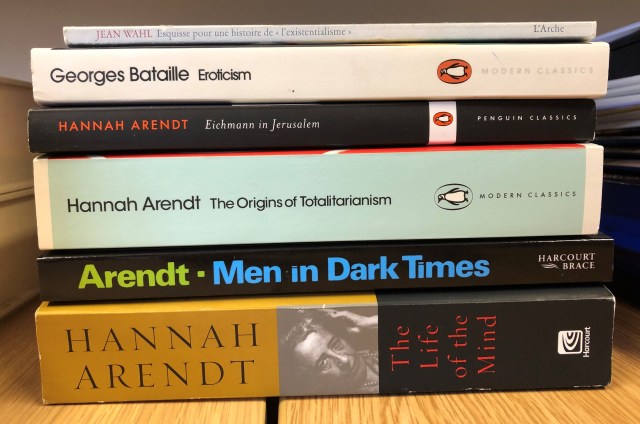
Books received – Arendt, Bataille, Wahl

Some books recently bought second-hand – mainly by Hannah Arendt but also Bataille’s Eroticism and Jean Wahl, Esquisse pour une histoire de l’existentialisme. I’ve read most of the Arendt books before, but I’m teaching her again this year and so it’s helpful to have copies.

arendt-etc.jpg

Posted in Georges Bataille, Hannah Arendt, Uncategorized | Leave a comment

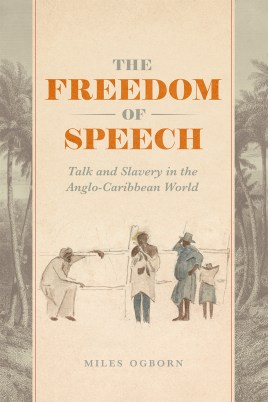
Miles Ogborn, The Freedom of Speech: Talk and Slavery in the Anglo-Caribbean World, University of Chicago Press, 2019

9780226657684.jpgMiles Ogborn, The Freedom of Speech: Talk and Slavery in the Anglo-Caribbean World, University of Chicago Press, 2019

The institution of slavery has always depended on enforcing the boundaries between slaveholders and the enslaved. As historical geographer Miles Ogborn reveals in The Freedom of Speech, across the Anglo-Caribbean world the fundamental distinction between freedom and bondage relied upon the violent policing of the spoken word. Offering a compelling new lens on transatlantic slavery, this book gathers rich historical data from Barbados, Jamaica, and Britain to delve into the complex relationships between voice, slavery, and empire. From the most quotidian encounters to formal rules of what counted as evidence in court, the battleground of slavery lay in who could speak and under what conditions. But, as Ogborn shows through keen attention to both the traces of talk and the silences in the archives, if enslavement as a legal status could be made by words, it could be unmade by them as well. A deft interrogation of the duality of domination, The Freedom of Speech offers a rich interpretation of oral cultures that both supported and constantly threatened to undermine the slave system.


Posted in Uncategorized | 1 Comment

Land and Territory – Thinking Aloud with Brett Christophers and Penelope Anthias

Land and territory on Thinking Allowed

Land Struggles: From Bolivia to Britain, the way that land is owned and controlled is central to many contemporary inequalities and political battles. Laurie Taylor talks to Brett Christophers, Professor in the Department of Social and Economic Geography at Uppsala University, Sweden, about ‘the new enclosure’, a UK study into the appropriation of public land by the private sector – an astonishing two million hectares worth £400 billion – in recent decades. This ownership now forms the largest component of wealth in Britain and is the largest privatisation of a public resource in European history. Also, Penelope Anthias, Assistant Professor in the Department of Geography at University of Durham, describes the lives of indigenous people in Bolivia as they struggle to regain ancestral territory after a century of colonialism and state backed dispossession.

Thanks to dmf for this link


Posted in Territory, Uncategorized, urban/urbanisation | Leave a comment

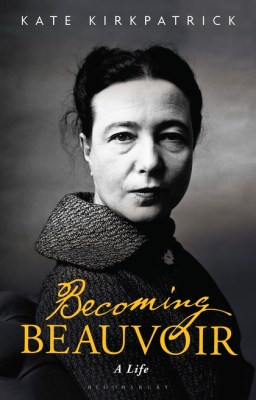
Kate Kirkpatrick, Becoming Beauvoir: A Life – Bloomsbury, 2019 (and short piece in The Guardian)

9781350047174.jpgKate Kirkpatrick, Becoming Beauvoir: A Life – Bloomsbury, 2019

“One is not born a woman, but becomes one”, Simone de Beauvoir

A symbol of liberated womanhood, Simone de Beauvoir’s unconventional relationships inspired and scandalised her generation. A philosopher, writer, and feminist icon, she won prestigious literary prizes and transformed the way we think about gender with The Second Sex. But despite her successes, she wondered if she had sold herself short.

Her liaison with Jean-Paul Sartre has been billed as one of the most legendary love affairs of the twentieth century. But for Beauvoir it came at a cost: for decades she was dismissed as an unoriginal thinker who ‘applied’ Sartre’s ideas. In recent years new material has come to light revealing the ingenuity of Beauvoir’s own philosophy and the importance of other lovers in her life.

This ground-breaking biography draws on never-before-published diaries and letters to tell the fascinating story of how Simone de Beauvoir became herself.

Short piece in The Guardian – Was Simone de Beauvoir as feminist as we thought?

Update: good piece on the book in The New Statesman

Posted in Simone de Beauvoir, Uncategorized | Leave a comment

Warwick IAS WIRL-COFUND 2 year early career fellowships

The Institute of Advanced Study (IAS) at the University of Warwick is pleased to announce that up to five fellowships will be available in 2019 as part of the Warwick Interdisciplinary Research Leadership programme (WIRL-COFUND). The WIRL-COFUND fellowships are jointly funded by the University of Warwick and the European Union through the Marie Skłodowska Curie COFUND scheme (Grant Agreement 713548). The fellowships will provide the opportunity for outstanding early career researchers from around the world to spend two years at Warwick, developing their independent research and undertaking training which will help them develop into the next generation of research leaders.

These two-year fellowships will offer successful applicants the opportunity to accelerate their research careers by developing their own independent research ideas in a world-leading research environment whilst undertaking a specific programme of advanced training delivered through the IAS Academic Careers and Leadership Programme.

Five 2-year independent Fellowships will be available to outstanding early career researchers, with successful candidates starting in September 2020.

Candidates are strongly encouraged to be in contact with host academic departments and mentors prior to applying.

Applications will be accepted from 1 October to 30 November 2019. Full details of the scheme can be found at www.warwick.ac.uk/wirl

Posted in Uncategorized | Leave a comment

Two four-year post-doctoral positions, University of Warwick – ‘Neoliberal Terror: The Radicalisation of Social Policy in Europe’

The Department of Politics and International Studies at the University of Warwick have two post-doctoral positions available, and seek your help sharing the vacancies.  Each post-doc has a fixed four-year term of employment, working on the European Research Council funded project ‘Neoliberal Terror: The Radicalisation of Social Policy in Europe’. This project investigates the political, economic and discursive mechanisms which have brought counterterrorism into European health and social care sectors. Doctors, nurses and social care professionals are now responsible for noticing, checking and sharing signs of radicalisation as part of national terrorism prevention programs. The project tests the hypothesis that neoliberalism contextualises and influences the diffusion of Countering Violent Extremism policies.

The closing date for both positions is the 31st October.

The qualitative position is centred around a large discourse analysis of European policies, speeches and instruments relating to CVE (Countering Violent Extremism), but will also involve some research interviews with practitioners. The vacancy can be found here.

The quantitative position is centred around building an index of CVE expansion across European nations, then performing a regression analysis to test the association between CVE expansion and neoliberal social/economic indicators. The vacancy can be found here.

For further information, please contact Dr Charlotte Heath-Kelly at C.Heath-Kelly@warwick.ac.uk

Posted in Uncategorized | Leave a comment

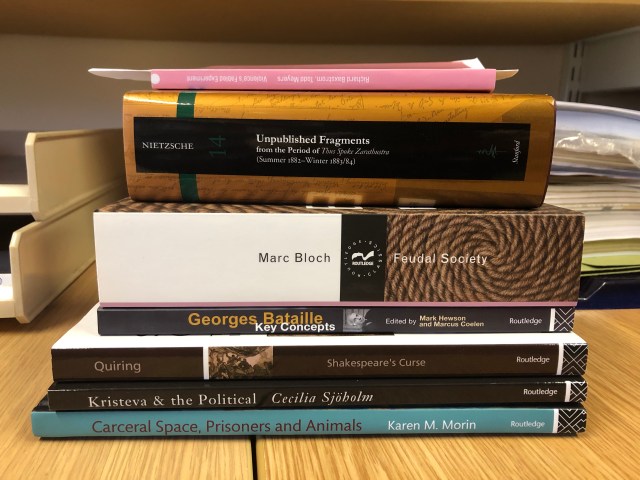
Books received – Baxstrom & Meyers, Nietzsche, Bloch, Bataille, Quiring, Sjöholm, Morin

books.jpg

Richard Baxstrom & Todd Meyers, Violence’s Failed Experiment; Friedrich Nietzsche, Unpublished Fragments from the Period of Thus Spoke Zarathustra; Marc Bloch, Feudal Society; Mark Hewson and Marcus Coelen, Georges Bataille: Key Concepts; Björn Quiring, Shakespeare’s Curse; Cecilia Sjöholm, Kristeva and the Political; and Karin M. Morin, Carceral Space, Prisoners and Animals. Richard and Todd kindly sent a copy of their book and the others were recompense for review work.

Posted in Friedrich Nietzsche, Georges Bataille, Julia Kristeva, Uncategorized, William Shakespeare | 1 Comment

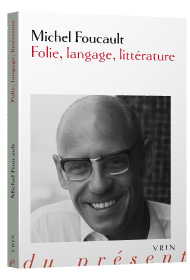
Michel Foucault, Folie, langage, littérature (2019)

Michel Foucault, Folie, langage, literature – the latest in this series from Vrin, making available a number of previously unpublished lectures from the archive.

Clare O'Farrell's avatarFoucault News

Michel Foucault, Folie, langage, littérature
Édition établie par H.-P. Fruchaud, D. Lorenzini et J. Revel. Introduction par J. Revel. Vrin 2019

La folie, le langage et la littérature ont longtemps occupé une place centrale dans la pensée de Michel Foucault. Quels sont le statut et la fonction du fou dans nos sociétés « occidentales », et en quoi se différencient-t-ils de ce qu’ils peuvent être dans d’autres sociétés? Mais également : quelle étrange parenté la folie entretient-elle avec le langage et la littérature, qu’il s’agisse du théâtre baroque, du théâtre d’Artaud ou de l’œuvre de Roussel? Et, s’il s’agit de s’intéresser au langage dans sa matérialité, comment l’analyse littéraire s’est-elle elle-même transformée, en particulier sous l’influence croisée du structuralisme et de la linguistique, et dans quelle direction évolue-t-elle?

Les conférences et les textes, pour la plupart inédits, réunis ici illustrent la manière dont, à partir des années 1960 et pendant…

View original post 61 more words

Posted in Uncategorized | Leave a comment