Tips for managing email as an academic – Veronika Cheplygina

Tips for managing email as an academic – Veronika Cheplygina has some good advice.

I’m a believer in Inbox Zero, but this doesn’t mean that all emails have yet been answered. It means that there is nothing kept in the inbox which I have already seen. The plan is the next time I see that email it will be when I have time to deal with it.

As I’ve mentioned before I use Sanebox as a filtering and snoozing function. It filters less important emails into other folders which I check regularly, but less frequently than the inbox. You can train it over time. You can also drop emails into folders so that they appear in your inbox tomorrow or next week. You can forward emails to an address to reappear at a specific time – handy if its directions to or an agenda for a meeting, etc. It’s like a virtual PA. I really can’t imagine trying to do email without it anymore.

I’ve not used plugins that allow you schedule when emails are sent. But I do save a lot of replies to drafts, and then send them at a later point – i.e. if I sort a lot of emails on a Sunday, I’ll send on a Monday morning.
Posted in Uncategorized | Leave a comment

Landscape as Territory – forthcoming book, Actar 2019, edited by Clara Olóriz Sanjuán and funded by Graham Foundation

1537805994.jpgSome good news from the Architectural Association. Clara Olóriz Sanjuán and her team have been awarded a grant from the Graham Foundation for an edited book on Landscape as Territory. Full details here. I have a piece in the book, based on a lecture I gave at the AA in 2015.

Landscape as Territory is a cartographic book project that critically addresses the agency of architects in the so-called “urban age,” through an understanding of territory as a design praxis through which consequential landscapes are produced. Territory, understood as a “political technology,” has the capacity to involve architects and designers into complex social, political, technical, legal, strategic, and economic processes that are both historical and geographical engines of contemporary urbanization. Territorial praxis is interrogated in a collection of threaded theory and design contributions where essays pose key questions that are addressed through projective cartographies, unfolding arguments related to three sections: (1) territory, (2) critical cartographies and (3) agency. This material proposes a critical reappropriation of cartographic tools, complicit in the production of territories, to question and expand the architect’s agency, beyond its current disciplinary confinements.

Posted in Territory, Uncategorized | Leave a comment

AA, Westminster and Greenwich collaborate on international symposium

Programme for an exciting event at the Architectural Association on 26 October. i’ll be in conversation with Neil Brenner and Jose Alfredo Ramirez.

The Landscape's avatarThe Landscape

Ed Wall (University of Greenwich), Lindsay Bremner (University of Westminster) and Alfredo Ramirez (Architecture Association) are co-organising a symposium on 26 October 2018 exploring Design Agency within Earth Systems.

Speakers include: Neil Brenner (UTL, Harvard GSD); Stuart Elden (Warwick University); El Hadi Jazairy and Rania Ghosn (Design Earth); Marti Franch (EMF Landscape Architecture) and Caroline Knowles (Goldsmiths).

Print8,000 metres above the sea level exists what climbers call the “death zone”. This altitude marks the limit for human habitation, above which our species cannot survive. We thrive in the “life zone” – the earth’s land surfaces and oceans, its geological layers beneath, the dynamic atmosphere above – all affected by gravitational magnetic forces beyond. This living world is constantly being transformed by our social, economic and political interactions revealing our intricate dependences on the earth and its systems. Terms such as…

View original post 48 more words

Posted in Uncategorized | Leave a comment

Laura Vaughan, Mapping Society: The Spatial Dimensions of Social Cartography – UCL Press, September 2018 (open access pdf/paperback)

Published today – open access pdf or purchase a physical copy

stuartelden's avatarProgressive Geographies

Mapping_Society.jpgLaura Vaughan, Mapping Society: The Spatial Dimensions of Social Cartography – UCL Press, September 2018 (open access)

From a rare map of yellow fever in eighteenth-century New York, to Charles Booth’s famous maps of poverty in nineteenth-century London, an Italian racial zoning map of early twentieth century Asmara, to a map of wealth disparities in the banlieues of twenty-first-century Paris, Mapping Society traces the evolution of social cartography over the past two centuries. In this richly illustrated book, Laura Vaughan examines maps of ethnic or religious difference, poverty, and health inequalities, demonstrating how they not only serve as historical records of social enquiry, but also constitute inscriptions of social patterns that have been etched deeply on the surface of cities.

The book covers themes such as the use of visual rhetoric to change public opinion, the evolution of sociology as an academic practice, changing attitudes to physical disorder, and the…

View original post 80 more words

Posted in Uncategorized | Leave a comment

Foucault, La sexualité/Le Discours de la sexualité (1964 and 1969 courses) – EHESS/Gallimard/Seuil 2018

140113_couverture_Hres_0Michel Foucault, La Sexualité. Cours donné à l’université de Clermont-Ferrand (1964) suivi de Le Discours de la sexualité. Cours donné à l’université de Vincennes (1969) – EHESS/Gallimard/Seuil 2018

The first volume of Foucault’s pre-Collège de France courses is due for publication in October 2018. I’ve mentioned this before, but the official description is now up at the Seuil site.

Michel Foucault avait engagé le projet d’une histoire de la sexualité dès les années 1960, et lui avait notamment consacré deux cours, jusqu’ici inédits.
Le premier, donné à Clermont-Ferrand en 1964, s’interroge sur les conditions d’apparition, en Occident, d’une conscience problématique et d’une expérience tragique de la sexualité, ainsi que de savoirs qui la prennent pour objet. Partant d’une réflexion sur l’évolution du statut des femmes et du droit du mariage, ce cours aborde l’ensemble des savoirs sur la sexualité, de la biologie ou l’éthologie à la psychanalyse.
Le second, donné à Vincennes en 1969, prolonge en même temps qu’il déplace ces interrogations. Foucault s’y intéresse en détail à l’émergence d’un savoir biologique sur la sexualité et à la manière dont celle-ci a été investie dans un ensemble d’utopies au long des XIXe et XXe siècles : utopies transgressives de Sade à Histoire d’O., utopies intégratives, visant à réconcilier la société et la nature sexuelle de l’Homme, de Fourier à Marcuse. C’est l’occasion pour Foucault d’approfondir sa généalogie critique du double thème de la sexualité naturelle et de la libération sexuelle, engagée dès 1964 mais qui prend d’autant plus de sens après Mai 1968.
Ces cours sont deux jalons essentiels pour une archéologie de la sexualité comme expérience moderne. On y découvre un Foucault qui n’hésite pas à faire jouer les données biologiques sur la sexualité contre une certaine conception étriquée du sujet humain ; un Foucault attentif à maintenir le potentiel transgressif contenu dans l’expérience sexuelle et à analyser les conditions économiques, sociales et épistémologiques de sa constitution récente en objet de savoir et en enjeu politique.


Posted in Michel Foucault, Uncategorized | 1 Comment

Friedrich Nietzsche, Unpublished Fragments from the Period of Thus Spoke Zarathustra – Stanford University Press, 2019

pid_7815Friedrich Nietzsche, Unpublished Fragments from the Period of Thus Spoke Zarathustra – Stanford University Press, March 2019

This is the next volume in The Complete Works project. Volume 16, of fragments from 1885-1886, is on some online sites, with a projected date of August 2019, but not yet on the Stanford UP site.

With this latest book in the series, Stanford continues its English-language publication of the famed Colli-Montinari edition of Nietzsche’s complete works, which include the philosopher’s notebooks and early unpublished writings. Scrupulously edited so as to establish a new standard for the field, each volume includes an Afterword that presents and contextualizes the material therein.

This volume provides the first English translation of Nietzsche’s unpublished notebooks from 1882–1884, the period in which he was composing the book that he considered his best and most important work, Thus Spoke Zarathustra. Crucial transitional documents in Nietzsche’s intellectual development, the notebooks mark a shift into what is widely regarded as the philosopher’s mature period. They reveal his long-term design of a fictional tetralogy charting the philosophical, pedagogical, and psychological journeys of his alter-ego, Zarathustra. Here, in nuce, appear Zarathustra’s teaching about the death of God; his discovery that the secret of life is the will to power; and his most profound and most frightening thought—that his own life, human history, and the entire cosmos will eternally return. During this same period, Nietzsche was also composing preparatory notes for his next book, Beyond Good and Evil, and the notebooks are especially significant for the insight they provide into his evolving theory of drives, his critical ideas about the nature and history of morality, and his initial thoughts on one of his best-known concepts, the superhuman (Übermensch).


Posted in Friedrich Nietzsche, Uncategorized | 1 Comment

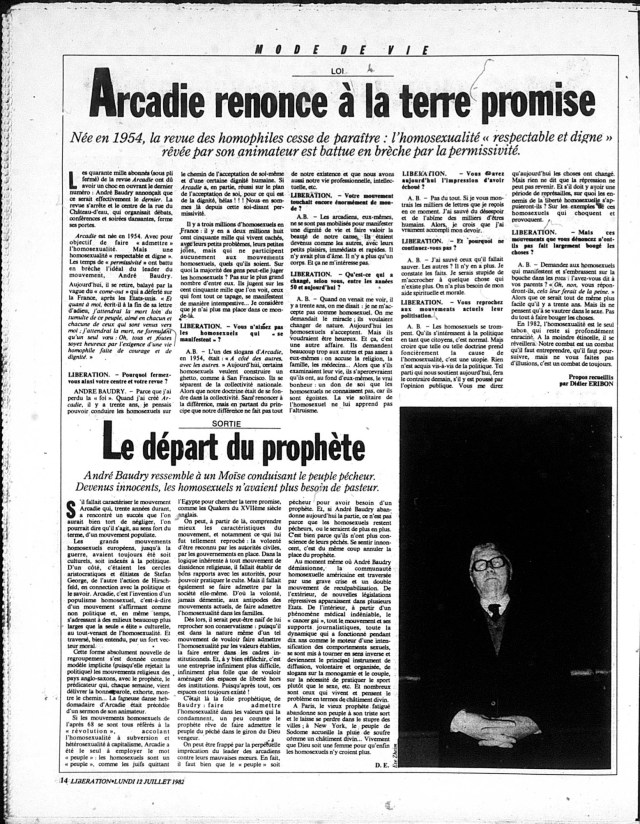
An anonymously published text by Foucault on Arcadie – ‘Le départe du prophète’, 1982 (with an interview between Didier Eribon and André Baudry)

Foucault and Eribon 1982 - Le départ du prophète (on André Baudry)

This text was first published in Libération, July 12, 1982, p. 14 (pdf). There it is signed ‘DE’, and follows an interview with Didier Eribon with André Baudry. Readers would assume that ‘DE’ meant Didier Eribon, but in his book Michel Foucault et ses contemporains, Paris: Fayard, 1994, pp. 274-77, Eribon says that it was actually written by Foucault.

Eribon reproduces Foucault’s text on pp. 280-81 of his book, and the interview with Baudry which it accompanied, on pp. 278-79. But I was curious to see the text in its original form, and thought others might be too. As Eribon notes, there is a difference between the original and published text. It’s a minor contribution to an understanding of Foucault’s political views in the 1980s – Arcadie was a journal and organisation campaigning for gay rights.

There are several other uncollected notes, lectures and interviews by Foucault here. An attempt at a comprehensive bibliography of ‘The Uncollected Foucault‘ appeared in Foucault Studies in 2015.


Posted in Michel Foucault, Uncategorized | 1 Comment

2018 Antipode lectures – videos online of Derek Gregory, Glen Coulthard and Silvia Federici

Previous years are here – an extraordinary archive

Posted in Derek Gregory, Uncategorized | Leave a comment

Books received – Dodds, McCormack, Derrida, Basso, Rekret, Brighenti and Kärrholm

IMG_3659.JPG

Klaus Dodds, Ice: Nature and Culture; Derek McCormack, Atmospheric Things: On the Allure of Elemental EnvelopmentJacques Derrida, The Ear of the Other; Elisabetta Basso, Michel Foucault et la Daseinsanalyse; The Derrida Reader edited by Julian Wolfreys; Paul Rekret, Derrida and Foucault, Andrea Mubi Brighenti and Mattias Kärrholm (eds.), Urban Walls: Political and Cultural Meanings of Vertical Structures and Surfaces.

Klaus kindly gave me copy of his new book, and Derek’s book and the Urban Walls collection were sent by the publishers – I wrote an endorsement for the latter. The Rekret book is horribly expensive, but was sent in recompense for review work.


Posted in Jacques Derrida, Michel Foucault, terrain, Uncategorized, urban/urbanisation | Leave a comment

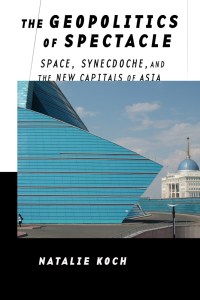
Natalie Koch, The Geopolitics of Spectacle (Cornell University Press, 2018) – reviewed at LSE review of Books by Kristin Eggeling

Koch.jpgNatalie Koch, The Geopolitics of Spectacle: Space, Synedoche and the New Capitals of Asia (Cornell University Press, 2018) – reviewed at LSE Review of Books by Kristin Eggeling

Why do autocrats build spectacular new capital cities? In The Geopolitics of Spectacle, Natalie Koch considers how autocratic rulers use “spectacular” projects to shape state-society relations, but rather than focus on the standard approach—on the project itself—she considers the unspectacular “others.” The contrasting views of those from the poorest regions toward these new national capitals help her develop a geographic approach to spectacle.

Koch uses Astana in Kazakhstan to exemplify her argument, comparing that spectacular city with others from resource-rich, nondemocratic nations in central Asia, the Arabian Peninsula, and Southeast Asia. The Geopolitics of Spectacle draws new political-geographic lessons and shows that these spectacles can be understood only from multiple viewpoints, sites, and temporalities. Koch explicitly theorizes spectacle geographically and in so doing extends the analysis of governmentality into new empirical and theoretical terrain.

With cases ranging from Azerbaijan to Qatar and Myanmar, and an intriguing account of reactions to the new capital of Astana from the poverty-stricken Aral Sea region of Kazakhstan, Koch’s book provides food for thought for readers in human geography, anthropology, sociology, urban studies, political science, international affairs, and post-Soviet and central Asian studies.

Posted in Uncategorized, urban/urbanisation | 1 Comment