
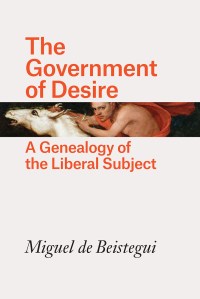
Miguel de Beistegui, The Government of Desire: A Genealogy of the Liberal Subject  – reviewed by John Protevi at NDPR

9780226547374.jpgMiguel de Beistegui, The Government of Desire: A Genealogy of the Liberal Subject (University of Chicago Press, 2018) – reviewed by John Protevi at NDPR. Here’s the press’s description of the book:

Liberalism, Miguel de Beistegui argues in The Government of Desire, is best described as a technique of government directed towards the self, with desire as its central mechanism.  Whether as economic interest, sexual drive, or the basic longing for recognition, desire is accepted as a core component of our modern self-identities, and something we ought to cultivate. But this has not been true in all times and all places. For centuries, as far back as late antiquity and early Christianity, philosophers believed that desire was an impulse that needed to be suppressed in order for the good life, whether personal or collective, ethical or political, to flourish.  Though we now take it for granted, desire as a constitutive dimension of human nature and a positive force required a radical transformation, which coincided with the emergence of liberalism.

By critically exploring Foucault’s claim that Western civilization is a civilization of desire, de Beistegui crafts a provocative and original genealogy of this shift in thinking. He shows how the relationship between identity, desire, and government has been harnessed and transformed in the modern world, shaping our relations with others and ourselves, and establishing desire as an essential driving force for the constitution of a new and better social order. But is it? The Government of Desire argues that this is precisely what a contemporary politics of resistance must seek to overcome. By questioning the supposed universality of a politics based on recognition and the economic satisfaction of desire, de Beistegui raises the crucial question of how we can manage to be less governed today, and explores contemporary forms of counter-conduct.

Posted in John Protevi, Uncategorized | 1 Comment

Paul Virilio (1932-2018) – obituary at France Culture and at Frieze by McKenzie Wark

Virilio_rdax_562x388Paul Virilio (1932-2018) – obituary at France Culture and at Frieze by McKenzie Wark

Virilio was one of the last representatives of a hugely influential generation of French theorists. Personally I found his early work most of interest – from Bunker Archaeology to his own architectural practice in The Function of the Oblique and the still untranslated L’insecurité du territoire. I draw on some of his ideas in my work on territory, especially when thinking about it in relation to volume and terrain. Of course, Virilio went on to do many other things, of which Speed and Politics is perhaps the most famous.


Posted in Paul Virilio, terrain, Territory, Uncategorized | 1 Comment

Bruno Latour, Down to Earth: Politics in the New Climatic Regime – reviewed at LARB

LatourThe book I mentioned yesterday – Bruno Latour, Down to Earth: Politics in the New Climatic Regime – is reviewed, in its French edition, in the Los Angeles Review of Books by James Delbourgo.

Posted in Bruno Latour, Uncategorized | Leave a comment

Bruno Latour, Down to Earth: Politics in the New Climatic Regime – Polity, September 2018

LatourBruno Latour, Down to Earth: Politics in the New Climatic Regime – Polity, September 2018

The present ecological mutation has organized the whole political landscape for the last thirty years. This could explain the deadly cocktail of exploding inequalities, massive deregulation, and conversion of the dream of globalization into a nightmare for most people.

What holds these three phenomena together is the conviction, shared by some powerful people, that the ecological threat is real and that the only way for them to survive is to abandon any pretense at sharing a common future with the rest of the world. Hence their flight offshore and their massive investment in climate change denial. The Left has been slow to turn its attention to this new situation. It is still organized along an axis that goes from investment in local values to the hope of globalization—and just at the time when, everywhere, people dissatisfied with the ideal of modernity are turning back to the protection of national or even ethnic borders.

This is why it is urgent to shift sideways and to define politics as what leads toward the Earth and not toward the global or the national. Belonging to a territory is the phenomenon most in need of rethinking and careful redescription; learning new ways to inhabit the Earth is our biggest challenge. Bringing us down to earth is the task of politics today.

Looks interesting, and am particularly intrigued by the idea that “belonging to a territory is the phenomenon most in need of rethinking and careful redescription; learning new ways to inhabit the Earth is our biggest challenge”.

Posted in Bruno Latour, Territory, Uncategorized | 10 Comments

Samuel Talcott, Georges Canguilhem and the Problem of Error – Palgrave, February 2019

Samuel Talcott, Georges Canguilhem and the Problem of Error – Palgrave, February 2019

Examining Georges Canguilhem’s enduring attention to the problem of error, from his early writings to Michel Foucault’s first major responses to his work, this pathbreaking book shows that the historian of science was also a centrally important philosopher in postwar France. Samuel Talcott elucidates Canguilhem’s contributions by drawing on previously neglected publications and archival sources to trace the continuity of commitment that led him to alter his early anti-vitalist, pacifist positions in the face of political catastrophe and concrete human problems. Talcott shows how Canguilhem critically appropriated the philosophical work of Alain, Bergson, Bachelard, and many others while developing his own distinct writings on medicine, experimentation, and scientific concepts in an ethical and political endeavor to resist alienation and injustice. And, while suggesting Canguilhem’s sometimes surprising philosophical importance for a range of younger thinkers, the book demonstrates Foucault’s own critical allegiance to Canguilhem’s spirit, techniques, and investigations.

This will appear at almost exactly the same time as my book on Canguilhem – which is also due to be published in early 2019.

Posted in Canguilhem (book), Georges Canguilhem, Uncategorized | Leave a comment

London Group of Historical Geographers Seminar Programme, Autumn Term 2018: Unsettling Land

London Group of Historical Geographers Seminar Programme, Autumn Term 2018: Unsettling Land

16 October 2018 David Matless (University of Nottingham)
Next the sea: Eccles and the Anthroposcenic.

30 October 2018 Bergit Arends (Tate)
Photographing the landscapes of the Anthropocene: Nguyen The Tuc’s Kohle unter Magdeborn, c. 1976.

13 November 2018 Briony McDonagh (University of Hull)
Unpeopling the land: enclosure, dispossession, and the making of property in early modern England. [NOTE: this seminar will be held in room 243, South Block, Senate House]

27 November 2018 Michael Bravo (University of Cambridge)
Cosmographical machinations: the materiality of the Earth’s shifting poles.

11 December 2018 Tom Simpson (University of Cambridge)
Find the river: discovering the Tsangpo-Brahmaputra in the age of empire.

Unless otherwise indicated, seminars are held on Tuesdays at 5.15pm in Wolfson Room I (NB01), Institute of Historical Research, North Block, Senate House, University of London.

Please subscribe to our mailing list to keep up-to-date with out activities or take a look at our archive of previous talks.


Posted in Uncategorized | 1 Comment

Michel Foucault, Penal Theories and Institutions – Palgrave, January 2020? (was November 2019, and previously 2018)

Update: the Palgrave site now says January 2020 24 November 2019 – but they have missed several previous dates…

Michel Foucault, Penal Theories and Institutions: Lectures at the Collège de France, 1971-1972 – Palgrave November 2018

“What characterizes the act of justice is not resort to a court and to judges; it is not the intervention of magistrates (even if they had to be simple mediators or arbitrators).  What characterizes the juridical act, the process or the procedure in the broad sense, is the regulated development of a dispute.  And the intervention of judges, their opinion or decision, is only ever an episode in this development.  What defines the juridical order is the way in which one confronts one another, the way in which one struggles. The rule and the struggle, the rule in the struggle, this is the juridical.”

Michel Foucault

Penal Theories and Institutions is the title Michel Foucault gave to the lectures he delivered at the Collège de France from November 1971 to March 1972.

In these lectures Michel Foucault presents for the first time his approach to the question of power that will be the focus of his research up to the writing of Discipline and Punish (1975) and beyond.  His analysis starts with a detailed account of Richelieu’s repression of the Nu-pieds revolt (1639-1640) and then goes on to show how the apparatus of power developed by the monarchy on this occasion breaks with the system of juridical and judicial institutions of the Middle Ages and opens out onto a “judicial State apparatus”, a “repressive system”, whose function is focused on the confinement of those who challenge its order.

Michel Foucault systemizes the approach of a history of truth on the basis of the study of “juridico-political matrices” that he had begun in the previous year’s lectures (Lectures on the Will to Know) and which is at the heart of the notion of “knowledge-power”.

In these lectures Foucault develops his theory of justice and penal law.

The appearance of this volume marks the end of the publication of the series Foucault’s courses at the Collège de France (the first volume of which was published in 1997).

I wrote a piece on these lectures when they first appeared in French in 2015 at Berfrois (open access). They are discussed in more detail in Foucault: The Birth of Power.

Posted in Foucault: The Birth of Power, Michel Foucault, Uncategorized | 5 Comments

Michel Foucault, “Discourse and Truth” and “Parresia” – University of Chicago Press, July 2019

Michel Foucault, “Discourse and Truth” and “Parresia” – University of Chicago Press, July 2019.

This volume collects a series of lectures given by the renowned French thinker Michel Foucault late in his career. The book is composed of two parts: a series of lectures entitled “Discourse and Truth” given at the University of California, Berkeley in 1983 and “Parrēsia,” a talk delivered at the University of Grenoble in 1982. Together, they provide an unprecedented account of Foucault’s reading of the Greek concept of parrēsia, often translated as “truth-telling” or “frank speech.” In typically Foucauldian style, the lectures trace the transformation of this concept across Greek, Roman, and early Christian thought, from its origins in pre-Socratic Greece to its role as a central element of the relationship between teacher and student across a range of societies. In mapping the concept’s history, Foucault’s concern is not to advocate for free speech; rather, his aim is to explore the moral and political position one must occupy in order to speak truthfully. In his analysis of parrēsia, Foucault both advances his project of a history of the present and paves the way for a genealogy of the critical attitude in modern and contemporary societies.

These essays—carefully edited and including notes and introductory material to fully illuminate Foucault’s insights—are a major addition to Foucault’s English language corpus that no scholar of ancient or modern philosophy will want to miss.

If this seems familiar, then that’s not surprising. It is a critical edition of the text previously published as Fearless Speech, and the Grenoble lecture previously appeared in Critical Inquiry. It’s the English equivalent of Discours et vérité, which appeared in 2016 with Vrin. The Fearless Speech book was unauthorised, and the seminars were transcribed from recordings – [update: they are also incomplete; see Daniel Lorenzini’s comment below]. For this volume, they are reedited, [corrected and completed] and supplemented by Foucault’s manuscripts. There is also a good amount of critical apparatus.

Posted in Michel Foucault, Uncategorized | 2 Comments

Deleuze seminars – some more translated into English

GD.pngSome more of Deleuze’s seminars have been translated into English – details here, and more are forthcoming. Ones currently available include lectures on Anti-Oedipus, Spinoza, painting, and Foucault. The site has the French text and audio as well as the translations. Thanks to dmf for the link.

Posted in Baruch Spinoza, Gilles Deleuze, Michel Foucault, Uncategorized | 1 Comment

Jacques Derrida, Geschlecht III: Sexe, race, nation, humanité – Seuil, 2018

139376_couverture_Hres_0Jacques Derrida, Geschlecht III: Sexe, race, nation, humanité 

The third, and previously unpublished, text in Derrida’s series of discussions of Heidegger is coming out with Seuil in October 2018. I’m not quite sure how an essay has become a whole book.

Geschlecht : ce mot allemand, qui a donné son titre générique à une série de quatre études consacrées par Jacques Derrida à la philosophie de Martin Heidegger, est proprement intraduisible en français. C’est que le mot a partie liée tout à la fois avec « sexe », « race », « nation », « humanité ». Or, telles sont bien les catégories que Derrida entend explorer dans l’œuvre de Heidegger.

Dans ce troisième volume de la série, c’est avant tout la dimension politico-sexuelle et la notion de patrie qui sont au cœur de l’enquête. Occasion, pour Derrida, de penser une sexualité plus radicale que la binaire, occasion aussi pour lui de dénoncer un nationalisme de nature troublante chez Heidegger – une approche pour le moins ambiguë par rapport à celle du nazisme dont elle prétend pourtant s’écarter.

Cette édition donne à lire une étude qui paraissait perdue à jamais. L’équipe de chercheurs qui en a établi le texte fait donc œuvre intellectuelle et éditoriale majeure.

Ce volume III prend désormais place dans la série des Geschlecht : I. Différence sexuelle, différence ontologique (in Psyché, Inventions de l’autre, Galilée, 1987) ; II. La Main de Heidegger (ibid.) ; IV. L’Oreille de Heidegger : philopolémologie (in Politiques de l’amitié, Galilée, 1994).

Édition établie par Geoffrey Bennington, Katie Chenoweth et Rodrigo Therezo.

Préface par Rodrigo Therezo.

I’ve previously mentioned a conference on this text – Reading Derrida’s Geschlecht III: Responses to an Archival Discovery, Princeton, Oct 12-13 2018, and David Farrell Krell’s Phantoms of the Other: Four Generations of Derrida’s Geschlecht (Albany: State University of New York, 2015) which is an excellent study of this series (my review is here).

Posted in David Farrell Krell, Jacques Derrida, Martin Heidegger, Uncategorized | 2 Comments