Echoes of Cologne [Forum], Introduction by Angela Last

The first few pieces of a Society and Space open site forum on the Cologne assaults of New Year’s Eve are now available.

Posted in Uncategorized | Leave a comment

Michel Foucault, Prisons and the future of abolition – an interview at Critical Theory

sarte-foucault-deleuze-672x372.jpgAt Critical-Theory.com, there is an interesting interview with Andrew Dilts and Perry Zurn about Foucault, the Prisons Information Group and the future of prisons and abolition. It builds on the work of their edited book Active Intolerance: Michel Foucault, the Prisons Information Group, and the Future of Abolition.

Posted in Michel Foucault, Politics, Uncategorized | 5 Comments

Books received – three Marxist classics from Verso: Lefebvre, Althusser et. al. and Goldmann

Books received – three Marxist classics from Verso. Henri Lefebvre’s Metaphilosophy, the first complete English translation of Althusser, Balibar, Establet, Macherey and Rancière’s Reading Capital and Lucien Goldmann’s The Hidden God.

Metaphilosophy is a book I’ve wanted to get translated into English for a long time. It is one of Lefebvre’s most important works, and provides a basis for the arguments he would develop in many of his more concrete works on the city, space, everyday life and so on. David Fernbach did a great job translating this difficult text. I edited the translation, provided most of the notes, and wrote the introduction.IMG_1592 copy.jpg


Posted in Etienne Balibar, Henri Lefebvre, Jacques Rancière, Louis Althusser, Pierre Macherey, Uncategorized | 1 Comment

A dark day for the UK – my early thoughts on the EU referendum

Yet again I find myself in a minority in a national vote. It was hard to take in the past – 1992, 2010, 2015 – but with those there was always the hope for the future. Now it is hard to see where. This is a backward step that cannot be reversed. This vote was always about more than EU membership. It was a vote about what kind of UK the people wanted. An open, inclusive, tolerant nation that saw itself as part of a wider world; or a closed one which saw divisions and barriers which it wanted hardened. 17.5 million people have voted for the latter. Some of those people may claim that they saw the vote as means of achieving the former, and I look forward to hearing from the left-exit voters and leaders how they will go about that. It seems clear, as it always appeared, that this has simply handed further power to the right.

For the past year I’ve had a divided life between home in Coventry – near University of Warwick – and a rented flat in London, in the borough of Lambeth, which is close to where my wife works. Coventry voted to leave; Lambeth had one of the strongest remain votes.  When the votes came in for Newcastle and Sunderland it was clear which way things were going. As someone who used to live in the northeast when I taught at Durham University it is devastating to see that the huge problems of that region are blamed on the EU and migration rather than domestic politics. Other places I’ve previously lived such as York and Bath voted to remain. The town I was born in, Ipswich, and the town where I grew up, Colchester, voted to leave. It is a divided country, by class, geography, age and other factors which may take some time to disentangle. 16 million people voted to remain. That at least gives some hope. But this was a one-off vote, the process begun cannot be reversed. Worse is to come. While the parties may have short term joy, the UK Independence Party and the bulk of the Conservative and Unionist party may have destroyed both the UK and the Union.

As an English European, an identity I saw as mutually reinforcing, rather than as an either/or, I feel that a part of that is being taken away. The EU was far from perfect, and there were serious problems with its democracy, its economic policies, its migration attitude and more. But it was a shared project to say that Europe in the second half of the twentieth century and beyond could be better, not just compared to the first half of the twentieth century but the centuries that came before. As a historian, a political theorist, a political geographer, those issues are very much in my mind. I have worked on two main topics in my research and teaching career – European thought and the question of territory. I will doubtless find ways to engage with the future politics and geography of the European continent, a continent of which the UK is and will remain a part, even though its future lies outside of the EU.

I worry for my non-British European PhD students, my European colleagues and friends who have made a life in the UK. I worry for my nieces and nephews, and the country they will grow up in. I worry for the future life of migrants, and the welcome they will, or will not, receive. I am married to a migrant, a US citizen who came here when we got married, took jobs in the UK, took citizenship and now works for the UK government on international development. What will be the future of that part of the UK’s role in the world? I worry for the future of the European project, which both includes and exceeds the EU. This is a dark day. Perhaps something good will come of this, but at the moment it is hard to see quite how.

Posted in Politics, Uncategorized | 5 Comments

“Sur les Toits”: An open-access Antipode Symposium on the Prison Protests in Early 1970s France

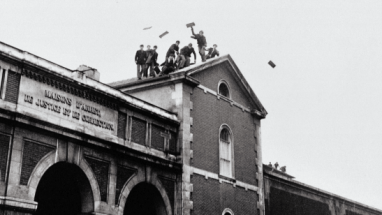
the-nancy-prison-revolt-gc3a9rard-drolc“Sur les Toits”: An open-access Antipode Symposium on the Prison Protests in Early 1970s France

This symposium contains a rich collection of contributions based on the screening of the French documentary film Sur les Toits (“On the Roofs”). On a Wednesday in May 2016 I invited the film’s independent maker, Nicolas Drolc, and a number of academics from across Warwick’s humanities and social sciences to the screening of the movie. The result was a friendly and productive discussion on an important, but sometimes forgotten, episode in the history of incarceration (see, however, Zurn and Dilts 2016). The essays presented here comprise an interview with the director and a series of original reflections (from Dominique MoranSophie FuggleAnastasia ChamberlenOliver Davis and Stuart Elden) on both the film and its subject of investigation.

My contribution discusses the riots in relation to the GIP and Foucault and other intellectuals, while praising the film for providing oral histories of key, non-elite voices, while other contributions look at the film, images, contemporary politics and related questions. Thanks to Marijn Nieuwenhuis for coordinating this symposium, and the director, Nicolas Drolc, for coming to Warwick to show the film and discuss it with us. Continue reading in Antipode online.

Posted in Foucault: The Birth of Power, Michel Foucault, Politics, Uncategorized | 1 Comment

Saba Mahmood 2016 AAG Society and Space lecture video

From the Society and Space open site:

Professor Saba Mahmood (University of California, Berkeley) delivered the Society and Space plenary lecture at the Association of American Geographers meeting on March 31, 2016. A video of her excellent talk, titled “Secularism, Sovereignty, and Religious Difference: A Global Genealogy?”, is now available on our publisher Sage’s website. A written version will appear in an upcoming issue of the journal.

Secularism, Sovereignty, and Religious Difference: A Global Genealogy? Delivered by Saba Mahmood on 31st March 2016 and chaired by Natalie Oswin

Posted in Society and Space, Uncategorized | Tagged , | 2 Comments

Migration, Borders, Territory – a commentary on the EU referendum

A few weeks ago I was asked by the Architectural Association to write a commentary on the UK’s EU referendum. The request was for a short piece on how the vote might impact on territory. It was written in late May. The piece is published in their newsletter, but it’s not yet online and with the referendum only two days away I’m sharing the text here.

Update: the piece as published is finally online here.

Migration, Borders, Territory

I have been dismayed by most of the discussion of the EU referendum. While I believe there is a progressive case to be made against the EU, challenging its politics in a range of aspects from economics to migration and security, I don’t see that argument being made well.  It’s hard to imagine that leaving the EU would lead to more progressive politics within the UK – it would surely hand more power to the Right, with its dislike of the environmental and social protections that EU membership provides. I see the nationalistic elements of the leave campaign as deeply reactionary, and out of place in a globalised world and a multicultural society. Aside from endlessly debated and frequently inaccurate arguments about cost and economic benefit, the issue in the referendum that has got the most attention is of course migration.

There have been grotesque and racist arguments made. This is both in the attitude to migration to the UK from within the EU, and outside it. Vote Leave’s website lists countries that have joined the EU in recent years, which are of course central or Eastern European, while then raising the prospect of others which are being considered, either Turkey or from the Balkans. “When they join, they will have same rights as other member states”. Readers are presumably being encouraged to question the wisdom of this, but the connotation is clear. ‘They’, and those that joined recently, are not sufficiently like us. UK citizens who have chosen to live, work or retire in other EU countries are rarely mentioned, even though they are often poorly integrated into local communities. In addition, we frequently hear the suggestion that the UK could prevent migration from outside the EU much more easily if it wasn’t bound by its rules.

This last claim is nonsense. The UK is not part of the Schengen agreement, and does have control over its borders. Indeed, the EU provides additional protections – a kind of double-boundary from the Schengen area’s external borders by Frontex, and individual member states’ border agencies. The UK has an active role in such processes, from policy to intelligence sharing to collective work. Some would argue these borders should be much more open and the process of crossing them much easier. There is a certainly a moral case to be made for why the UK should be doing far more in welcoming and supporting refugees. This would be grounded on its colonial past as well as the colonial present – from the UK’s role in the breakup of the Ottoman Empire, to its ex-colonies in the African continent, to refugees from Iraq, Syria, Libya and elsewhere who are often in that situation because of UK military or foreign policy. But to suggest the current situation is out of the UK’s control because of EU membership is just not accurate.

People tend to forget why the European Economic Community, which became the European Community and then the EU, was set up in the first place. The original binding together of coal and steel, especially between France and Germany, was both politically important and military structured. It was to try to ensure those two countries could never wage war against each other again. Other aspects grew from that beginning. We tend to forget the recent history of Europe and what has been achieved. A break-up of the European Union might seem unlikely to descend into another war like the ones fought in the nineteenth and twentieth centuries, but smaller scale conflicts between existing EU members over disputed territories are much more possible.

The UK’s territory would barely change as a result of leaving the EU, unless Scotland went independent. It would be most noticeable in Northern Ireland with its land border with the Republic of Ireland. Processing of border controls in Dover rather than Calais might be a result of an unravelling of bi-lateral agreements with France. But many of the UK’s responsibilities are dependent on wider supra-national bodies – the United Nations and various conventions on refugees. Whether you agree or not with tighter borders and control of migration from outside the EU, the biggest change in this area might well be that the EU could no longer be blamed.

I will be voting to remain, and then hoping once this issue is put to rest, political action can be taken to try to reform and improve the EU.

Posted in Boundaries, Politics, Territory, Uncategorized | Tagged | Leave a comment

Tim Ingold, ‘Reclaiming the University of Aberdeen’

A powerful piece by Tim Ingold, ‘Reclaiming the University of Aberdeen’:

We, staff and students of the University of Aberdeen, are angry. We are angry about the way our academic community and our commitment to education and scholarship have been eaten away by a corrosive regime of management that works by bullying and intimidation. We have watched in anger and dismay as fundamental principles of trust, professionalism and freedom of expression on which academic life depends have been crushed under an avalanche of mindless bullet points, dehumanising and dysfunctional IT systems, arbitrary directives and sham consultations. During the spring and summer of last year, amidst cuts to academic programmes, threats of redundancy and collapsing morale, this anger turned to outrage. In response, we mounted a campaign to claim our University back from the regime. [continues]

And for the drafted manifesto and futher links, see here.

Posted in Politics, Uncategorized, Universities | 1 Comment

Why do so many academics publish in unreadable outlets?

Why do so many academics publish in unreadable outlets?

I don’t mean the prose style is unreadable (though it might be), but I’m thinking of the outlets they chose to publish in.

Obviously, I recognise that the ‘gold standard’ for many academics is the refereed journal article, and the majority of these journals, especially the ones that are ‘highly ranked’, are subscription-only. If you are working towards getting a job, tenure, promotion, research assessment and so on, you may need to publish in those kinds of outlets. Fine, this is a compromise between accessibility and recognised outlet.

I’m thinking of two other kinds of outputs.

First, authored and edited books. Why do so many academics continue to publish books which are hardback only, very expensive, often with poor production values, and so on? And, given the current trend for very short books (Briefs, Shorts, Forerunners, Swifts, Pivots, etc.) why do authors often go with the trade presses where the price for these little books would be prohibitive for a full-length study?

In terms of my own authored books, all but one appeared in paperback immediately, and the exception had that agreed (verbally), only for the publisher to change their mind when the book was in production. No amount of work or persuasion have made them change their mind. Lesson learned – I now insist on this being in the contract before I sign. And in a sense, more fool them: all my other books have sold many times as many copies, about the same as this one in hardback and many more in paperback.

For edited books, I know that placing these is extremely difficult. I’ve generally found edited books much harder to persuade publishers to do. So, sometimes a compromise is needed here – hardback first, then paperback in a year’s time or similar. But again, get it in the contract. The one complete exception to this is when I was commissioned to lead the editing of a reprint collection for Sage from the Environment and Planning journals. That was very expensive, and destined for library sales only – all the content bar editors’ introductions was available to journal subscribers already, and I got my own introduction made open access.

Second, smaller pieces that count little for promotion, tenure, etc. and would never be submitted in a research assessment – book reviews, interventions, responses, commentaries, etc. Why do so many of these end up in inaccessible outlets? What is the point? These days I try to only write short pieces like this if it’s got a chance of being open access or otherwise easily available. It’s why I rarely do book reviews for conventional journals, unless they appear on an open-access companion site, and prefer to write for Berfrois or similar.

I don’t tend to write that many book chapters for other people’s books these days, but when I do, it would make a big difference if the book was going to be reasonably cheap or even open access (I’ve written a few recently for collections with Punctum books, for example). I know that opinions on book chapters differ, but I’ve yet to find an academic manager who thinks they should be equal weighted with a refereed journal article. So if you’re going to write them then it must be principally to be read – an entirely good reason, of course! So, try to make them available and accessible…

And, beyond that… why don’t more academics use institutional repositories, or their own websites to upload pdfs? Almost all my articles and other short pieces are available on this site, and even links to some books.

I can imagine that some responses will be – I have no choice! My department/university/chair expects this… Publishers are all the same… But you do have choices, and not all publishers are the same. Yes, for journal articles you probably need to be aware of where is deemed a good place to publish, but for anything else…


Posted in Publishing, Uncategorized, Universities, Writing | 8 Comments

Second English volume of Heidegger’s Black Notebooks forthcoming

9780253024718_med

Martin Heidegger, Ponderings VII–XI: Black Notebooks 1938–1939, translated by Richard Rojcewicz, forthcoming in early 2017. Thanks to Chathan Vemuri for the tip.

Through these broad and sprawling notebooks, Heidegger offers fascinating opinions on Holderlin, Nietzsche, Wagner, Wittgenstein, Pascal, and many others. The importance of Black Notebooks transcends Heidegger’s relationship with National Socialism. These personal notebooks contain reflections on technology, art, Christianity, the history of philosophy, and Heidegger’s attempt to move beyond that history into another beginning.

By the way, whoever came up with the dreadful ‘ponderings’ as the title? As Richard Polt noted in his review of the first English volume:

The word Überlegungen refers to trains of thought that contemplate practical or theoretical problems; it has dignified and quite unfunny connotations, like the English ‘considerations’ or ‘deliberations’. In contrast, the label Ponderings cannot fail to provoke chuckles. Heidegger’s ruminations may well be ponderous and pompous, but the reader should not be pushed toward that conclusion by a title that seems as tin-eared as the misbegotten term “enowning” that was foisted on us by Parvis Emad and Kenneth Maly in their 1999 translation of Contributions to Philosophy.

Posted in Martin Heidegger, Uncategorized | Leave a comment