
Bruno Latour, ‘Onus Orbis Terrarum: About a Possible Shift in the Definition of Sovereignty’, Millennium, Vol 44 No 3, 2016, pp. 305-20 (open access).
Derek Gregory picks up a few contentious claims here.
Bruno Latour, ‘Onus Orbis Terrarum: About a Possible Shift in the Definition of Sovereignty’, Millennium, Vol 44 No 3, 2016, pp. 305-20 (open access).
Derek Gregory picks up a few contentious claims here.
A supplemental essay at the Society and Space open site – original journal article open access for a limited time.
Ways of Doing Genealogy: Inquiry after Foucault: A Group Interview with Verena Erlenbusch, Simon Ganahl, Robert W. Gehl, Thomas Nail, and Perry Zurn, conducted by Colin Koopman.
Details of the Foucault @ 90 conference later this month in Scotland.
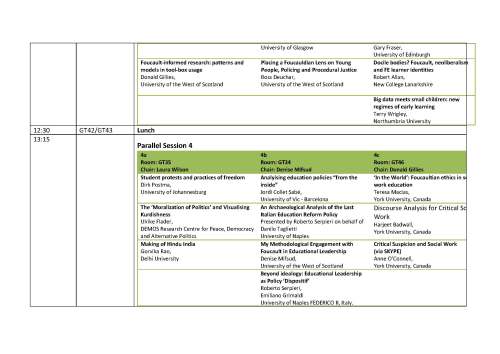
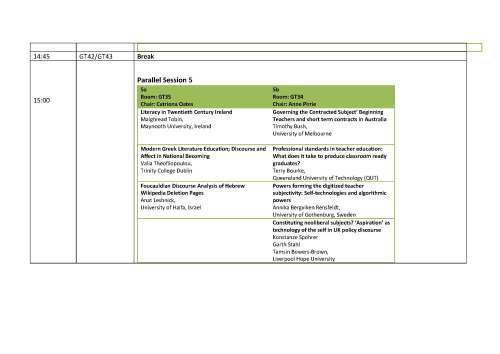
Conference program (PDF) for the Foucault @ 90 conference 22-23 June 2016, in Ayr, University of West Scotland.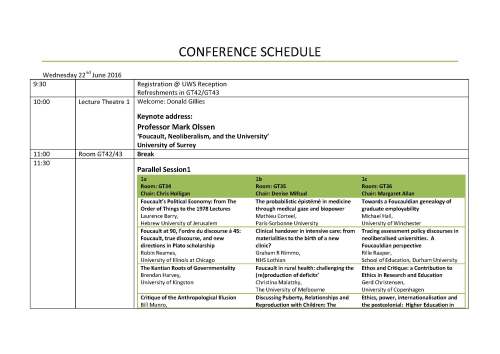


 Ali Riza Taskale, Post-Politics in Context, now out with Routledge (in another obscenely priced hardback, unfortunately).
As disciplines, Politics and International Relations remain dominated by ideas drawn from traditions of liberal internationalism and political realism in which political imagination is preoccupied with command and order, rather than with disruption and emancipation. Yet, they have failed to offer adequate answers to why political action is foreclosed in contemporary times.
Proposed through a historically informed engagement with seminal thinkers, including Walter Benjamin, Friedrich Nietzsche, Gilles Deleuze, and Michel Foucault, and examples from films and contemporary events, Ali Riza Taskale presents an original and much needed new perspective to interpret politics in our contemporary societies. He argues that post-politics is a counterrevolutionary logic which aims to create a society without conflict, struggle and radical systemic change.
Post-Politics in Context serves as seminal intervention upon the debate over the depoliticised conditions of contemporary neoliberal society as well as functioning as an introduction to the core theoretical frameworks of alternative tradition of social and political thought in a manner that is lacking in current debates about Politics and International Relations.
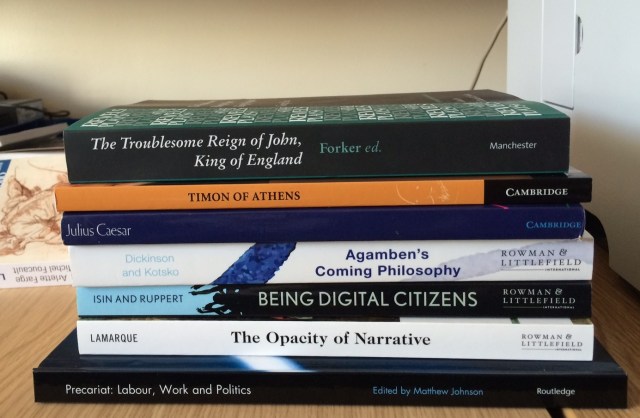 A few books for the Shakespeare work, including the new in paperback edition of the anonymous The Troublesome Reign of John, King of England; three books from Rowman & Littlefield, International in recompense for review work; and Matthew Johnson (ed.), Precariat: Labour, Work and Politics, in which I have a short piece reprinted.
Rob Kitchin, ‘Geographers matter! Doreen Massey (1944-2016)‘ in Social and Cultural Geography (open access). I’ve added this to the list of obituaries and tributes on this site.
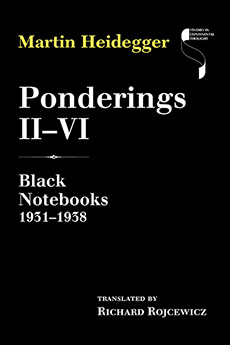 The first volume of the English translation of Heidegger’s ‘Black Notebooks’ (Ponderings II-VI: Black Notebooks 1931-1938) is reviewed at NDPR by Richard Polt.
Polt is a serious Heidegger scholar, especially good on the 1930s, and this is a thoughtful and balanced review.
NDPR also have a review of a book by the editor of the notebooks, Peter Trawny, Heidegger and the Myth of a Jewish World Conspiracy.
 Robert Latham, The Politics of Evasion: A Post-Globalization Dialogue Along the Edge of the State – published in Routledge’s Interventions series. Looks interesting, though disappointing it is another example of Routledge’s crazy pricing – £90 for 176 pages!
Burgeoning national security programs; thickening borders; Wikileaks and Anonymous; immigrant rights rallies; Occupy movements; student protests; neoliberal austerity; global financial crises – these developments underscore that the fable of a hope-filled post-cold war globalization has faded away. In its place looms the prospect of states and corporations transforming a permanent war on terror into a permanent war on society. How, at the critical juncture of a post-globalization era, will policymakers and power-holders in leading states and corporations of the Global North choose to pursue power and control? What possibilities and limits do activists and communities face for progressive political action to counter this power inside and outside the state?
This book is a sustained dialogue between author and political theorist, Robert Latham and Mr. V, a policy analyst from a state in the Global North. Mr. V is sympathetic to the pursuit of justice, rights and freedom by activists and movements but also mindful of the challenges of states in pursuing security and order in the current social and political moment. He seeks a return to the progressive, welfare-oriented state associated with the twentieth century. The dialogue offers an in-depth consideration of whether this is possible and how a progressive politics might require a different approach to social organization, power and collective life.
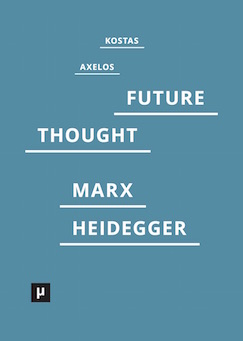 Kostas Axelos’s Introduction to a Future Way of Thought, which I edited and introduced last year, has been reviewed by George Tomlinson at Marx and Philosophy. It’s a thoughtful and incisive review. Both the review and the book are available open access. Here’s the first paragraph:
Regrettably, the Greek-French philosopher Kostas Axelos (1924-2010) remains relatively unknown by Anglo-American readers of the modern European philosophical tradition. For those familiar with Axelos’s work, his 1961 Alienation, Praxis, and Techne in the Thought of Karl Marx is generally the first, and only, port of call: it has been – until now – his only major work to be translated into English. As Stuart Elden’s excellent introduction to Introduction to a Future Way of Thought: On Marx and Heidegger makes clear, the situation is quite different in continental Europe, where the availability of Axelos’s corpus in multiple languages is a testament to the wide-ranging character and rich complexity of his thought. Axelos was at the forefront of postwar French intellectual life: a prodigious author, editor, translator, and interpreter, his writings were read – and commented on – by the likes of Gilles Deleuze, Jacques Derrida, and Henri Lefebvre, and his editorship of the journal and later book series Arguments yielded new works by writers including Georges Bataille, Jean Beaufret, Maurice Blanchot, Deleuze, Karl Jaspers, Karl Korsch, Lefebvre, and Herbert Marcuse, not to mention the first French translation of Georg Lukács’ History and Class Consciousness.


