Perec’s Geographies / Perecquian Geographies

This looks interesting – thanks to Jeremy Crampton for the link.

Jeremy's avatarOpen Geography

The unaccountably overlooked Georges Perec (member of Oulipo) and author of Espèces d’espaces (Species of Spaces) a great geographical fiction, is the subject of a symposium about his work. The cfp follows:

PEREC’S GEOGRAPHIES / PERECQUIAN GEOGRAPHIES
Interdisciplinary Symposium, University of Sheffield, Friday 6 May, 2016

Georges Perec was one of the most inventive and original geographical writers of the twentieth century. His writing explores cities and streets; homes and apartments; conceptions of space and place; mathematical and textual spaces; imagined, utopian and dystopian spaces; time and the city; landscapes of memory and trauma; consumption and material culture; domestic spaces; everyday life, the everyday, the quotidian; ordinary and ‘infra-ordinary’ places. Perec addressed methods of urban exploration and observation; classification, categorisation and taxonomy; spatial inventories and indexes; and geographical and ethnographic description.

This symposium explores Perec’s Geographies (his own geographical writing) and the wider body of geographical writings…

View original post 210 more words

Posted in Uncategorized | Leave a comment

“About the Concept of the ‘Dangerous Individual’ in Legal Psychiatry of the 19th Century” – details of variant English and French texts

I’ve updated this post from March 2014 because a photocopy of a 36pp. typescript of the unpublished original French text is available at IMEC. It appears in the catalogue as reference FCL 1.10: “A propos de la notion d’individu dangereux dans la psychiatrie légale au XIXe siècle”.
This copy breaks off very slightly incomplete. The final sentence ends ‘… alors’; there is no French text according to ‘the judicial machine ceases to function’. The remainder of the material in the original post is correct.

stuartelden's avatarProgressive Geographies

A couple of months ago [update: in January 2014], I asked three minor questions concerning Foucault’s ‘About the Concept of the Dangerous Individual’ lecture in Toronto in 1977.

  • is the version in Dits et écrits the original French, or a re-translation with an uncredited translator?
  • was the conference at the Clark Institute or York University, or a joint event?
  • why is the paragraph from the course summary discussing the seminar omitted from «Il faut défendre la société» and the subsequent English translation Society Must Be Defended?

Following a useful exchange of comments with Javier Velásquez, it is clear that we have the answer to the first. The text in Dits et écrits is not a translation; but nor is it the entirety of the original French. It is an edited version of the original.

We have constructed a clear chronology of the publication history of this text to help…

View original post 537 more words

Posted in Uncategorized | Leave a comment

Back in Paris at the Bibliothèque Nationale, Caen tomorrow for the Foucault work

BNF.jpgBack in Paris at the Bibliothèque Nationale today. A few hours going through another box of Foucault’s manuscripts at the Richelieu site, then over to the François Mitterrand site to go through some newsletters and pamphlets relating to his activism. Off to Caen tomorrow to work at IMEC, again mainly on his activist work with the Groupe d’information sur les prisons and Groupe Information Santé.

Proper update soon – previous ones here.

Posted in Foucault: The Birth of Power, Michel Foucault, Uncategorized | Tagged | Leave a comment

Top posts on Progressive Geographies this week

Posted in Uncategorized | Leave a comment

Occupy: A People Yet To Come (after Deleuze & Guatarri)

Another open access title from Open Humanities press.

dmf's avatarsynthetic zerØ

Click to access Conio-2015_Occupy-A-People-Yet-To-Come.pdf

“The term Occupy represents a belief in the transformation of the capitalist system through a new heterogenic world of protest and activism that cannot be conceived in terms of liberal democracy, parliamentary systems, class war or vanguard politics. These conceptualisations do not articulate where power is held, nor from where transformation may issue. This collection of essays by world-leading scholars of Deleuze and Guattari examines how capitalism can be understood as a global abstract machine whose effects pervade all of life and how Occupy can be framed as a response to this as a heterogenic movement based on new tactics, revitalised democratic processes and nomadic systems of organisation. Seeing the question as a political tactic aimed at delegitimizing their protest, Occupiers refused to answer the question ‘what do you want?’, produce manifestos, elect leaders or act as a vanguard. Occupy: A People Yet to Come goes…

View original post 117 more words

Posted in Uncategorized | 1 Comment

Isabelle Stengers’ new book available open access

Isabelle Stengers’ new book, In Catastrophic Times, is available for free download or print-on-demand.

Jeremy Schmidt's avatarJeremy J Schmidt

Isabelle Stengers’ new book, In Catastrophic Times, is available for free as a .pdf download at this site. Here is a description of the book (which you can also buy in hard copy as well following the link above):

There has been an epochal shift: the possibility of a global climate crisis is now upon us. Pollution, the poison of pesticides, the exhaustion of natural resources, falling water tables, growing social inequalities – these are all problems that can no longer be treated separately. The effects of global warming have a cumulative impact, and it is not a matter of a crisis that will “pass” before everything goes back to “normal.”

Our governments are totally incapable of dealing with the situation. Economic warfare obliges them to stick to the goal of irresponsible, even criminal, economic growth, whatever the cost. It is no surprise that people were so struck…

View original post 32 more words

Posted in Uncategorized | 2 Comments

Andy Merrifield: Europe’s New Urban Question

Andy Merrifield: Europe’s New Urban Question – lecture at University of Kentucky.

Posted in Uncategorized | 1 Comment

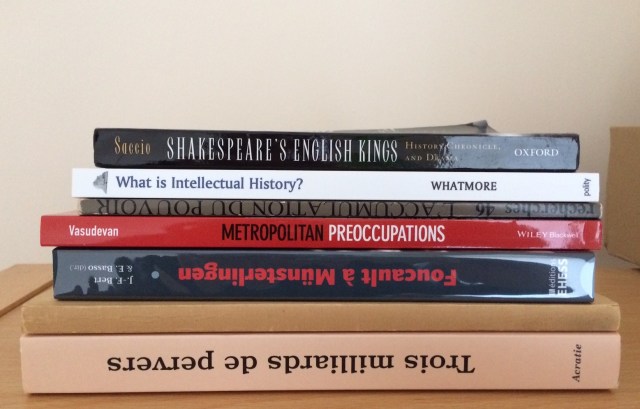
Books received – Recherches, Foucault, Fourquet, Shakespeare, Vasudevan, Whatmore

A pile of recent books bought or received. Alex Vasudevan’s Metropolitan Preoccupations: The Spatial Politics of Squatting in Berlin was sent by him; and Richard Whatmore, What is Intellectual History? came from Polity – preordered in recompense for review work. Both look really interesting.

The rest were bought and, except for Saccio, Shakespeare’s English Kings, they are all for the Foucault work. Trois milliards de pervers is a reproduction of an issue of the Recherches journal (no 12) run by Guattari’s CERFI group – it was banned as an obscene publication and original copies are very hard to find. This is a reproduction that appeared earlier this year. Foucault spoke out in defence on the journal and was part of a discussion in the next issue. Also a copy of Recherches no 46 which is François Fourquet’s reflection on the collaborative work done with Guattari, Deleuze, Foucault and others in the early 1970s. The book with no spine marking is the first report from that work, Généalogie des équipements collectifs : première synthèse, which appeared in 1973. These works are all listed in this site’s bibliography of Foucault’s collaborative projects. The final book is the very recent Foucault à Münsterlingen, which is a documentary account of Foucault’s visit to the ‘fête des fous’ in 1954. It includes some reproductions of Foucault’s texts and letters relating the translation work he did on Ludwig Binswanger.

IMG_1169

Posted in Felix Guattari, Foucault: The Birth of Power, Gilles Deleuze, Michel Foucault, Politics, Uncategorized, William Shakespeare | Leave a comment

Extraterritorialities in Occupied Worlds – forthcoming collection from Punctum with essays by Levinas, Bauman, Agamben… and Elden

Amir_Sela_EiOW_Cover_Front_Mockup1

Extraterritorialities in Occupied Worlds – forthcoming collection edited by Maayan Amir and Ruti Sela from Punctum. Includes essays by Levinas, Bauman, Agamben, Harman and many others, including a piece by me entitled ‘Outside Territory’ which is mainly on Shakespeare. Some of the papers, including mine, were first presented at a conference in Paris; some come from a similar conference in New York; others are classic papers reprinted. Should be out in early 2016. Full details here.

The concept of extraterritoriality designates certain relationships between space, law and representation. This collection of essays explores contemporary manifestations of extraterritoriality and the diverse ways in which the concept has been put to use in various disciplines. Some of the essays were written especially for this volume; others are brought here together for the first time. The inquiry into extraterritoriality found in these essays is not confined to the established boundaries of political, conceptual and representational territories or fields of knowledge; rather, it is an invitation to navigate the margins of the legal-juridical and the political, but also the edges of forms of representation and poesies.

Within its accepted legal and political contexts, the concept of extraterritoriality has traditionally been applied to people and to spaces. In the first case, extraterritorial arrangements could either exclude or exempt an individual or a group of people from the territorial jurisdiction in which they were physically located; in the second, such arrangements could exempt or exclude a space from the territorial jurisdiction by which it was surrounded. The special status accorded to people and spaces had political, economic, and juridical implications, ranging from immunity and various privileges to extreme disadvantages. In both cases, a person or a space physically included within a certain territory was removed from the usual system of laws and subjected to another. In other words, the extraterritorial person or space was held at what could be described as a legal distance. (In this respect, the concept of extraterritoriality presupposes the existence of several competing or overlapping legal systems.) It is this notion of being held at a legal distance around which the concept of extraterritoriality may be understood as revolving.


Posted in Politics, Territory, Uncategorized, William Shakespeare | 1 Comment

Foucault’s Last Decade – available to preorder

Foucault's Last Decade coverFoucault’s Last Decade is now available to preorder, either direct from the publisher or at online bookstores. It’s currently scheduled for May 2016, but might be a little earlier. It will be in hardcover and paperback, the latter going for £17.99 or $26.95.

On 26 August 1974, Michel Foucault completed work on Discipline and Punish, and on that very same day began writing the first volume of The History of Sexuality. A little under ten years later, on 25 June 1984, shortly after the second and third volumes were published, he was dead.

This decade is one of the most fascinating of his career. It begins with the initiation of the sexuality project, and ends with its enforced and premature closure. Yet in 1974 he had something very different in mind for The History of Sexuality than the way things were left in 1984. Foucault originally planned a thematically organised series of six volumes, but wrote little of what he promised and published none of them. Instead over the course of the next decade he took his work in very different directions, studying, lecturing and writing about historical periods stretching back to antiquity.

This book offers a detailed intellectual history of both the abandoned thematic project and the more properly historical version left incomplete at his death. It draws on all Foucault s writings in this period, his courses at the Collège de France and lectures elsewhere, as well as material archived in France and California to provide a comprehensive overview and synthetic account of Foucault s last decade.

Posted in Foucault's Last Decade, Michel Foucault | 1 Comment