

All in recompense for review work – two for the ‘earth’/geopolitics project; Thomas Sheehan’s new book on Heidegger; and Rosa Luxemburg’s classic The Accumulation of Capital.
All in recompense for review work – two for the ‘earth’/geopolitics project; Thomas Sheehan’s new book on Heidegger; and Rosa Luxemburg’s classic The Accumulation of Capital.
Elizabeth Straughan reviews James Wilkes’ new book A Fractured Landscape of Modernity at the Society and Space open site.
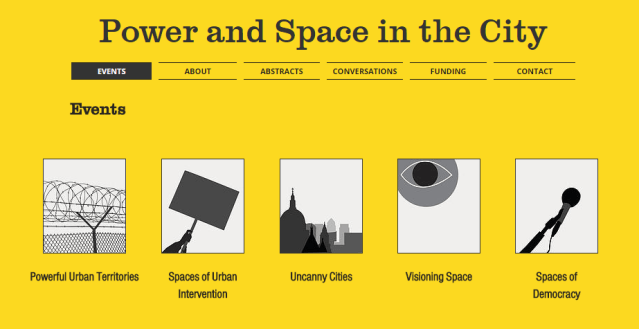 Yesterday I was part of a conversation on the theme of ‘Powerful Urban Territories‘, one of a sequence of five events on Power and Space in the City, jointly organised by The Bartlett, University College London and the Open University’s Open Space. Allan Cochrane and Wendy Pullan were the other panelists, in an event organised by Liza Griffin and chaired by Janet Newman.
The discussion was recorded and I’ll post the link here when it’s available. In the meantime, each of the speakers provided an extended abstract of their remarks – given we only had 10 minutes to speak, these are not much shorter that what was actually said.
Some discussion of the South China Sea, geopolitics and the Anthropocene.
As per our disciplinary formations, IR scholars often indoctrinate instruct their students with the assumption that anarchy is a constant in international relations. The use of the term, however, generally assumes that there are natural/material constants within the international that transcend central concepts of sovereignty, power, and choice/preference. In other words, the assumption is that anarchy has (material) limits. Even those subscribing to the discursive turn would/might agree that there are material constraints that limit ‘meaning construction.’ We base a number of international laws, norms and regulations on this assumption; there are certain constants that cannot be changed through human actions. Our aspirations, capabilities, hopes, preferences, do not change these constants. What if – and this is a big ‘what if’ – for the time being, we are increasingly wrong about this assumption? What if human ability to transform the earth’s eco-systems has reached a level where…
View original post 881 more words
Gerard Toal reflects on de facto states, airspace and geopolitics, especially in relation to Ukraine.
Given the recent helicopter shoot down in Nagorno Karabakh, and the ongoing fighting over Donetsk airport, I’m posting below some remarks I made at the New School conference last month on the Ukrainian crisis. Point 2 addresses airspace.
On Overlapping Sovereignty & Legitimacy in De Facto States
Gerard Toal, New School, 3 October 2014.
I am going to seek to bridge the theme of ‘narratives of legitimacy’ in the first panel with the question of ‘overlapping sovereignties’ by speaking a little bit about the phenomenon of enduring de facto states. There are three issues I want to raise for our discussion – de facto states, airspaces, and the flattening qualities of an affectively fueled civilizational geopolitical discourse.
De facto states are usually defined as states that have proclaimed and established de facto sovereignty, for at least two years, over a claimed territorial space…
View original post 1,495 more words
To accompany my article The Geopolitics of Boko Haram and Nigeria’s ‘War on Terror’ in The Geographical Journal, I have a short piece at the Geography Directions blog.
By Stuart Elden, University of Warwick and Monash University
 Military Presence in Maitama, Abuja (image credit: Stuart Elden)
The Sunni Islamic group known as ‘Boko Haram’, active in the northeast of the country since at least 2007, came to much wider Western attention in April 2014 with the kidnapping of the school girls at Chibok in Borno state. It then somewhat slipped off the radar with events in Ukraine and the rise of the so-called ‘Islamic State’ in Syria and Iraq. The ‘Islamic State’ was formerly known as al-Qaeda in Iraq, and then as the Islamic State of Iraq and al-Sham. Al-Sham is frequently translated as either the ‘Levant’ or Syria, but part of the point is to encompass a much wider geographical area, and the group has been explicit about its aim of dissolving colonial-era boundaries between states. Foremost among these is the much-hated ‘Sykes-Picot line’ between Iraq and…
View original post 780 more words
Details of an interesting conference coming up in May at Kingston university.
CRMEP 2015 Graduate Conference: Philosophy, Power, Potentialities
Centre for Research in Modern European Philosophy,
Kingston University London, Penrhyn Road campus, KT1 2EE
Thursday 21st – Friday 22nd May 2015
Confirmed keynote speaker: Alenka Zupančič (Slovenian Academy of Sciences and Arts/EGS)
Deadline for abstracts: 28th February 2015
* * *
In a contemporary discourse suffused with the theme of ‘crisis’ – political, economic, educational, social, ecological, technical – what are the resources of philosophy at this moment for thinking power relations and potentialities?
‘Power’ has long been a central concept for philosophy and critical thought. The theme gained particular influence in the wake of Michel Foucault’s studies of the 1970s and ’80s, spurring productive dialogue with different accounts of power and domination provided by the feminist, post-colonial and Marxist traditions, and in race/ethnicity, gender and queer studies. More recent European thought – drawing on influences…
View original post 197 more words
Phil Steinberg discusses his forthcoming Society and Space paper, a related publication, and some upcoming talks.
Two articles from my ‘Wet Ontologies’ project, both co-authored with Kimberley Peters, are due for publication in the next month or two: ‘Wet Ontologies, Fluid Dynamics: Giving Depth to Volume through Oceanic Thinking’, which will be published in Environment and Planning D: Society & Space, and a companion paper, ‘Volume and Vision: Toward a Wet Ontology’, which will be published in Harvard Design Magazine. To roll out the papers, I’ll be giving a number of talks on the topic over the next months.
View original post 206 more words
Another very good discussion of the pension issue in UK higher education.
Given the level of interest in my previous post (over 2,400 views in the last 10 days), I thought I would provide an analysis of UCU’s counter-proposals on USS and of the ongoing contestation of the leadership’s strategy in the current industrial action. In brief, UCU is offering to sacrifice the final salary scheme and give employers much of what they want, in exchange for a modestly improved career-average scheme. Conservatives within the union are also moving to rescind the industrial action before it has even properly started.
UCU’s Counter-Proposals
UCU’s response to UUK’s proposals, and its counter-proposals, were initially buried in a circular to branches posted on UCU’s website, before being circulated to members on Friday, only after they had been put to employers’ representatives in writing and at the USS Joint Negotiating Committee on Thursday. UCU’s critique of UUK’s proposals is excessively technical, but it does provide this…
View original post 1,454 more words


