
A recent piece by Negri on reading Foucault with Marx.

Generation online has posted Arianna Bove’s translation of Negri’s presentation from the Marx-Foucault Colloquium at Nanterre, December 18-19, 2014.
A recent piece by Negri on reading Foucault with Marx.
Generation online has posted Arianna Bove’s translation of Negri’s presentation from the Marx-Foucault Colloquium at Nanterre, December 18-19, 2014.

David Harvey’s essay for the exhibition catalog of Uneven Growth Tactical Urbanisms for Expanding Megacities is published here on post to mark the opening of the exhibition.
(via Reading Capital with David Harvey)
 A Spanish interview with David Harvey has been translated at My Desiring Machines. I’m not sure if it was conducted in Spanish or this is a re-translation. Anyway, it’s nice to have it available. It was posted in parts, but the whole thing can be read here.
Judith Butler, ‘Human Shield’ – lecture at LSE on 4 February 2015 (details)
Recent debates about human shields in the summer bombardment of Gaza raised the question of how the unarmed human form comes to be regarded as a military instrument. The lecture will consider how the perception of racialized bodies as threatening instruments informs both the public debates on the use of children as human shields in Gaza and the numerous figures of unarmed Black men and women in US cities who are gunned down either because they seem to be reaching for weapons or because their gestures, including their standing still, are regarded as weapons. In the context of the increasing militarization of police forces tasked with containing or eliminating social protest against social and economic inequality, how is racial perception both built and ratified through recasting the human form as threatening instrument? To what extent does the racialized structure of the visual field become instrumental to justifying the unjustifiable?
I’ve made a list of uncollected notes, lectures and interviews by Michel Foucault. Many of these have been posted on this site before, but this is an attempt at collecting details and links in one place. There are a couple of scans of hard to find material.
The four-volume Dits et écrits collects almost all the short pieces published in any language in Foucault’s lifetime. For an English bibliography of translations of pieces in Dits et écrits, see Richard Lynch’s work (available at www.michel-foucault.com and updated in A Companion to Foucault). I’ve not repeated any of that information, nor listed his major works or the lecture courses.
The list is of pieces which didn’t make it into Dits et écrits, but which are available in some form. With a couple of exceptions where I can link to an online version or to correct a reference I’ve not included things in Jacques Lagrange’s ‘Complément bibliographique’ in Dits et écrits (Vol IV, 829-38).
On Foucault’s collaborative projects, see the list here; for audio and video recordings here.
Corrections and additions very welcome.
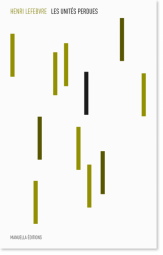
Although it appears in at least one bibliography of the better-known Henri Lefebvre, Les unités perdues, translated as The Missing Pieces, is actually by a different author, born in 1959. It’s an interesting book on abandoned, lost, destroyed, forgotten and unfinished works, and a short excerpt is available on the Berfrois website.
Update September 2026: unfortunately, though perhaps fittingly, the excerpt has disappeared with the demise of Berfrois. I briefly write about the confusion of this Henri Lefebvre with the more famous Marxist in one of my ‘Sunday History‘ pieces.
 Verso have an ebook sale – 90% off until January 1st 2015.
I picked up nine for less than £15 – books by Eric Hazan, Danny Dorling, Slavoj Zizek, Shlomo Sand, Walter Benjamin, Stanley Aronowitz, Keller Easterling, Arundhati Roy and Marcus Rediker.
 This isn’t recent news, but I hadn’t seen this before. Foucault’s preparatory notes to Les mots et les choses (The Order of Things) are available online at La bibliothèque de Foucault : Guide des papiers de travail de Michel Foucault.
The page reproduced left and here is on Kant’s ‘Des différentes races humaines’ from 1775. Thanks to Benoît Dillet, whose excellent review of the L’Herne volume on Michel Foucault alerted me to this resource.
Les mots et les choses isn’t within the time period I’m working on for the current book, But if it were, this would be an invaluable resource.
Perhaps material from the later years will become available in time for a second edition…
 A lecture by Foucault in 1982 at Université de Grenoble, on “Parrēsia” was first published in French in 2012 in the journal Anabases. Another lecture from this same trip, “Rêver de ses plaisirs”, was published in 1983, and is a variant of the first chapter of Le souci de soi/The Use of Pleasures. I outline and discuss the differences here.
The French version of the “Parrēsia” article will be available online in October 2015. A translation by Graham Burchell is forthcoming in Critical Inquiry in early 2015 [update: now available here]. For the moment, that journal has just posted the first two paragraphs:
Thank you very much for inviting me. I am here, as you know, as a supplicant. What I mean is that, until four or five years ago, my field, at any rate the domain of my work, had scarcely anything to do with ancient philosophy; and then, following a number of zigzags, detours, or steps back in time, I began to say to myself that, after all, it was very interesting. So I come to ancient philosophy as part of the work I am doing. One day, when I was asking him some questions, telling him about my problems, Henri Joly was kind enough to say that you might agree to discuss my work with me, in its present imperfect state. It is some material, some references to texts, some indications; what I am going to sketch out to you is therefore incomplete, and, if you were willing, it would be very good of you, first, to call out if you can’t hear me, stop me if you do not understand or if it’s not clear, and then anyway, at the end, tell me what you think.
So, to start with, this is how I came to be asking myself this set of questions. What I had been studying for really quite a long time was the question of the obligation to tell the truth: what is this ethical structure internal to truth-telling, this bond that, beyond necessities having to do with the structure or reference of discourse, means that at a given moment someone is obliged to tell the truth? And I tried to pose this question, or rather I encountered this question of the obligation to tell the truth, of, if you like, the ethical foundation of truth-telling, with regard to truth-telling about oneself. In actual fact it seems to me that I encountered it several times. First of all in medical and psychiatric practice since, from a given moment, which is moreover quite precise and can be pinpointed at the beginning of the nineteenth century, we see the obligation to tell the truth about oneself becoming part of the great ritual of psychiatry. Obviously we come across this problem of truth-telling about oneself in judicial practice and more especially in penal practice. And, finally, I came across it for the third time with regard to, let’s say, problems of sexuality and more precisely of concupiscence and the flesh in Christianity.

