Kostas Axelos in English – a bibliography with links

auteur_1383I’ve made a page with a list of pieces by Kostas Axelos in English with links, along with a few suggestions of secondary reading. It includes all the pieces of which I am aware. Additions or corrections welcome. The picture in this post comes from his publisher site; the painting on the page is from the Voyages to Freedom series by Anna Filini – a series of portraits of Greek figures who fled the country in 1945 on the Mataroa ship, also including Cornelius Castoriadis.

Axelos is a very interesting figure who can perhaps best be described as a ‘left Heideggerian’. He has been important to my thinking of the concept of ‘world’. He was a lifelong Marxist, but connected to a wide range of figures across Europe – from Greece to France and Germany and beyond. Among other things, he was the interpreter when Heideggger met Lacan – picture here – and knew Pablo Picasso well. Much more of his work is available in other European languages – he wrote mainly in French, but also in Greek and German, and there are Italian and Spanish translations of major works. He became editor of the journal Arguments, and launched the Arguments book series with Les Éditions de Minuit, which published works by Barthes, Blanchot, Deleuze, Lefebvre, Lukács and many others. 

Posted in Georg Lukács, Gilles Deleuze, Henri Lefebvre, Kostas Axelos | 3 Comments

Scotland’s Maritime Boundaries? – the cover of the Land Reform Review report


There is a interesting image on the front cover of the newly released report of The Land Reform Review Group – The Land of Scotland and the Common Good. The report is a 263 page document, but the image is striking for setting out Scotland’s purported maritime boundaries – both the twelve nautical mile ‘Scottish territorial seas’ and what it calls the ‘Scottish Seas’, set at 200 nautical miles. The latter is the legal Exclusive Econonic Zone, but the label chosen is telling. Some of these boundaries are taking the UK boundaries – see, for example, this DEFRA map for fishing rights – to apply to Scotland, but others are intra-UK – between Scotland and England, the Isle of Man, and Northern Ireland. There is also a large sector that is within the ‘civil jurisdiction offshore activities boundary’ but not within the ‘Scottish Seas boundaries’. And, as with the existing UK maps, the continental shelf extends to the West, which has implications especially for drilling rights.

I’ve taken a quick look at some of the text but not yet read the whole report – I was initially interested in questions of property in land and territory on land, but the cover image was very striking. I’m sure my ex-colleagues at Durham’s International Boundaries Research Unit such as Phil Steinberg and Martin Pratt could provide some expert commentary on some of the issues at stake here. This could become a major issue if there is a ‘yes’ vote to Scottish independence.

00451083

00451083b

Posted in Boundaries, Politics, Territory | 7 Comments

Gastón Gordillo, The Politics of Ruins – interview with Léopold Lambert of The Funambulist

Archipelago-Banner-headerA recording of a fascinating discussion between Léopold Lambert and Gastón Gordillo, “The Politics of Ruins: What’s Hidden Under Rubble” at The Archipelago – the podcast platform of The Funambulist. Here’s Léopold’s description of the discussion:

In early May, Gastón Gordillo received me at the University of British Columbia, which allowed us to talk about his upcoming book, Rubble: The Afterlife of Destruction, as well as the essay “Nazi Architecture as Affective Weapon” written for The Funambulist Papers series. We talk aboutthe politics of ruins from Albert Speer’s plans for Third Reich Berlin that was meant to generate glorious ruins to the different types of ruins that exist at the foot of the Andes in North Argentina. There, in contrast to the attitude by local authorities, local people do not view ruins as historic relics that should to be preserved but as rubble that evokes the destruction and violence the created the regional geography. We also talk about the production of ruins in the context of proletarian revolution like the 1871 Paris Commune versus the destruction to the very last stone of the Palestinian villages on Israeli territory after the Nakba (1948). Rubble is political for the narrative it tells of its past existence as well as the means of its destruction/production.

The Society and Space open site interview I conducted with Gastón is available here.

I met Léopold this week in New York for a discussion which should be posted on The Archipelago in a couple of weeks. We mainly talked about my ‘Secure the Volume‘ paper, and associated questions such as verticality, the fractured spaces of the West Bank, Paul Virilio’s early work, and then, at the end, my Shakespearean Territories project.

Posted in Gaston Gordillo, Paul Virilio, Politics, Shakespearean Territories, Territory | Leave a comment

Barry Stocker on Foucault’s The Punitive Society VII 1 and 2

Barry Stocker continues his reading of Foucault’s La société punitive, lecture seven, parts one and two.

Posted in Michel Foucault | Leave a comment

Bradley Garrett receives conditional discharge – ‘a qualified victory for academic freedom’

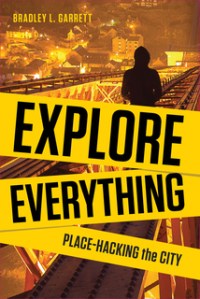
Explore_Everything_CMYK_300dpi-max_221-fb27ee2de94df07db9665c238cbf330fBradley Garrett, whose work I’ve praised on this site before, was yesterday given a ‘conditional discharge’ in relation to charges of ‘conspiring to commit criminal damage’. I exchanged some emails with Brad yesterday so knew about it, but there were some limits on reporting. The story has just been released by The Guardian, so it’s now clearly okay to talk about this.

It’s not a complete victory, as he still has a fine to pay, and it does raise a lot of important questions about academic freedom, especially for ethnography. But it’s still good news – the worst possible outcome was imprisonment. One way to celebrate, and support Brad, is to read some of his work – perhaps beginning with picking up a copy of the excellent Explore Everything: Place-Hacking the City or visiting his stunning website.

[Update: a piece on the case and the wider implications at The Conversation.]

Posted in Politics, Publishing, urban/urbanisation | Leave a comment

Sensing War: war, violence, militarism, bodies, sensation – 12-13 June 2014, London

Sensing War: war, violence, militarism, bodies, sensation

International Interdisciplinary Conference. 12 – 13th June 2014. London, UK

War is a crucible of sensory experience and its lived affects radically transform ways of being in the world.  It is prosecuted, lived and reproduced through a panoply of sensory apprehensions, practices and ‘sensate regimes of war’ (Butler 2012) – from the tightly choreographed rhythms of patrol to the hallucinatory suspicions of night vision; from the ominous mosquito buzz of drones to the invasive scrape of force-feeding tubes; from the remediation of visceral helmetcam footage to the anxious tremors of the IED detector; from the desperate urgencies of triage to the precarious intimacies of care; from the playful grasp of children’s war-toys to the feel of cold sweat on a veteran’s skin.

Recognising the recent growth of ground-breaking work on the senses across the humanities and social sciences, SensingWar aims to bring together researchers from a wide variety of disciplines to foster creative dialogue and critical exploration of the multiple and shifting relationships between war and sensation.  What concepts, resources and methods does the sensuous turn in scholarship offer to further our understandings of the myriad experiences of war and militarism?  How is war sensed by and for the drone operator, the occupied population, the female engagement team, the insurgent, the medic, the refugee, the veteran, the military family, the arms fair delegate, the war tourist, the video-gamer, the artist?  As war continuously shape-shifts, bleeding across the global flows of late modernity, how might attentiveness to sensory experience help us to rethink its genealogy and ontology?  How might we enable innovative and critical sensory engagements with war that allow us to see, hear, sense and understand it anew?

Full details here.

Posted in Conferences | Leave a comment

An interview with Elizabeth Grosz “Ontogenesis and the Ethics of Becoming” by Kathryn Yusoff

Kathryn Yusoff interviews Elizabeth Grosz on the Society and Space open site.

Posted in Uncategorized | Leave a comment

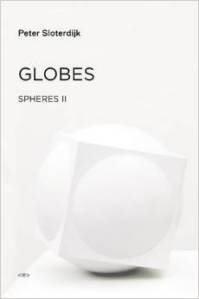
Peter Sloterdijk’s Globes: Spheres II forthcoming in October 2014

Now with a link to the MIT page for the book.

stuartelden's avatarProgressive Geographies

Unknown  Peter Sloterdijk’s  Globes –  Spheres II: Macrospherology listed on Amazon . It’s not on the Semiotext(e) page yet, but is on the MIT Press page (they distribute the books). It will be published in October 2014, and comes in at 1048 pages. Thanks to Chathan Vemuri for spotting this.

View original post

Posted in Uncategorized | Leave a comment

Herbert Marcuse, Collected Papers – sixth and final volume published

9780415137850Earlier this year, the sixth and final volume of Herbert Marcuse’s Collected Papers was published. The series was begun back in 1998, and they were edited by Douglas Kellner, joined by Clayton Pierce for the final two volumes. They are expensive –  £65 or $105 each, and even the earliest is not available in paperback, with even the e-books the same price. Maybe something to consider the next time I do review work for Routledge.

Thanks to Noir Ecologies for the link – worth a read for some reflections on Marcuse’s changing status as thinker and activist.

Posted in Herbert Marcuse, Publishing | Leave a comment

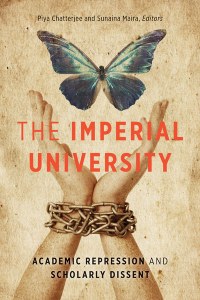
The Imperial University: Academic Repression and Scholarly Dissent

The Imperial University: Academic Repression and Scholarly Dissent – edited by Piya Chatterjee and Sunaina Maira and published by University of Minnesota Press.

image_mini

From the front lines of the war on academic freedom, linking the policing of knowledge to the relationship between universities, militarism, and neoliberalism

The Imperial University brings together scholars to explore the policing of knowledge by explicitly linking the academy to the broader politics of militarism, racism, nationalism, and neoliberalism that define the contemporary imperial state. Based on multidisciplinary research, autobiographical accounts, and even performance scripts, this urgent analysis offers sobering insights into varied manifestations of “the imperial university.” 


Posted in Books, Politics, Universities | Leave a comment