Foucault’s Lectures on the Punitive Society XIII (concluding here)

Barry Stocker’s reading of this course concludes.

Barry Stocker's avatarStockerblog

Lecture of March 28th, 1973

The last lecture. Coming soon, summaries of the lectures in Subjectivité et Vérité: Cours au Collège de France. 1980-1981, published a few weeks ago.

Foucault refers to the role of the prison, as the dominant form of the punishment of criminality, having a history of 150 years. It has been a failure from the beginning in that criminals and recidivists did not decline in number, while the coherence of delinquents as a group increased. The architecture of the prison is discussed in relation to the development of the state. The prison has a particular kind of space, in a star shape. The centre of the star is an observation tower which is the place of constant and universal surveillance of prisoners. The arms of the start shaped prison contain the life and work of the prisoners, pushed towards complete regularity and order.

The architectural…

View original post 933 more words

Posted in Uncategorized | 2 Comments

Foucault’s Lectures on the Punitive Society XII (should be XI)

Barry Stocker’s reading of Foucault continues.

Barry Stocker's avatarStockerblog

Lecture of March 14th 1973

In my last post on Foucault I referred to my mistake in dates and orders of the lectures I am summarising. I have had to correct my own correction and have finally worked out the problem. I wrote notes for today’s post a few days ago but forget them when posting again and put later notes in there. Everything is now corrected in previous notes, so just remember that this should been XI in this series, and XI should be XII. That is swap this post with the last post in your imagination, and remember that references to the previous lecture, refer to material I covered in post X .

Foucault begins by saying that when he referred in the previous lecture to accumulated wealth, he was misleading in suggesting that that the wealth was in the form of goods ready to consume, or elements…

View original post 957 more words

Posted in Uncategorized | Leave a comment

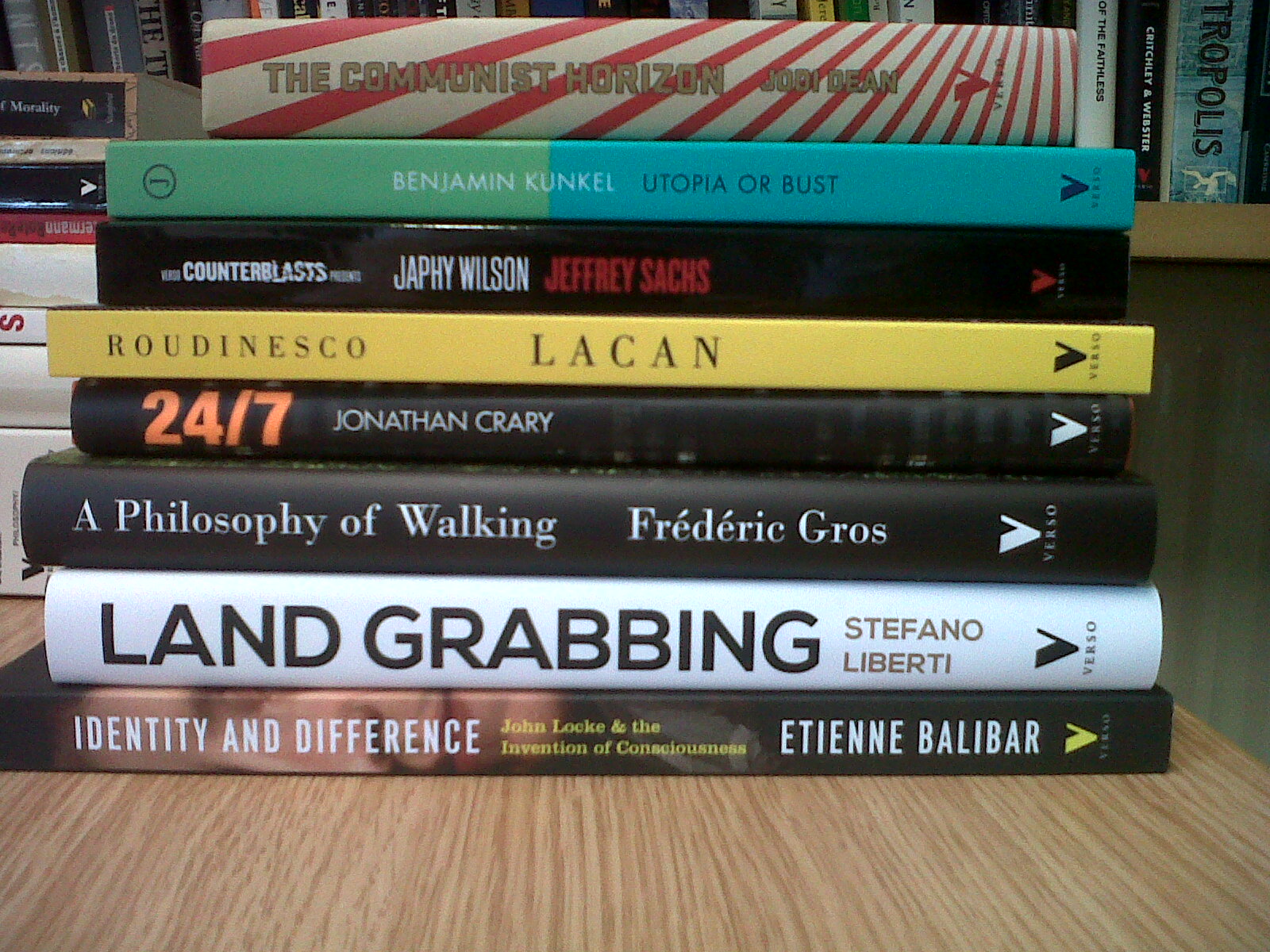
Books received – Verso (3 of 3)

Some of these I’ve read already due to Verso’s excellent e-book bundling. I wish more publishers would do this.

Verso 1 Verso 2


Posted in Books, Etienne Balibar, Frantz Fanon, Jacques Rancière, Slavoj Zizek | 4 Comments

Books received – Nietzsche, Heidegger, Foucault, Lefebvre etc. (2 of 3)

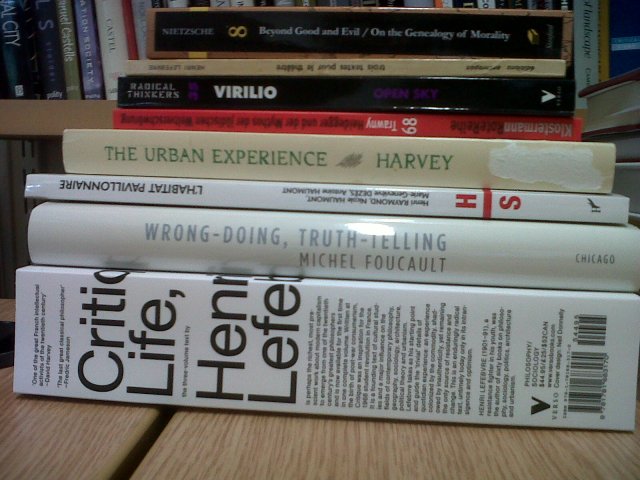
The new translation of Nietzsche’s Beyond Good and Evil and On the Genealogy of Morality; Lefebvre’s Trois textes pour le theâtre; Virilio’s Open Sky; Trawny’s Heidegger und der Mythos der jüdischen Weltverschwörung; Harvey’s The Urban Experience; the new edition of a collection Lefebvre wrote the preface to – L’habitat pavillonaire, the translation of Foucault’s 1981 Louvain lectures, Wrong-Doing, Truth-Telling; and the one-volume edition of Lefebvre’s Critique of Everyday Life. Some of these were pre-ordered in recompense for review work; a couple bought new; the rest picked up second-hand.

Lefebvre etc

Posted in David Harvey, Friedrich Nietzsche, Henri Lefebvre, Michel Foucault, Paul Virilio, Politics | 1 Comment

Books received – territory, borders, architecture, government (1 of 3)

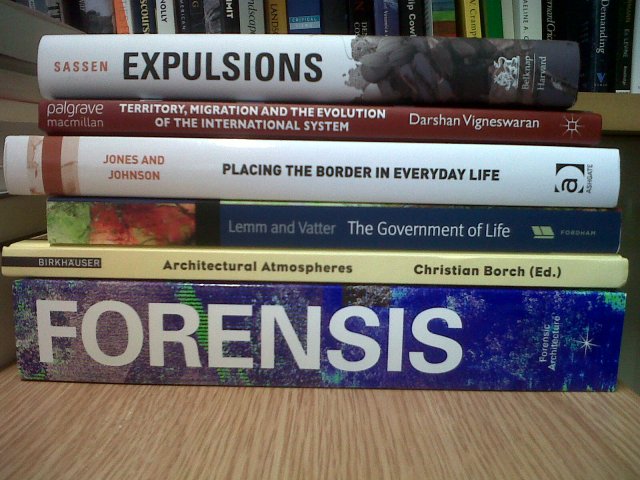
Working through the post… Saskia Sassen’s Expulsions and Darshan Vigneswaran’s Territory, Migration and the Evolution of the International System – both to review; Jones and Johnston’s Placing the Border in Everyday Life – which I endorsed; and Lemm and Vatter’s The Government of Life: Foucault, Biopolitics and Neoliberalism, Christian Borch’s Architectural Atmospheres collection; and the Forensic Architecture collection Forensis – sent by publishers or editors.

Territory etc

Posted in Books, Eyal Weizman, Politics, Saskia Sassen, Territory | 1 Comment

Gerry Kearns reviews The Birth of Territory – and a minor note on ‘land’

12 The Birth of TerritoryGerry Kearns has written a review of The Birth of Territory for Society and Space. My sincere thanks to Gerry, and Veronica della Dora, who commissioned the review. The review is available open access, so I won’t quote from it here. It’s a detailed, lengthy and very generous review. Likening it to studies by Clarence Glacken, David N. Livingstone and Derek Gregory is a considerable honour. I won’t pick up on lots of small issues of nuance and complexity in the review, but will clarify one thing that I think is important.

The point is not about land itself, but about understanding territory as land. If we understand territory as land, then I think it is hard to trace the specificity of territory. Territory is much more than land, as I try to show. But territory is obviously related to land, and that I do try to discuss in depth, as Gerry notes. For me then, the two conceptual markers for the inquiry are not ‘land and power’ (as Gerry suggests) but ‘power and place’. I know that these are complicated terms, and I have no wish to reduce those complexities, but we are fortunate in having excellent historical studies of both concepts – by Edward Casey and Michael Mann. I was therefore able to situate my inquiry alongside studies such as those. I think there are clearly related terms to power and place in Greek and Latin thought – I don’t believe there are with territory. With land, I’m less sure – it’s a much more complicated concept than we give it credit for, I think we too quickly collapse it into rent and to my knowledge there is no study comparable to Casey or Mann that interrogates it in depth. (I will go back to the Keith Tribe book noted by Gerry, which I don’t reference in the study.) I’d like to see more work on land – and we also need more on terrain, as Gerry notes. I’m considering doing work on both at some point.

I’m very grateful to Gerry for the review (as I was to Tom Conley yesterday) – authors need other authors to take the time to engage with their work, to point out problems, highlight ambiguities, and point to future directions for work. At their best – as Gerry does at the end – they indicate how books might be used, rather than just read.

Posted in Clarence J. Glacken, David N. Livingstone, Derek Gregory, Society and Space, The Birth of Territory | 3 Comments

Critical Theory books that came out in May

critical-theory-book-release-may-2014-672x372A nice round-up of some recent books – Derrida, Laclau, Lefebvre, Damlé, Flusser, etc. -at critical-theory.com
 

Posted in Books, Ernesto Laclau, Henri Lefebvre, Jacques Derrida | 1 Comment

The post mountain

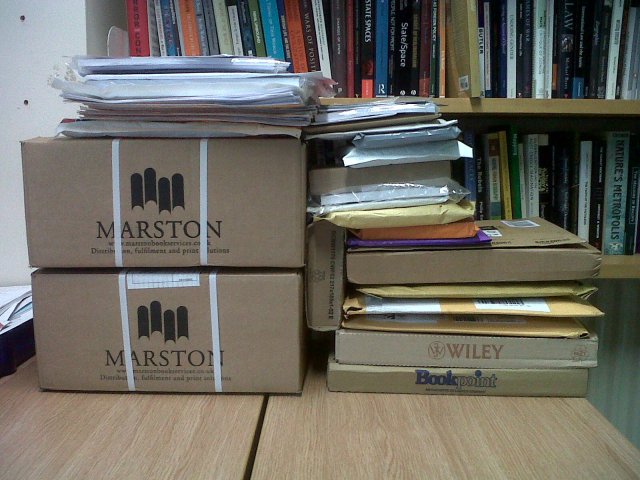
Back in the UK – this was what was awaiting me at work. The two big boxes are from the Verso sale; the rest I’m not yet sure.

Post

Posted in Books | 3 Comments

Tom Conley reviews The Birth of Territory in Imago Mundi

12 The Birth of TerritoryTom Conley reviews The Birth of Territory in Imago Mundi (subscription required). It’s a thoughtful, generous and engaged review.

Here’s the first paragraph:

Readers of Imago Mundi will appreciate this book for what it does along the fringes the history of cartography. In his intellectual history of what (on the back cover) he calls ‘emergence of the concept of territory in western political thought’, Stuart Elden discusses, both copiously and elegantly, writings from Homer to Rousseau bearing witness to how place and power can be understood. From the Iliad to the Social Contract, territory, he concludes, is best defined in terms of political technology, the latter a lens through which the term resembles a mosaic of modes of measure and control. Territory acquires currency when, in its formative phases, the nation-state implements technologies of measure. Res extensa becomes, as it were, coextensive with the power that a nation exerts upon what it sets under its jurisdiction…

A few bits from later on:

The stunning virtue of The Birth of Territory is found in its sweep and intellectual panache… The close readings of an astounding number of texts attest to the complexity of a term that Elden shows bearing a dazzling history… Elden has provided an exhaustively comprehensive gloss of what in the wake of his book we can now call the territorial canon.

Aside from the generosity, I really like some of the phrases here – “a mosaic of modes of measure and control” and the “territorial canon”. There are some suggestions for where future work might go, which are good, but perhaps most interesting is the critique in the concluding paragraph, suggesting something that would break with much modern scholarly convention, but harks back to some earlier ways of referencing and linking:

The Birth of Territory might have been better arranged, however, were its material organised cartographically. Rather than a cumbrous mass of 2,750 footnotes covering 146 pages, readers would have found a gazetteer-like list of works consulted more useful, especially if coordinated with references in the text itself. Such a system would allow the reader better to see how the politics of Elden’s view of territory in this rich study is born of its capacious matrix of primary and secondary material.

My thanks to Tom for this engagement with the work.

Posted in Politics, Territory, The Birth of Territory | 1 Comment

Top posts this week

  1. Mapping the world through its airport connections – excellent visualisation
  2. Medieval rules for sex in an easy to use flowchart
  3. Boko Haram – An Annotated Bibliography
  4. Wendy Brown—Governmentality in the Age of Neoliberalism (2014)
  5. Rob Kitchin’s forthcoming The Data Revolution has a website, with bibliography
  6. House-prices to salaries ratio map of England
  7. The problems of peer review
  8. The Onuf Principles
  9. Derek Gregory interviewed at The Archipelago
  10. National Academy of Sciences report on mass incarceration in the US
Posted in Uncategorized | Leave a comment