David Harvey, Megacities Lecture 4: Possible Urban Worlds – pdf online

Harvey - Possible Urban Worlds (Megacities 4 lectures)In 2000 David Harvey gave the Megacities Lecture 4: Possible Urban Worlds Twynstra Gudde Management Consultants, Amersfoort, The Netherlands, 2000).

It’s the one key text of Harvey’s that I didn’t already know, partly because it doesn’t appear to be on sale and I don’t know a library that has it – worldcat.org suggests it’s only in libraries in Holland and Germany. But I’ve just found the whole thing online (a previous link appears to be broken).

The lectures share some material with the Spaces of Hope book, but also (to my knowledge) include some material that isn’t in his other books.
Posted in David Harvey, urban/urbanisation | 3 Comments

Tom Slater’s Bibliography on ‘Territorial Stigmatization’

Wacquant PPC (Page 1)This is a useful resource – Tom Slater’s ‘An International Bibliography on Territorial Stigmatization‘.

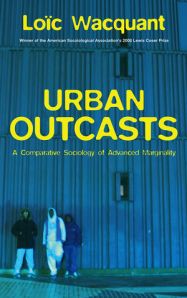
The work on this develops from Loïc Wacquant’s Urban Outcasts, and earlier references, with the suggestion that “the exploration of contemporary urban poverty must start with the powerful territorial stigma attached to residency in the bounded and segregated spaces of ‘advanced marginality’” (Hancock and Mooney 2013, 52).

There is some useful and politically important work here, though I’m still unclear why ‘territorial’ was used as the key geographical term here, as opposed to regional, locational, spatial, place, etc.

Posted in Boundaries, Politics, Territory, urban/urbanisation | Leave a comment

Saskia Sassen, ‘Expulsions: Complexity and Brutality’ – lectures at Durham, LSE and Dublin

Sassen Saskia Sassen’s Expulsions is forthcoming in June 2014.

Saskia Sassen, “Expulsions: Complexity and Brutality” – lecture at Durham University in February 2014 (via ANTHEM).

Update: a lecture at the LSE on the same topic is available here (via The Anthropo.scene]

And one at UC Dublin below (via Synthetic Zero)

Posted in Boundaries, Politics, Saskia Sassen, Territory | 3 Comments

Reconstruction of the Machine from Franz Kafka’s In the Penal Colony

Biblioklept's avatarBiblioklept

 “However,” the Officer said, interrupting himself, “I’m chattering, and his apparatus stands here in front of us. As you see, it consists of three parts. With the passage of time certain popular names have been developed for each of these parts. The one underneath is called the Bed, the upper one is called the Inscriber, and here in the middle, this moving part is called the Harrow.” “The Harrow?” the Traveller asked. He had not been listening with full attention.

“In the Penal Colony,” Franz Kafka.

View original post

Posted in Uncategorized | Leave a comment

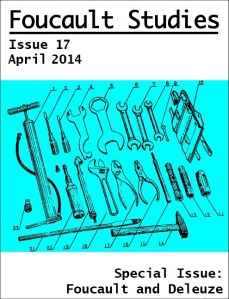
Foucault Studies 17 now out – Foucault and Deleuze

cover_issue_517_en_USA special issue on Foucault and Deleuze, edited by Nicolae Morar, Thomas Nail, Daniel W. Smith, and including essays by William Connolly and Dianna Taylor; plus unconnected articles and a large number of reviews.

Posted in Gilles Deleuze, Michel Foucault, William E Connolly | 4 Comments

Recursions: a new book series in media & cultural theory

A new book series with Amsterdam University Press.

jussiparikka's avatarMachinology

recursions logoWe are proud to announce the launch of a new book series titled Recursions: Theories of Media, Materiality and Cultural Techniques. Placed with Amsterdam University Press, a publisher known for its strong track-record in film and media studies, the series will publish fresh, exciting and important books in media theory. This includes both translations and other volumes that address the core themes outlined below. I am very excited about this project and working with my co-editors Anna Tuschling and Geoffrey Winthrop-Young. We have already some significant projects lined up for 2015 and more forthcoming that we will announce in the coming weeks and months. We are supported by a very strong international advisory board. Get in touch if you want to learn more but first read below for more information!

New Series Announcement

The new book series Recursions: Theories of Media, Materiality, and Cultural Techniques provides a platform for cutting-…

View original post 411 more words

Posted in Uncategorized | Leave a comment

Seeing the secret state with Trevor Paglen

A superbly illustrated, deeply disturbing, and yet very entertaining insight into rendering the secret visible with Trevor Paglen. I’ve said before that Trevor gave one of the best twenty-minute AAG presentations I’ve ever seen, and he is just as good over fifty minutes here. His paper ‘Goatsucker: toward a spatial theory of state secrecy’ is one of the open access highlight papers at Society and Space.

jonescraig's avatarWar Law Space

Earlier this week I blogged about Trevor Paglen’s new work over at Intercept, and now Joseph Lee (via Gab Olah) send news of a talk Paglen gave at the Chaos Communication Congress in Berlin last December. It’s remarkably perceptive and provides insight into the digital and logistical mechanics of his photography as well as his take on secrecy. He insists that secrecy is not merely what we don’t know, but rather a way of seeing and a way of organising society that always leaves a trace in the non-secret world. And, as ever, his visuals are stunning: well worth the full 50 minutes.

For more on Paglen and his other work see commentaries from geographicalimaginations here and here, or Paglen’s site here.

View original post

Posted in Politics, Trevor Paglen | Leave a comment

Three forthcoming papers (require subscription)

New papers in Society and Space – discussing social movements, Kant’s Geography, and water in the city.

Posted in Uncategorized | Leave a comment

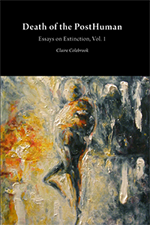
Claire Colebrook, Death of the PostHuman: Essays on Extinction, Vol. 1 – pdf available online

Claire Colebrook’s Death of the PostHuman: Essays on Extinction, Vol. 1 is available online and as downloadable pdf from Open Humanities Press – print version coming soon.

colebrook_death-of-the-posthuman_150x225

Death of the PostHuman undertakes a series of critical encounters with the legacy of what had come to be known as ‘theory,’ and its contemporary supposedly post-human aftermath. There can be no redemptive post-human future in which the myopia and anthropocentrism of the species finds an exit and manages to emerge with ecology and life. At the same time, what has come to be known as the human – despite its normative intensity – can provide neither foundation nor critical lever in the Anthropocene epoch. Death of the PostHuman argues for a twenty-first century deconstruction of ecological and seemingly post-human futures.


Posted in Uncategorized | Leave a comment

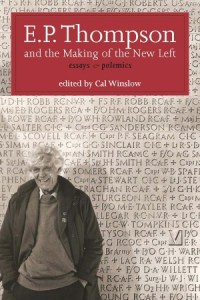
E.P. Thompson and the Making of the New Left


E.P. Thompson and the Making of the New Left: Essays and Polemics by E. P. Thompson; edited by Cal Winslow – out in June with Monthly Review Press. More details and endorsements at the site – here’s the blurb.

PB4437-300x450

E. P. Thompson is a towering figure in the field of labor history, best known for his monumental and path-breaking work, The Making of the English Working Class. But as this collection shows, Thompson was much more than a historian: he was a dedicated educator of workers, a brilliant polemicist, a skilled political theorist, and a tireless agitator for peace, against nuclear weapons, and for a rebirth of the socialist project.

The essays in this book, many of which are either out-of-print or difficult to obtain, were written between 1955 and 1963 during one of the most fertile periods of Thompson’s intellectual and political life, when he wrote his two great works,The Making of the English Working Class andWilliam Morris: Romantic to Revolutionary. They reveal Thompson’s insistence on the vitality of a humanistic and democratic socialism along with the value of utopian thinking in radical politics. Throughout, Thompson struggles to open a space independent of official Communist Parties and reformist Social Democratic Parties, opposing them with a vision of socialism built from the bottom up. Editor Cal Winslow, who studied with Thompson, provides context for the essays in a detailed introduction and reminds us why this eloquent and inspiring voice remains so relevant to us today.

Posted in Books, E. P. Thompson, Politics | 2 Comments