Marc Crépon, The Thought of Death and the Memory of War – reviewed at NDPR

Marc Crépon, The Thought of Death and the Memory of War is reviewed at NDPR. I didn’t know about this translation before, but it sounds important and interesting:

image

The first English translation of one of the foremost voices of contemporary moral and political philosophy

Marc Crépon pursues a path toward a cosmopolitics of mourning through readings of works by Freud, Heidegger, Sartre, Derrida, and Ricœur, and others. The movement among these writers marks a way through—and against—twentieth-century interpretation to argue that no war, genocide, or neglect of people is possible without suspending how one relates to the death of another human being.

There is an interview with him in French here that puts his work in relation to that of Bernard Stiegler.
Posted in Bernard Stiegler, Jacques Derrida, Jean-Paul Sartre, Marc Crépon, Martin Heidegger, Politics | Leave a comment

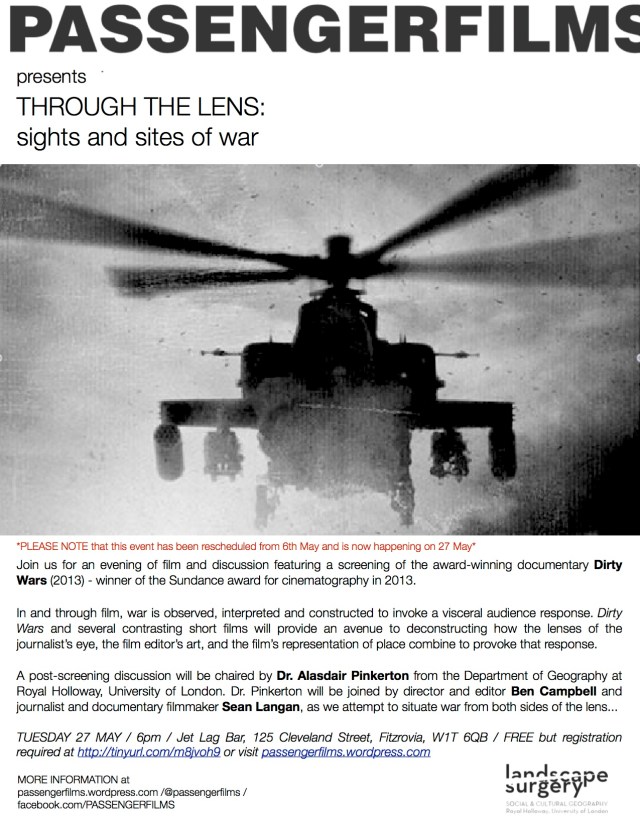
Through the Lens: Sights and Sites of War – a screening and discussion of Dirty Wars, London, 27 May 2014

A rearranged date for this screening and discussion of Jeremy Scahill’s Dirty Wars, organised by Royal Holloway Geopolitics & Security- 27 May 2014, London. Full details including booking (free, but required) here.

Join us for an evening of film and discussion featuring a screening of the award-winning documentary Dirty Wars (2013) – winner of the Sundance award for cinematography in 2013. This screening is being held in partnership between Passengerfilms and the Royal Holloway MSc Geopolitics and Security Programme.

In and through film, war is observed, interpreted and constructed to invoke a visceral audience response. Dirty Wars and several contrasting short films will provide an avenue to deconstructing how the lenses of the journalist’s eye, the film editor’s art, and the film’s representation of place combine to provoke that response.

A post-screening discussion will be chaired by Dr. Alasdair Pinkerton from the Geography department at Royal Holloway, University of London. Dr. Pinkerton will be joined by director and editor Ben Campbell and journalist and documentary filmmaker Sean Langan, as we attempt to situate war from both sides of the lens.

Diry Wars RESCHEDUELD2

Posted in Politics | Leave a comment

Elizabeth Povinelli – ‘The Four Figures of the Anthropocene’

Elizabeth Povinelli – lecture and a reminder of the Society and Space open site interview.

Posted in Uncategorized | Leave a comment

Foucault’s 1980-81 course Subjectivité et vérité is published today

Foucault’s 1980-81 lecture course Subjectivité et vérité has now been published. Amazon.fr have copies in stock.

9782020862592

« L’hypothèse de travail est celle-ci : il est vrai que la sexualité comme expérience n’est évidemment pas indépendante des codes et du système des interdits, mais il faut rappeler aussitôt que ces codes sont étonnamment stables, continus, lents à se mouvoir. Il faut rappeler aussi que la façon dont ils sont observés ou transgressés semble elle aussi très stable et très répétitive. En revanche le point de mobilité historique, ce qui sans doute change le plus souvent, ce qui a été le plus fragile, ce sont les modalités de l’expérience. »

Michel Foucault

Foucault prononce en 1981 un cours qui marque une inflexion décisive dans son chemin de pensée et le projet ébauché dès 1976 d’une Histoire de la sexualité. C’est le moment où les arts de vivre deviennent le foyer de sens à partir duquel pourra se déployer une pensée neuve de la subjectivité. C’est le moment aussi où Foucault problématise une conception de l’éthique comprise comme l’élaboration patiente d’un rapport de soi à soi. L’étude de l’expérience sexuelle des Anciens permet ces nouveaux déploiements conceptuels. Dans ce cadre, Foucault analyse des écrits médicaux, des traités sur le mariage, la philosophie de l’amour ou la valeur pronostique des rêves érotiques, afin d’y retrouver le témoignage d’une structuration du sujet dans son rapport aux plaisirs (aphrodisia) antérieure à la construction moderne d’une science de la sexualité, antérieure à la hantise chrétienne de la chair. L’enjeu est en effet d’établir que l’imposition d’une herméneutique patiente et interminable du désir constitue l’invention du christianisme. Mais pour cela, il importait de ressaisir la spécificité irréductible des techniques de soi antiques.

Dans cette série de leçons, qui annoncent clairement L’Usage des plaisirs et Le Souci de soi, Foucault interroge particulièrement le primat grec de l’opposition actif / passif sur les distinctions de genre, ainsi que l’élaboration par le stoïcisme impérial d’un modèle de lien conjugal prônant une fidélité sans faille, un partage des sentiments, et conduisant à la disqualification de l’homosexualité.

Posted in Foucault's Last Decade, Michel Foucault | 1 Comment

Richard Sennett on the Open City – lecture at Durham

thanks again to dmfant for this one.

Posted in Uncategorized | Leave a comment

David Harvey and Andy Merrifield in conversation at Birkbeck

Thanks to dmfant for the link in comments to a previous post.

[David Harvey doesn’t begin talking until 48 minutes in.]

Posted in David Harvey | 1 Comment

The Actuality of the Theologico-Political – Conference in London May 23-24

The Actuality of the Theologico-Political – Conference in London May 23-24, 2014

Today’s (post) political thought has been turned into an ethics and a legal philosophy. The business of politics is supposed to promote moral values and ethical policies which are reached either through a discursive will formation (human rights, humanitarianism, freedom etc.) or through the language of rights (original positions, striking a balance between individual rights and community goods, rights as trumps etc.).

Religion can help to revive the political, to re-politicize politics: it can help the construction of new political subjects who break out of the ethico-legal entanglement and ground a new collective space. In early Christianity, the communities of believers created the ecclesia, a new form of collectivity. Asimilar role was played in early Islam by the umma. Paraphrasing Kierkegaard, one can say that we need today the theologico-political suspension of the legal-ethical.

Speakers:

Tina Beattie – Conviction, Commitment and Law: religion outside the limits of reason alone
Enrique Dussel – Marx’s Critique: Turning Economics and Theology Back on their Feet 
Costas Douzinas – The Eternal Return of The Theologico-Political
Dominik Finkelde– Luther and Lacan
Boris Gunjevic – Theology As Spiritual Exercise – Discernment, Repetition, Discipline
Adam Kotsko – Political Theology From Below
James Martel –
John Milbank – Political Theology And Economic Theology: The New Debate
Eric Santner – The Weight Of All Flesh: On The Subject-Matter Of Political Economy
Rowan Williams – Representation: political problems and philosophical solutions?
Slavoj Zizek –“Se Conduire Comme Si Le Vieillard Existait”

Posted in Enrique Dussel, Slavoj Zizek | Leave a comment

Ryan Brading on Ernesto Laclau as Theorist of Populism

Another nice tribute to Ernesto Laclau, this time by Ryan Brading on his work as a theorist of populism at Adam David Morton’s For the Desk Drawer blog.

Posted in Ernesto Laclau | Leave a comment

Call for Papers: Philadelphia Summer School in Continental Philosophy with John Caputo

Call for Papers: Philadelphia Summer School in Continental Philosophy –

Topic: “Continental Philosophy of Religion and the New Metaphysics” (featuring seminars on the work of Quentin Meillassoux, Ray Brassier, Bruno Latour, and Catherine Malabou)

Seminar Leader: John Caputo

Saturday, August 9th, 2014; 9am-4:30pm, Campus of Immaculata University, Malvern, Pennsylvania

More details here.

Posted in Bruno Latour, Catherine Malabou, Conferences, Quentin Meillassoux, Ray Brassier | Tagged | Leave a comment

Lois McNay, The Misguided Search for the Political

Lois McNay’s new book, The Misguided Search for the Political, has just been published by Polity Press.

McNaysketch2.indd

There has been a lively debate amongst political theorists about whether certain liberal concepts of democracy are so idealized that they lack relevance to ‘real’ politics. Echoing these debates, Lois McNay examines in this book some theories of radical democracy and argues that they too tend to rely on troubling abstractions – or what she terms ‘socially weightless’ thinking. They often propose ideas of the political that are so far removed from the logic of everyday practice that, ultimately, their supposed emancipatory potential is thrown into question. 

Radical democrats frequently maintain that what distinguishes their ideas of the political from others is the fundamental concern with unmasking and challenging unrecognized forms of inequality and domination that distort everyday life. But this supposed attentiveness to power is undermined by the invocation of rarefied models of political action that treat agency as an unproblematic given and overlook certain features of the embodied experience of oppression. The tendency of radical democrats to define democratic agency in terms of dynamics of perpetual flux, mobility and agonism passes over too swiftly the way in which objective structures of oppression are often taken into the body as subjective dispositions, leaving individuals with the feeling that they are unable to do little more than endure a state of affairs beyond their control.

Drawing on the work of Adorno, Bourdieu and Honneth, amongst others, McNay argues that in order to make good the critique of power, radical democratic theory should attend more closely to a phenomenology of negative social experience and what it can reveal about the social conditions necessary for effective political agency.

Posted in Uncategorized | Leave a comment