Anthropologie du conscrit français – a text mentioned by Foucault in 1974

Anthropologie du conscrit françaisIn an addendum to a piece on this site about Foucault’s seminar colleague Jean-Pierre Peter, I made the following note:

Update: the only other place I know where Foucault mentions Peter is in “The Birth of Social Medicine” – the second of his 1974 lectures in Rio. Foucault mentions the work of Le Roy Ladurie and Jean Pierre-Peter on conscription statistics (DE III, 208; EW III, 135). The note – presumably added by the editors – references “Emmanuel Le Roy Ladurie, Jean-Pierre Peter, and Paul Dumont, Anthropologie du conscrit français, d’après les comptes numériques et sommaires du recrutement de l’armée (1819-1826), Paris: Mouton, ‘Civilisation and Societies’ 1972. However, references to this work elsewhere, such as the EHESS publisher page, say Jean-Paul Aron not Jean-Pierre Peter was the third editor.

Having now checked a copy of the book itself, I can confirm that Aron, and not Peter, was the third person involved. I could have simply trusted the EHESS page, but I was intrigued by Foucault’s reference (checking what Foucault read is perhaps done too infrequently in Foucault studies). I’m especially grateful for the spur to look at this book. Foucault mentions the work because he’s interested in the assessment of conscripts, which includes data on which départements they came from, which years are missing from data sets, medical information, and especially exemptions because of conditions, the height of young men, professions, education level and so on. There is some quite interesting spatial-cartographic analysis in the first part (the work of Dumont and le Roy Ladurie) and then epistemological and methodological reflections by Aron on the work and the field of connaissance of military dossiers more generally. François Furet and Fernand Braudel are among those thanked in the acknowledgements. Aron’s contribution is entitled “Taile, maladie et société: essai d’histoire anthropologique”, pp. 193-262.

A minor link between Foucault’s work and that of the Annales school of historians.

Posted in Michel Foucault | Tagged , | 3 Comments

The original source for Foucault’s Pierre Rivière collaborative project

2187-b-i-am-pierre-riviereI’ve long known that Foucault and his colleagues discovered the case of Pierre Rivière in Annales d’hygiène publique et de médecine légale, during the seminar of his first year of his work at the Collège de France. This particular case so fascinated them that they spent a considerable part of the second year of this seminar on the case; and the third seminar preparing its publication. The book that resulted comprised a dossier of all the reports alongside the memoir, and some contemporary essays by seminar participants. I’ve written a bit about the role of Jean-Pierre Peter in this work (and in uncovering some other cases) before.

9782070328284_1_75
Only today did I discover that the original piece from the Annales was available online at Criminocorpus, which has several other documents from this journal.

« Condamnation à mort d’un aliéné homicide : demande en commutation de peine, formée par le jury [affaire Pierre Rivière] » Annales d’hygiène publique et de médecine légale, 1836, série 1, n° 15, pp. 129-205.

It seems that Foucault and his colleagues used the material here, but in a different order, supplemented by other pieces they found or the complete text of some documents. Nonetheless, it’s an interesting piece in its own right, given that it’s the original impetus for the project.

Posted in Books, Michel Foucault, Publishing | 1 Comment

Michel Foucault and Fons Elders – a preparatory interview for the Chomsky debate

I’d not seen this before – fifteen minutes of video in preparation for the Chomsky debate between Foucault and Fons Elders. Thanks to Sjoerd van Tuinen and Elena Loizidou for sharing this.

Update: Jeremy Crampton has more news on this here, including the link to the book of the interview transcript, which only seems to be available on Fons Elders’s own site.

Update 2: Aphelis has a lot more information on the debate itself here.


Posted in Michel Foucault | 4 Comments

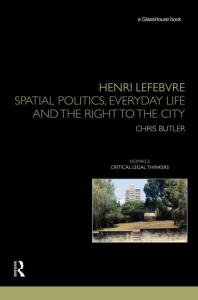
Chris Butler – Henri Lefebvre: Spatial Politics, Everyday Life and the Right to the City

Now out in paperback at a more reasonable price.

stuartelden's avatarProgressive Geographies

Recently out with Routledge . Looks good, though shame about the price.

While certain aspects of Henri Lefebvre’s writings have been examined extensively within the disciplines of geography, social theory, urban planning and cultural studies, there has been no comprehensive consideration of his work within legal studies. Henri Lefebvre: Spatial Politics, Everyday Life and the Right to the City provides the first serious analysis of the relevance and importance of this significant thinker for the study of law and state power. Introducing Lefebvre to a legal audience, this book identifies the central themes that run through his work, including his unorthodox, humanist approach to Marxist theory, his sociological and methodological contributions to the study of everyday life and his theory of the production of space. These elements of Lefebvre’s thought are explored through detailed investigations of the relationships between law, legal form and processes of abstraction; the spatial dimensions of…

View original post 109 more words

Posted in Uncategorized | Leave a comment

Understanding the City: Henri Lefebvre and Urban Studies

Understanding the City: Henri Lefebvre and Urban Studies – a collection edited by Gülçin Erdi-Lelandais (via here).

0069758_understanding-the-city_300

Henri Lefebvre is undoubtedly one of the most influential thinkers in the field of urban space and its organization; his theories offer reflections still valid for analyzing social relations in urban areas affected by the crisis of the neoliberal economic system. Lefebvre’s ideal of the “right to the city” is now more widely accepted given today’s current cultural and social situation. Most current research on Henri Lefebvre refers solely to his ideas and their theoretical discussion, without focusing on the empirical transcription of the philosopher. This book fills this gap, and proposes examples about the empirical use of Henri Lefebvre’s sociology from the perspective of different cities and researchers in order to understand the city and its evolutions in the context of neoliberal globalization. The book’s main purpose is to revisit Lefebvre’s still-relevant key concepts to propose new comprehensions of the contemporary city. Case studies in this book will show also that the reception of Lefebvrian concepts differs across different contexts, depending on the social and political circumstances of each country. The debates in this book both expand the scope of urban imagination, and help to reinvigorate, unify, and empower shared desires for just urban outcomes. The contributions to this book also illuminate the everyday choices concerning the form and social processes of the city, and the inspiration that they draw from Lefebvre’s theoretical legacy in the realm of urban sociology.

Posted in Henri Lefebvre, urban/urbanisation | 1 Comment

A Survey of University Presses

Some interesting information on university presses, including the revelation that for many presses their own websites account for only 1% of sales…

Posted in Uncategorized | Leave a comment

Garcia, Johnston, Bryant – Speculative Realism book introductions online

Edinburgh University Press has posted the introductions to three books in the Speculative Realism series edited by Graham Harman:

  1. Tristan Garcia’s Form and Object (here),
  2. Adrian Johnston’s Adventures in Transcendental Materialism (here), and
  3. Levi Bryant’s Onto-Cartography (here).

Thanks to New APPS and Levi’s Larval Subjects blog for the alerts.

Posted in Graham Harman, Levi Bryant, Tristan Garcia | Leave a comment

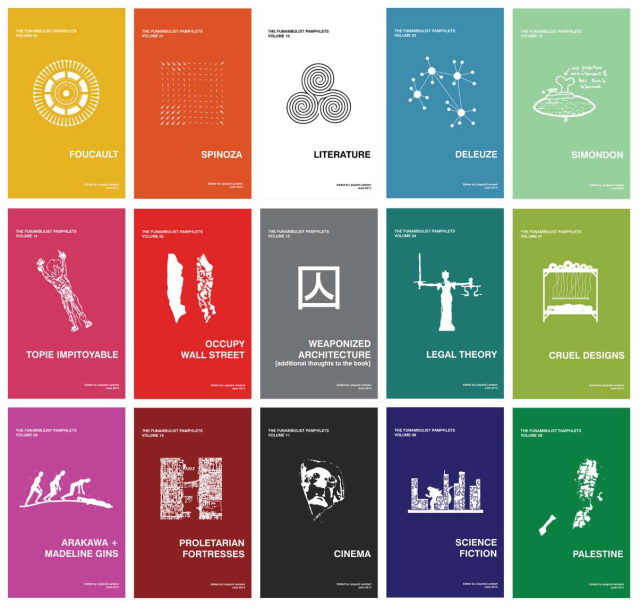
Eight Funambulist books available from Punctum

the-funambulist-pamphlets-vol1-15Eight collections of pieces (of a projected fifteen) originally published at The Funambulist by Léopold Lambert are available as books – pdfs online or print-on-demand – from Punctum.

Posted in Books | Leave a comment

David Harvey, Seventeen Contradictions… – introduction available online

HarveyDavid Harvey’s latest, Seventeen Contradictions and the End of Capitalism is out in April 2014; the introduction is available online. More information here.

Posted in Books, David Harvey, Politics | Leave a comment

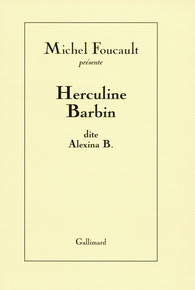
Herculine Barbin dite Alexina B. Nouvelle édition (2014)

Foucault’s presentation of the Herculine Barbin memoir in a new French edition. The Oscar Panizza dramatisation of the story is in the English translation. The Eric Fassin postface therefore appears to be the only new material here, but it’s been long out-of-print in France – I picked up a copy in Paris while doing my PhD.

Clare O'Farrell's avatarFoucault News

barbinMichel Foucault, Herculine Barbin dite Alexina B.

Première parution en 1978

Postface d’Éric Fassin

Nouvelle édition suivie d’Un scandale au couvent d’Oscar Panizza en 2014

Parution : 13-03-2014
En 1868 à Paris, rue de l’École-de-Médecine, un homme se donne la mort en laissant à la postérité un manuscrit autobiographique. C’est l’«Histoire d’Alexina B.» que publiera en 1874 un grand notable de la médecine légale, Ambroise Tardieu. Pour celui-ci, il s’agit des «souvenirs et impressions d’un individu dont le sexe avait été méconnu», bref, d’un «pseudo-hermaphrodite». En 1860, à plus de vingt et un ans, Herculine Adélaïde Barbin, surnommée Alexina, devenait Abel en changeant de sexe à l’état civil. Sa plume passionnée raconte les tourments et les émois de la jeune fille, et s’achève sur l’amer désespoir de l’homme.
En 1978, Michel Foucault publie ce document remarquable, assorti d’un dossier historique, pour inaugurer une…

View original post 127 more words

Posted in Uncategorized | Leave a comment