Rowman & Littlefield International new series – Reframing the Boundaries: Thinking the Political

Rowman & Littlefield International have launched a new series – Reframing the Boundaries: Thinking the Political – with an attempt to cross the division between ‘analytic’ and ‘continental’ thought. Here’s the first part of the series description:

Reframing the Boundaries: Thinking the Political aims to mine the rich resources of philosophers in the ‘continental’ tradition for their contributions to thinking the political. There are many philosophers – Hannah Arendt, Walter Benjamin, Semën Frank, Benedetto Croce, Carl Schmitt, or Jan Patočka, for example – who have explicitly mentioned the sphere of the political; there are many others, for instance Søren Kierkegaard, Emmanuel Levinas, Merab Mamardašvili, Maurice Merleau-Ponty, or Julia Kristeva, in whose writings the implications for the domain of the political remain largely implicit, but are not therefore less interesting or relevant. We feel that it is high time, in the field of political philosophy, to readdress the very concept of the political. [more here]

Posted in Politics, Publishing | Leave a comment

The English language sources of Foucault’s L’origine de l’herméneutique de soi

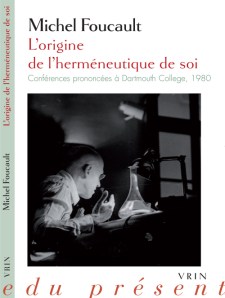
foucaultLast year a little book of Foucault’s lectures at Dartmouth College in 1980 was published in French – L’origine de l’herméneutique de soi: Conférences prononcées à Dartmouth College, 1980, edited by Henri-Paul Fruchaud and Daniele Lorenzini, Paris: Vrin, 2013.

[Update: A full translation appeared in 2016 from University of Chicago Press – details here]

The texts in the book are French translations of lectures and other material originally delivered and/or published in English. The text comprises four texts by Foucault:

  1. ‘Subjectivité et vérité’, 17 November 1980 lecture at Dartmouth College, with variants from 20 October 1980 Howison lecture at University of California, Berkeley
  2. ‘Christianisme et aveu’, 24 November 1980 lecture, with variants from 21 October 1980 lecture at Berkeley
  3. ‘Débat sur Subjectivité et vérité’, 23 October 1980 discussion from Berkeley
  4. ‘Interview de Michel Foucault’, 3 November 1980 interview with Michael Bess

The two Dartmouth lectures first appeared as ‘About the Beginning of the Hermeneutics of the Self’ in Political Theory in 1993, edited by Mark Blasius (requires subscription, but easily available elsewhere); and were reprinted in the collections The Politics of Truth and Religion and Culture. The Berkeley lectures are available as audio recordings here; with transcripts available at IMEC and Berkeley. The Political Theory version (and the reprints) note some of the variants between Dartmouth and Berkeley. The texts did not appear in Dits et écrits as they were not published in Foucault’s lifetime; the versions in this French book are therefore their first publication in French. The editorial note says that “Some transcription errors have been corrected”. There are some helpful notes added to the translation.

The third text is a new transcription from the recordings held at UC Berkeley library. As far as I know this is previously unpublished in any language, and the key draw of this volume. It’s a very good discussion with some particularly interesting comments on Christianity.

The fourth text was originally published as “Power, Moral Values, and the Intellectual”, Interview with Michael Bess, History of the Present 4.1-2, Spring 1988, 11-13 – available online here. That text is a translation from the French; the text in this volume is based on the recording archived at IMEC. As far as I know, this is the first publication of the French original, which is also not in Dits et écrits.

The book also has some helpful notes and an introduction. The title of Foucault’s lectures at Berkeley – the Howison lectures – was ‘Subjectivity and Truth’; the Dartmouth lectures were entitled ‘Truth and Subjectivity’ and ‘Christianity and Confession’. The French book is entitled L’origine de l’herméneutique de soi (close to the English title in Political Theory, itself taken from a remark Foucault made at Berkeley) to avoid confusion with the forthcoming lecture course  Subjectivité et vérité, which was delivered in Paris between 7 January and March 1981. In this instance Foucault delivered material in Paris after trying out some of this work in the first of these US lectures – he usually did this the other way round. The second lecture draws on material from the 1980 course Du gouvernement des vivants – presented here in chronological order, as he intended with the History of Sexuality itself, even though the research had been done in the opposite order. Foucault also used some of this material for the April-May 1981 Louvain lectures Mal faire, dire vrai, translation forthcoming as Wrong-Doing, Truth-Telling.

The other available text from this crucial period in the USA (October-November 1980) is ‘Sexuality and Solitude‘, delivered as the James lecture on 20 November 1980 at New York University with contributions added by Richard Sennett. (There are reports of a more substantial seminar too.) The English text of Foucault and Sennett was published in The London Review of Books (open access), and there are various reprints, though without Sennett’s contributions. There are substantial overlaps with the Berkeley/Dartmouth material. The English text is reprinted in Essential Works Volume I, and in Religion and Culture where it is heavily abridged but with some variants from the original manuscript. A French translation is in Dits et écrits, again without Sennett. There is a slightly different version of the text, based on the original manuscript rather than the transcript, in Marshall Blonsky, On Signs – the source for the Religion and Culture variations. These variants are not in French, as far as I know, presumably because On Signs was published in 1985, and therefore the version there counts as a posthumous text.

From Daniel Defert’s ‘Chronology’, we know there were also seminars at Berkeley in October 1980 on ‘Sexual Ethics in Late Antiquity and Early Christianity’; and a talk at Princeton on ‘The Birth of Biopolitics’ in November 1980. These remain unpublished. From the announcement at the beginning of the Howison lectures it appears the seminars at Berkeley were on the 22 and 27 October.

This is a crucial period because it is the moment between the shift of Foucault’s focus from  Christianity to antiquity – but this is a return, not a turn, because we now know of the content of Lectures on the Will to Know from 1970-71, and Oedipus returns in other places, not least Du gouvernement des vivants. All Foucault’s subsequent Collège de France courses would have antiquity as their focus. And in late 1980 Foucault decided to cancel his seminar at the Collège, so there were no parallel projects going on there.

I’ve pieced this together from various sources, including all the books, journals and recordings mentioned above, Defert’s chronology and Richard Lynch’s bibliography of Foucault in English. Corrections or additions welcome.

Posted in Foucault's Last Decade, Michel Foucault | Tagged | 7 Comments

Derrida Postcard Film in the THE

News of an intriguing film based on Derrida’s work.

Peter Gratton's avatarPHILOSOPHY IN A TIME OF ERROR

derrida_scholar_on_cliff_edg_450 Here . Put together by Joanna Callaghan and Martin McQuillan, this will be making the rounds at various festivals. I’ll see at the screening in New York in late May during the Derrida Today conference .

View original post

Posted in Uncategorized | Leave a comment

Warwick University Limited – reissue by Spokesman Books & Launch on 31 March

E.P. Thompson’s classic edited study reissued.

andrewmcgettigan's avatarCritical Education

Spokesman Books have reissued Warwick University Ltd edited by EP Thompson and originally published in 1970.

In February 1970, students occupying the Registry at Warwick University uncovered evidence of secret political surveillance of staff and students. There followed not only fierce debates within the university on issues of governance and democracy, but also a legal battle as the administration tried to stop the press from publishing the documentary evidence, and wider public debate on the purpose and values of university education. Warwick University Ltd will be of great interest to today’s activists, because the conflict at Warwick clearly prefigures current struggles over the subordination of higher education to commercial goals, as well as political surveillance, policing, the use of legal injunctions, press freedom and business corruption. This edition includes a new introduction prepared by some of the original contributors, highlighting the links between then and now

The London launch

Date:…

View original post 153 more words

Posted in Uncategorized | Leave a comment

Harm de Blij (1935-2014)

deblijLike many people I heard the news this morning of the death of Harm de Blij – the message from the AAG is reproduced here. I never met him, and was quite critical of his book Why Geography Matters in a review for The Times Higher Education a few years ago. But he unquestionably raised the public awareness of geography, with a media profile few can match. There will be a tribute session at the AAG conference in Tampa in early April.

Update: there are brief notes in the Examiner and from the NCGE, with a comment from Alec Murphy, here.

Posted in Uncategorized | Tagged | Leave a comment

Japanoise reviewed

A new review at the Society and Space open site.

Posted in Uncategorized | Leave a comment

A few translated excerpts from the discussion following Foucault’s ‘Truth and Juridical Forms’ lectures in Rio

20130507-112649Between 21-25 May 1973, Foucault gave five lectures in Rio de Janeiro. These were under the collective title of ‘Truth and Juridical Forms’. They were published in Portuguese in 1974 as “A verdade e as formas jurídicas” (easily available online), in French in 1994 in Dits et écrits (text no 139 – a retranslation from the Portuguese); and in English in the ‘Power’ volume of Essential Works in 2000.

I say a bit more about the lectures in a previous post on Foucault in Rio. There is also a forty-years on discussion in Portuguese here (from which I borrowed the picture).

The English translation does not include the 23 page discussion that followed the fifth lecture. The discussion covers Deleuze and Guattari, Oedipus, the relation of strategy and discourse, the Sophists, Dumézil and Lévi-Strauss, Jean-Pierre Vernant, Robert Castel and his archaeological work. The whole thing would be good to translate, though I recognise the reasons why it wasn’t – for I suspect similar reasons of cost and space to why the discussion that followed ‘The Meshes of Power’ was omitted from Space, Knowledge, Power: Foucault and Geography.

Here are a few of the choice bits from the discussion, translated from the French retranslation – I’m aware of the problems in doing this, but they didn’t seem to concern the editors of the Essential Works. I did check a couple of things in the Portuguese though. References are to the original four volume Dits et écrits.

Archaeology is “a historico-political attempt [tentative – Portuguese: tentativa] which is not grounded on relations of resemblance between the past and the present, but rather on relations of continuity and on the possibility of defining currently the tactical objectives of the strategy of struggle, precisely according to that” (DE no 139 II, 644).

Unnamed questioner: “Is archaeology a miraculous machine?”

MF: “Archaeology is a machine, certainly, but why miraculous? A critical machine, a machine which puts in question certain relations of power, a machine which has – or at least tries to have – a liberating function” (DE no 139 II, 644).

“It must be underlined that I do not agree without restriction with what I have said in my books… Fundamentally, I write for the pleasure of writing” (DE no 139 II, 645)

“I would like to add that archaeology, this kind of historical-political activity, does not necessarily translate well into books, or speech [discours], or articles. In the final analysis, and what actually bothers me currently, is precisely the obligation to transcribe [transcrire], to capture [d’enfermer] everything in a book” (DE no 139 II, 645)

In a discussion with psychoanalyst Hélio Pellegrino – excerpted here – Foucault is accused of having an “extremely curious” position in relation to Oedipus (DE no 139 II, 624). Foucault responds by suggesting that ‘Oedipus’ does not exist for him, and that he is interested in the figure mobilised in the texts Oedipus rex and Oedipus at Colonnus by Sophocles, along with other classical Greek sources. Foucault suggests that many analyses of Oedipus – it seems clear he is including Pellegrino – are pre-Deleuzian, though post-Freudian (DE no 139 II, 625). It continues:

MF: You find me hateful [détestable], and you are right: I am hateful. Oedipus, I don’t know. When you say of Oedipus – this is desire, that is not desire – I reply: if you want. Who is Oedipus? What on earth is that [Qu’est ce que c’est que ça – Portuguese: o que é isso]?

HP: A fundamental structure of human existence.

MF: Then I will reply in Deleuzian terms – and here I am entirely Deleuzian – that this is absolutely not a fundamental structure of human existence, but a certain kind of constraint, a certain relation of power that society, the family, political power etc. establishes over individuals .

HP: The family is an incest factory.

MF: Take things in another way… (DE no 139 II, 625-6).

Foucault keeps trying to bring this to a close, eventually rather exasperated he tries to say that he can’t speak for Deleuze, and that psychoanalysis is more the domain of Guattari than Deleuze in any case. Later, in another exchange with Pellegrino he says “I repeat that I am not a psychoanalyst… Let me speak as a historian” (DE no 139 II, 640-1).

There are lots of other interesting things here – including some that seem especially charged given the situation in Brazil at the time – these are just some passages I found intriguing.

Posted in Foucault's Last Decade, Michel Foucault | 3 Comments

The remaining Foucault lecture courses – French and English publishing details

9782020862592Update 8 July 2014: Subjectivité et vérité and Wrong-Doing, Truth-Telling have now been published; Théories et institutions pénales is forthcoming in 2015.


Only two of Foucault’s Collège de France lecture courses remain unpublished in French – Théories et institutions pénales (1971-72) and Subjectivité et vérité (1980-81).

As I’ve mentioned before, Subjectivité et vérité, edited by Frédéric Gros will be published in May 2014. There is nothing on the Seuil page for Théories et institutions pénales as yet.

The English translations are coming too – On the Government of the Living will be out in September 2014; The Punitive Society is being translated at present, and will likely be out in 2015. The two courses mentioned above will presumably follow in order. These are all being done by Graham Burchell. Also forthcoming in English is Wrong-Doing, Truth-Telling (May 2014), translated by Stephen W. Sawyer, which comprises Foucault’s 1981 lectures from Louvain and some related material – originally published as Mal faire, dire vrai.

Posted in Foucault's Last Decade, Michel Foucault, Publishing | 3 Comments

Governing Emergencies network – new blog and project website

News of a new blog of a team based at Durham on ‘Governing Emergencies’

Posted in Uncategorized | Leave a comment

Scarry thoughts

Derek Gregory links to Elaine Scarry’s new book and a wide-ranging interview on its contents and implications.

Derek Gregory's avatargeographical imaginations

SCARRY Thermonuclear monarchy I imagine most readers will know Elaine Scarry ‘s vital account of The Body in Pain .  She has produced several important books since then, of course, but Scarry explains that her latest book, T hermonuclear monarchy: choosing between democracy and doom , published last month by Norton, emerged directly from her first:

It directly emerged from “The Body in Pain,” which has a first chapter on torture and a second on war. I was trying to address the question why when people prohibit torture they make it an absolute prohibition, but when they make a prohibition on war, they always make exceptions.

I realized that nuclear weapons much more approximate the condition of torture than of war. Torture involves zero consent on the part of the injured, whereas conventional war allows many levels of consent. With nuclear weapons, there’s zero consent.

There is an excellent, wide-ranging conversation between Scarry…

View original post 41 more words

Posted in Uncategorized | Leave a comment