Deleuze / Foucault: A Neoliberal Diagram (2013)

A special issues on Deleuze, Foucault and the Neoliberal Diagram.

Clare O'Farrell's avatarFoucault News

tweetsDeleuze / Foucault: A Neoliberal Diagram, Mediatropes Vol 4, No 1 (2013)

Link to issue. Full PDFs available

Table of Contents

Editorial Introduction: Neoliberal Diagrammatics and Digital Control
Matthew Tiessen, Greg Elmer

IPO 2.0: The Panopticon Goes Public
Greg Elmer

Resilience versus Resistance: Affectively Modulating Contemporary Diagrams of Social Resilience, Social Sustainability, and Social Innovation
Petra Hroch

Monetary Mediations and the Overcoding of Potential: Nietzsche, Deleuze & Guattari and How the Affective Diagrammatics of Debt Have Gone Global
Matthew Tiessen

Info Nymphos
Erika Biddle

A New Individuation: Deleuze’s Simondon Connection
Andrew Iliadis

Special Semiotic Characters: What is an Obstacle-Sign?
Gary Genosko

Tweets Speak: Indefinite Discipline in the Age of Twitter
Steven James May

View original post

Posted in Uncategorized | Leave a comment

Brett Christophers – The Territorial Fix

PIHGBrett Christophers has an interesting piece in Progress in Human Geography, entitled “The territorial fix: Price, power and profit in the geographies of markets” (requires subscription). It takes the notion of the ‘spatial fix’ developed by David Harvey and others and argues for a ‘territorial fix’, and developing from my claim that territory is a ‘political technology’, suggests it is also an ‘economic technology’.

The article heeds recent calls for closer attention to the geographies of markets. Speaking primarily to a rich tradition of geographical political economy, it argues that such geographies are highly material to value and profit creation and realization. In developing this argument, the article invokes the concept of a ‘territorial fix’, whereby territory is conceptualized as a technology of market-making geared to putting in place and optimizing the conditions for capital accumulation. The article draws selectively and critically on studies of territorialized market formation and pricing in two globalized industries – pharmaceuticals and television – to formulate this argument.

Posted in David Harvey, Politics, Territory | Tagged | Leave a comment

Peters on Jensen’s Staging Mobilities

A new review at the Society and Space open site.

Posted in Uncategorized | Leave a comment

OCHA maps of the West Bank and Gaza access restrictions

West BankOCHA (U.N. Office for Coordination of Human Affairs) maps of West Bank and Gaza – especially focusing on access restrictions. Thanks to Léopold Lambert for the links.

Posted in Boundaries, Politics, Territory | 1 Comment

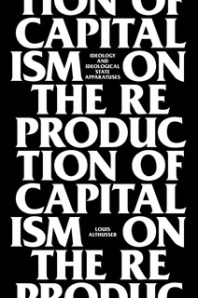
Althusser, On the Reproduction of Capitalism – the translator’s list of errata

AlthusserWhile most of us are still waiting to see the translation of Althusser’s On the Reproduction of Captalism, the translator G.M. Goshgarian has provided a list of errata.

It would be interesting to know the story behind this – lack of proof-reading or publisher error?

Posted in Louis Althusser, Publishing | Leave a comment

Álvaro Sevilla Buitrago – Hegemonía, gubernamentalidad, territorio

If you read Spanish, this looks like a really interesting article linking Foucault, Gramsci and Lefebvre to the study of urban planning – ‘Hegemonía, gubernamentalidad, territorio. Apuntes metodológicos para una historia social de la planificación’ (via Álvaro’s blog – Multipliciudades).

Posted in Antonio Gramsci, Henri Lefebvre, Michel Foucault, Politics, Territory, urban/urbanisation | Leave a comment

# THE FUNAMBULIST PAPERS 47 /// Nazi Architecture as Affective Weapon by Gastón Gordillo

The latest Funambulist paper, on Nazi Architecture as Affective Weapon, written by Gastón Gordillo

Léopold Lambert's avatarThe Funambulist

Today’s guest writer is Gastón Gordillo, professor in anthropology at the University of British Columbia in Vancouver, to whom we owe the great work on Space and Politics, as well as a forthcoming book, Rubble (Duke University Press, 2014) about the narrative power contained in the figure of the ruin. In the following text, entitled “Nazi Architecture as Affective Weapon,” Gastón uses Third Reich main architect Albert Speer’s memoirs to examine Adolf Hitler’s relationship with architecture, and to which extent this relationship may have influenced his political and military strategies — Gastón goes as far as writing that the competition between Berlin’s projected People’s Hall and Moscow’s Palace of the Soviets might have had a weight in the creation of the Nazi Russian front in 1941. The text also describes Hitler’s admiration for the Baron Haussmann’s transformation — or as I often write, weaponization —…

View original post 3,746 more words

Posted in Uncategorized | Leave a comment

Foucault, La Société punitive video of discussions – Harcourt, Balibar, Defert

The video of a discussion between Bernard Harcourt, Étienne Balibar, Daniel Defert, Pierrette Poncela and Corentin Durand on Foucault, La Société punitive, with links to subsequent sessions. Thanks to Graham Burchell for the link.

Posted in Etienne Balibar, Michel Foucault | Leave a comment

Adam Kotsko to translate Agamben’s ‘Pilate and Jesus’ and ‘The Use of Bodies’

AgambenAdam Kotsko has news of two forthcoming Agamben translations at AUFS.

The first is a pamphlet-length book entitled Pilate and Jesus, which I have promised to complete this summer. The second, and presumably more interesting to most, is the final volume of the Homo Sacer series, entitled The Use of Bodies, which I have promised to complete by the end of next summer.

Both forthcoming with Stanford University Press.

Posted in Giorgio Agamben | Leave a comment

Saskia Sassen – Expulsions: Brutality and Complexity in the Global Economy

Saskia Sassen’s Expulsions is forthcoming in June 2014.

Sassen

Soaring income inequality and unemployment, expanding populations of the displaced and imprisoned, accelerating destruction of land and water bodies: today’s socioeconomic and environmental dislocations cannot be fully understood in the usual terms of poverty and injustice, according to Saskia Sassen. They are more accurately understood as a type of expulsion—from professional livelihood, from living space, even from the very biosphere that makes life possible.

This hard-headed critique updates our understanding of economics for the twenty-first century, exposing a system with devastating consequences even for those who think they are not vulnerable. From finance to mining, the complex types of knowledge and technology we have come to admire are used too often in ways that produce elementary brutalities. These have evolved into predatory formations—assemblages of knowledge, interests, and outcomes that go beyond a firm’s or an individual’s or a government’s project.

Sassen draws surprising connections to illuminate the systemic logic of these expulsions. The sophisticated knowledge that created today’s financial “instruments” is paralleled by the engineering expertise that enables exploitation of the environment, and by the legal expertise that allows the world’s have-nations to acquire vast stretches of territory from the have-nots. Expulsions lays bare the extent to which the sheer complexity of the global economy makes it hard to trace lines of responsibility for the displacements, evictions, and eradications it produces—and equally hard for those who benefit from the system to feel responsible for its depredations.

Posted in Politics, Territory | Tagged | 1 Comment