Henri Lefebvre and Education

This book is now published.

stuartelden's avatarProgressive Geographies

Sue Middleton’s book Henri Lefebvre and Education: Space, Theory, History is forthcoming in November with Routledge.

During his lifetime Henri Lefebvre (1901-1991) was renowned in France as a philosopher, sociologist and activist. Although he published more than 70 books, few were available in English until The Production of Space was translated in 1991. While this work – often associated with geography – has influenced educational theory’s ‘spatial turn,’ educationalists have yet to consider Lefebvre’s work more broadly.

This book engages in an educational reading of the selection of Lefebvre’s work that is available in English translation. After introducing Lefebvre’s life and works, the book experiments with his concepts and methods in a series of five ‘spatial histories’ of educational theories. In addition to The Production of Space, these studies develop themes from Lefebvre’s other translated works: Rhythmanalysis, The Explosion, the three volumes of Critique of Everyday Life and a…

View original post 106 more words

Posted in Henri Lefebvre | Leave a comment

Literary Geographies – new open-access e-journal

A call for papers for the first issue of Literary Geographies – and check out the blog of the same name which has really useful bibliographies of existing work in this area.

Literary Geographies is an interdisciplinary open-access e-journal that provides a forum for new research and collaboration in the field of literary/geographical studies.

The journal features work combining topics and methods from literary studies, cultural geography, cartography, and spatial theory. Recognising that the term ‘literary geography’ itself (along with its variants in other languages) has multiple meanings and is practised in a variety of ways within different academic traditions, the journal takes a broad view of its subject matter. The journal is fully refereed, and welcomes submissions (in English) from scholars at all career stages, and from all parts of the world.

Posted in Publishing | Leave a comment

The Signature of Power: Sovereignty, Governmentality and Biopolitics (2013)

Mitchell Dean’s new book – The Signature of Power.

Clare O'Farrell's avatarFoucault News

deanMitchell Dean, The Signature of Power: Sovereignty, Governmentality and Biopolitics, SAGE, September 2013

Publisher’s page

Description
Mitchell Dean revitalized the study of ‘governmentality’ with his bestselling book of the same title. His new book on power is a landmark work. It combines an extraordinary breadth of perspective with pinpoint accuracy about what power means for us today. For students it provides sharp readings of the main approaches in the field. On this level, it operates as a foundational work in the study of power. It builds on this to reframe the concept of power, offering original and exceptionally fruitful reading. It throws new light onto the importance of biopolitics, sovereignty and governmentality. Mitchell Dean has established himself as a master of governmentality. This new book will do the same for how we conceptualize and use power.

Mitchell Dean is Professor of Public Governance at Copenhagen Business School, Denmark and…

View original post 38 more words

Posted in Uncategorized | 1 Comment

Unlimited Migration in a Limited World, Saskia Sassen

Synethetic Zero with a lecture from Saskia Sassen (in English, despite the German text at the beginning).

dmf's avatarsynthetic zerØ

interesting presentation on what she calls the analytic tactics (working out of “epistemic indignation”) before method, which makes sense I think if we consider these terms along sociological lines rather than as strict categories, these updates by social scientists like Sassen, her husband Richard Sennett, John Law and co, Paul Rabinow’s crew, etc,  of/after thinkers like Derrida and Foucault seem like the way to go if we want to be able to intervene in the world in a timely manner.

http://www.saskiasassen.com/

View original post

Posted in Uncategorized | Leave a comment

Peter Johnson on Foucault’s heterotopia

Peter Johnson has a review essay on Foucault’s heterotopia essay and its afterlife in the new issue of Geography Compass (requires subscription). See also the blog Heterotopian Studies that Peter runs.

Posted in Michel Foucault | 1 Comment

Territory, Politics, Governance – issue 2 published

Vol 1 No 2 of Territory, Politics, Governance has just been published. Essays by Ananya Roy, Jamie Peck, Gerard Toal & John O’Loughlin and others, many open access. The whole of issue 1 (including pieces by Saskia Sassen, Kevin Cox and me) is still open access.

Posted in Territory | 1 Comment

Books received

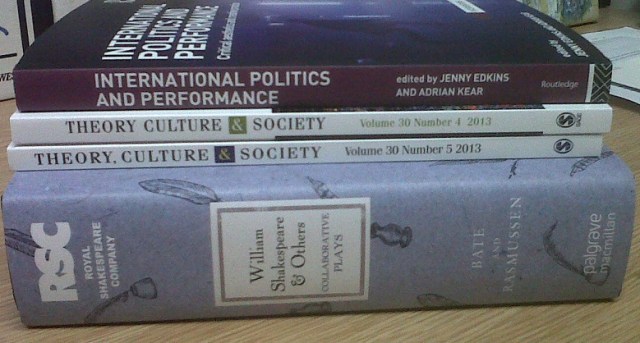
books received 11 NovThe new collection of Shakespeare and others’s Collaborative Plays (see also the news story on this in The Guardian); two issues of Theory, Culture & Society; and the International Politics and Performance collection – hot off the press. I have a piece in the last of these, on the political bodies of Shakespeare’s Coriolanus. This was originally given as the Politics, Philosophy and International Thought lecture at the University of Aberystwyth. Jenny Edkins and Adrian Kear asked for the text for this collection over dinner that evening. The recording of the lecture itself is available here.
Posted in Jenny Edkins, My Publications, Politics, Shakespearean Territories, Theory, Culture and Society, William Shakespeare | 1 Comment

Andrew Neal – the myth of Hadrian’s firewall

Andrew Neal has a piece in The Scotsman on the likely impact of a Scottish independence vote on the UK’s national security infrastructure.

Posted in Uncategorized | 1 Comment

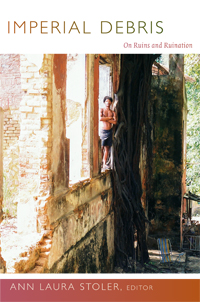
Ann Laura Stoler (ed.) Imperial Debris: On Ruins and Ruination

I missed this when it came out in June, but an important looking collection edited by Ann Laura Stoler, Imperial Debris: On Ruins and Ruination has been published by Duke University Press.

StolerImperial Debris redirects critical focus from ruins as evidence of the past to “ruination” as the processes through which imperial power occupies the present. Ann Laura Stoler’s introduction is a manifesto, a compelling call for postcolonial studies to expand its analytical scope to address the toxic but less perceptible corrosions and violent accruals of colonial aftermaths, as well as their durable traces on the material environment and people’s bodies and minds. In their provocative, tightly focused responses to Stoler, the contributors explore subjects as seemingly diverse as villages submerged during the building of a massive dam in southern India, Palestinian children taught to envision and document ancestral homes razed by the Israeli military, and survival on the toxic edges of oil refineries and amid the remains of apartheid in Durban, South Africa. They consider the significance of Cold War imagery of a United States decimated by nuclear blast, perceptions of a swath of Argentina’s Gran Chaco as a barbarous void, and the enduring resonance, in contemporary sexual violence, of atrocities in King Leopold’s Congo. Reflecting on the physical destruction of Sri Lanka, on Detroit as a colonial metropole in relation to sites of ruination in the Amazon, and on interactions near a UNESCO World Heritage Site in the Brazilian state of Bahia, the contributors attend to present-day harms in the occluded, unexpected sites and situations where earlier imperial formations persist.

Contributors. Ariella Azoulay, John F. Collins, Sharad Chari, E. Valentine Daniel, Gastón Gordillo, Greg Grandin, Nancy Rose Hunt, Joseph Masco, Vyjayanthi Venuturupalli Rao, Ann Laura Stoler

Posted in Ann Laura Stoler, Books, Gaston Gordillo | 1 Comment

Kathryn Yusoff on Project Anthropocene at Geocritique

Kathryn Yusoff’s short essay “Project Anthropocene: a minoritarian manifesto for reoccupying the strata” is available at Geocritique.

Posted in Uncategorized | 2 Comments