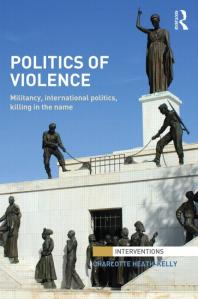
Charlotte Heath-Kelly – Politics of Violence

9780415856232

New book out from my Warwick colleague Charlotte Heath-Kelly – Politics of Violence: Militancy, International Politics, Killing in the Name. Great shame about the price though.

Critical thinkers like Foucault, Benjamin, Derrida and Žižek have long challenged the liberal separation of violence and politics by highlighting the implicit violence within political and economic structures. But in an era of international terrorism and counter-terrorism, should we not also reverse the question to ask ‘what is political about violence?’ Using interviews with ex-militants from Italian leftist struggle of the 1970s and the Cypriot anti-colonial militancy of the 1950s, Heath-Kelly explores the political utility of violence. Studies of conflict and international politics rarely address how killing and injuring function to win wars or overturn regimes. But by rejecting conceptions of violence as a means-to-an-end found in the works of Clausewitz and Arendt, this book draws upon studies of pain to explore the ways in which armed struggle produces new political subjects and regimes, and discredits others, through experiences of violence. Using Elaine Scarry’s conception of pain as ‘world-destroying’ and Walter Benjamin’s delineation of violence as either lawmaking or law-preserving to frame ex-militant discussions of participation in armed struggle, the book contributes a pathbreaking empirical exploration of violence to international politics literatures – moving the study of political violence away from an understanding of violence as just a means-to-an-end.

Drawing out insights that have a far wider resonance and significance for the analysis of the ‘politicality’ of political violence, this work will be of interest to students and scholars in areas such as international relations, security studies and international relations theory.
Posted in Books, Jacques Derrida, Michel Foucault, Slavoj Zizek, Walter Benjamin | Leave a comment

A Symposium on Resistance – audio recordings

A Symposium on Resistance – audio recordings from the launch of Howard Caygill’s latest book On Resistance: A Philosophy of Defiance. Contributions from Jacqueline Rose, Peter Hallward, Costas Douzinas, Michael Dillon, Howard Caygill (thanks to Ayşe Mermutlu for the link).

Posted in Conferences, Michael Dillon, Peter Hallward | 1 Comment

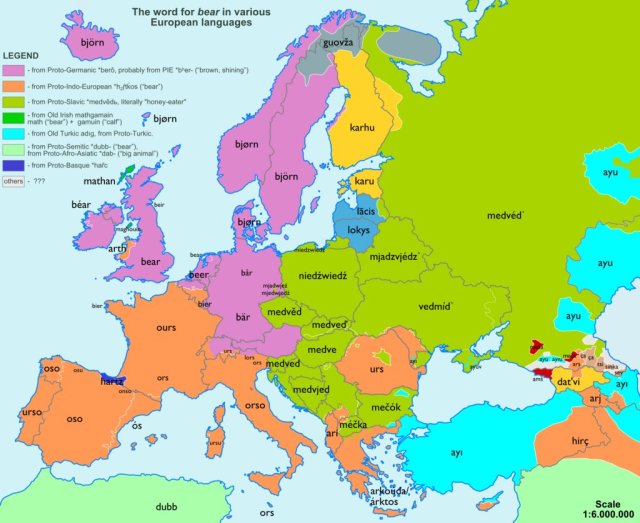
European maps of language groups – words for bear, church, beer, etc.

HHtHenfhMore maps here (thanks to Simon Springer for the link).

Posted in Uncategorized | 1 Comment

Book Review Symposium – Philip Mirowski’s ‘Never Let a Serious Crisis Go to Waste: How Neoliberalism Survived the Financial Meltdown’

Antipode book review forum on Philip Mirowski’s Never Let a Serious Crisis go to Waste.

Antipode Editorial Office's avatarAntipodeFoundation.org

Guest editor: Brett Christophers, Uppsala University

Philip Mirowski’s Never Let a Serious Crisis Go to Waste is an important and distinctive contribution to debates around the politics and economics of the economic crisis which began in 2007-8 and, as such, is well-deserving of the symposium convened here at Antipode.

Never Let...For one thing, the book is different. As Mirowski remarks in his response to our four reviews, the last five years have seen a veritable “torrent of crisis books”; so why single out this one for particular scrutiny? Because it does not profess, like so many other crisis books tend to do, to identify broad causes and consequences of the crisis. Instead, its specific agenda is to offer an “intellectual history of the crisis and its aftermath” (p.11). That is to say, while it tentatively “explores the economic crisis as a social disaster”, it explores the crisis much more…

View original post 973 more words

Posted in Uncategorized | Leave a comment

Don Mitchell on Neil Smith – long article available

Don Mitchell‘s essay “Neil Smith, 1954-2012: Radical Geography, Marxist Geographer, Revolutionary Geographer” is available on his website. The whole thing is well worth reading, even if you know the work well. It’s a thoughtful and moving piece. What is especially interesting, though, is the concluding discussions of the unfinished work on revolution, including a collaborative book with his students “from his Revolution seminar, Revolting New York, which would lay out the historical geography of revolt, rebellion, riot, and revolution in New York City. This was unfinished when Neil died; his students are currently working to finish it off and get it into print” (p. 43 n. 17).

Posted in Don Mitchell, Neil Smith | Leave a comment

On Academic Rudeness

The Times Higher Education has a good piece.

Posted in Universities | 1 Comment

# HISTORY /// The Body as a Terrain of Experiments: Medicine and Vile Bodies According to Grégoire Chamayou

Very interesting discussion of Grégoire Chamayou’s first book – Les corps vils : Expérimenter sur les êtres humains aux XVIIIe et XIXe siècles.

Léopold Lambert's avatarThe Funambulist

Science-Anatomy-Dissection-room-med-school

As announced in the previous article about the “thanatopolitics of death penalty,” I will propose a review of the book Les corps vils : Expérimenter sur les êtres humains aux XVIIIe et XIXe siècles (Vile Bodies: Experimenting on Human Beings in the 18th and 19th Centuries) written by Grégoire Chamayou (see past article) and published in 2008 (La Découverte). This book has not been translated into English yet and I am happy to propose a clumsy translation of a few excerpts in this article in order to share a little of its content to a broader audience than the francophone one. The original excerpts in French are included at the end of this article.

The subtitle of the book is explicit about the content of the research. In the Foucaldian tradition of drawing philosophical arguments through the precise examination of history, Chamayou investigates the role of medicine in…

View original post 2,139 more words

Posted in Uncategorized | Leave a comment

ACME theme issue on ‘Impact’ and ‘Enforced Disappearances’

ACME: An International E-Journal for Critical Geographies Vol 13 No 1 has now been published, and includes a theme section on the impact agenda in UK higher education; as well as another theme section on enforced disappearances. As ever, all available open access.

Posted in Publishing, Universities | Leave a comment

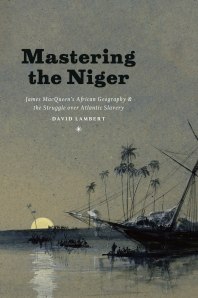
David Lambert – Mastering the Niger

9780226078069David Lambert’s new book Mastering the Niger: James MacQueen’s African Geography and the Struggle over Atlantic Slavery has just been published by University of Chicago Press.

In Mastering the Niger, David Lambert recalls Scotsman James MacQueen (1778–1870) and his publication of A New Map of Africa in 1841 to show that Atlantic slavery—as a practice of subjugation, a source of wealth, and a focus of political struggle—was entangled with the production, circulation, and reception of geographical knowledge. The British empire banned the slave trade in 1807 and abolished slavery itself in 1833, creating a need for a new British imperial economy. Without ever setting foot on the continent, MacQueen took on the task of solving the “Niger problem,” that is, to successfully map the course of the river and its tributaries, and thus breathe life into his scheme for the exploration, colonization, and commercial exploitation of West Africa.

Lambert illustrates how MacQueen’s geographical research began, four decades before the publication of the New Map, when he was managing a sugar estate on the West Indian colony of Grenada. There MacQueen encountered slaves with firsthand knowledge of West Africa, whose accounts would form the basis of his geographical claims. Lambert examines the inspirations and foundations for MacQueen’s geographical theory as well as its reception, arguing that Atlantic slavery and ideas for alternatives to it helped produce geographical knowledge, while geographical discourse informed the struggle over slavery.

Posted in Books | Leave a comment

Judith Butler – Parting Ways explained in six minutes

Parting Ways has just been released in paperback – embed doesn’t work so see critical-theory.com.

Posted in Judith Butler | 2 Comments